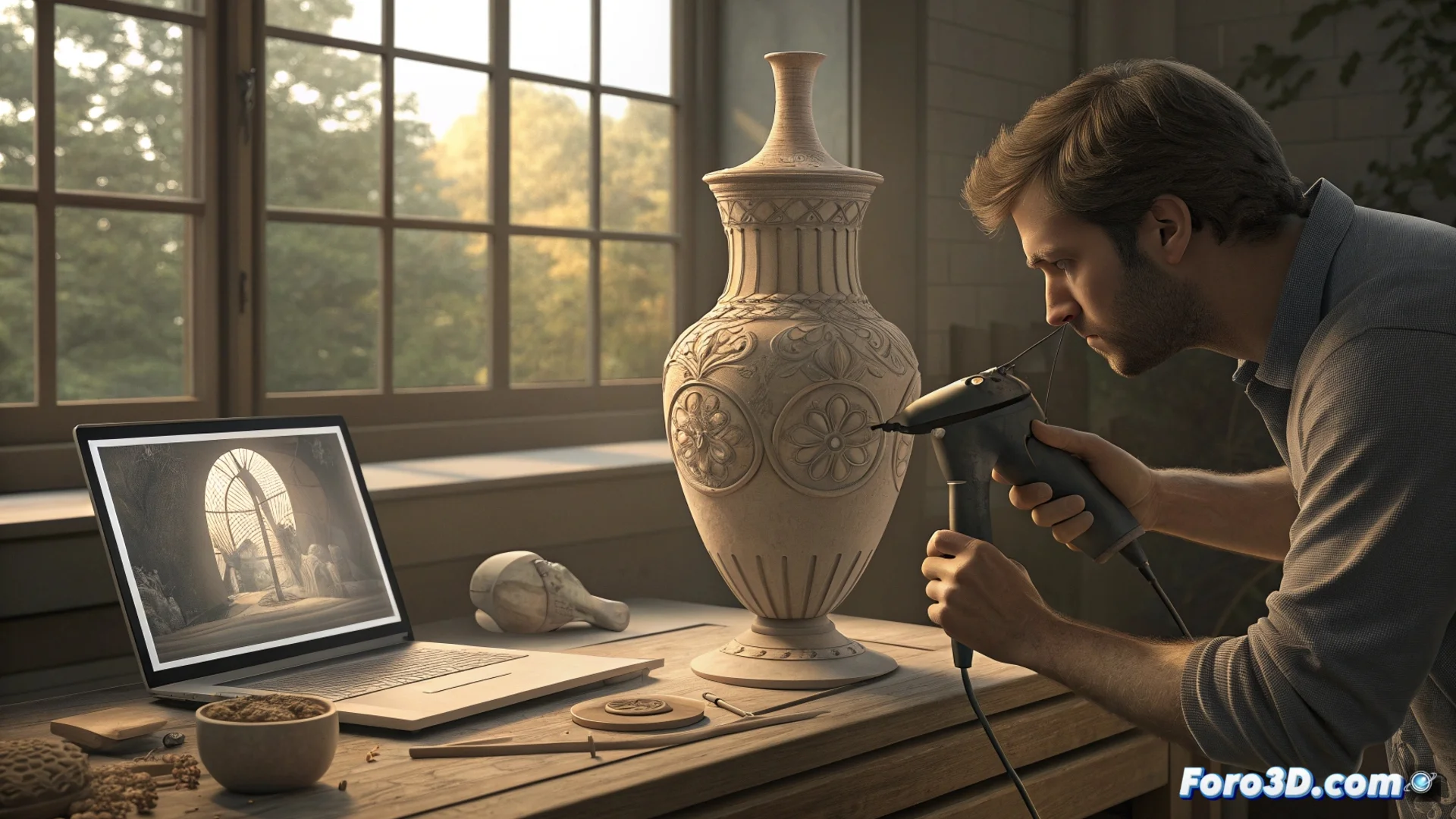
3D Scanning Integrates into the Daily Creative Workflow
Technology for three-dimensional digitization is no longer confined to specialized environments. Now it is a common resource in design studios, art workshops, and conservation projects. This democratization requires teams to be more agile, affordable, and capable of adapting to an immense variety of objectives. The EINSTAR 3D scanner line arises precisely from observing this change, proposing not a single device, but concrete solutions for specific problems within a real workflow. 🚀
Prioritizing Efficiency in Dynamic Environments
For a tool to be truly useful in a daily creative routine, it must process data quickly and deliver reliable results. These scanners are designed to capture geometry and textures efficiently, which drastically reduces the time spent correcting or cleaning models after scanning. This allows end users, whether artists, engineers, or restorers, to focus on their main task without prolonged waits.
Keys to Practical Experience:- Capture Speed: Acquires the object's surface in seconds, accelerating the entire workflow.
- Delivered Precision: Generates faithful meshes and textures that require fewer manual adjustments.
- Integrated Software: Includes tools to align and fuse multiple scans coherently and automatically.
Technology must fade into the background, allowing creativity to take center stage.
Adapting to the Diversity of Objects and Scales
The same professional may need to digitize a small piece of jewelry in the morning and an architectural fragment in the afternoon. For this reason, flexibility is a fundamental pillar. The system is designed to handle extreme variations in size, surface complexity, and material type. This is achieved through hardware that can adjust its working range and intelligent software that unifies partial scans into a complete and consistent model.
Direct Application Areas:- Art and Design: Create digital assets from sculptures or physical models.
- Reverse Engineering: Document and replicate industrial parts without blueprints.
- Cultural Preservation: Archive and study historical objects with millimeter detail.
A Tool for the Present
The ability to 3D scan everyday objects, like a family bust, illustrates how integrated this technology is. However, its true value lies in optimizing professional processes and opening new ways to create and document. The evolution of devices like EINSTAR consolidates 3D scanning not as an end, but as a fluid and powerful step within the digital production chain. Always remember to explain to your grandmother what that device surrounding her is doing, capturing every angle. 😉