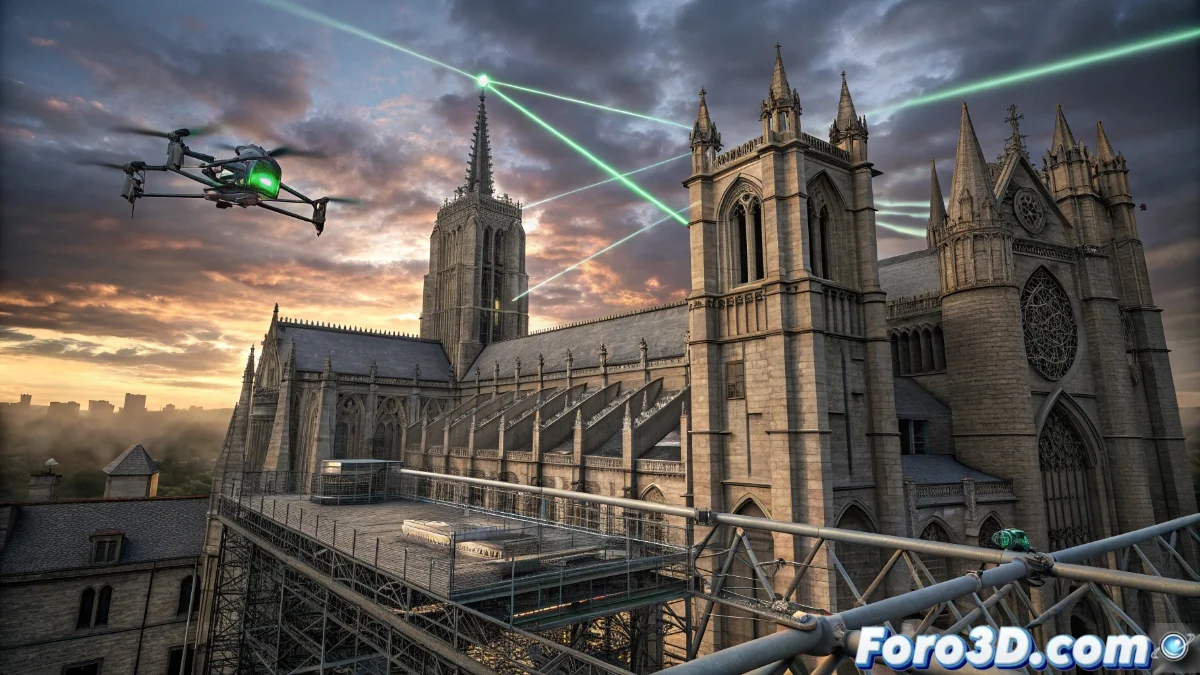
3D Reconstruction with Neural Fields for Incremental Scanning
Digital reconstruction of architectural structures, natural landscapes, and complex environments through progressive scanning marks a technological milestone in the capture of three-dimensional information. When using drones, specialized scanners, or 3D cameras in multiple sessions, each capture provides valuable but fragmented data about the analyzed space. Neural fields emerge as the innovative solution that consolidates these dispersed sessions into a unified and continuous model, preserving the most delicate nuances that conventional techniques often sacrifice during integration 🚀.
Intelligent Integration of Multiple Captures
Neural systems process point clouds and images captured at different time intervals, identifying shared geometric patterns and textural features between different sessions. This machine learning capability allows the algorithm to automatically synchronize all captures within a unified coordinate framework, suppressing inconsistencies and problematic overlaps. The final product is a volumetric representation where transitions between areas scanned at different times are completely invisible, preserving precise scale and appropriate proportions throughout the entire extent of the digital model.
Key advantages of neural integration:- Automatic alignment of multiple scanning sessions without manual intervention
- Complete elimination of spatial discrepancies and unwanted overlaps
- Preservation of metric scale and proportional relationships throughout the model
Neural field technology transforms fragmented data into coherent representations, overcoming the limitations of traditional fusion methods.
Preservation of Details and Spatial Continuity
Unlike conventional fusion techniques that frequently average or eliminate contradictory information, neural fields retain the refined details of each scanning session through continuous mathematical representations. The system learns the fundamental geometry and material properties of the environment, intelligently completing regions with insufficient data coverage and maintaining visual coherence throughout the entire model. This approach avoids common artifacts in traditional reconstructions, such as perceptible seams or resolution degradation in transition zones between scans.
Detail preservation features:- Continuous mathematical representations that maintain high-fidelity information
- Intelligent filling of areas with limited data coverage
- Absolute visual consistency throughout the reconstructed model
Overcoming the Limits of Conventional Reconstruction
Imagine having to justify to a client that ghost seams between different scans are an advanced feature of the model, rather than recognizing them as processing defects. Neural fields eliminate this issue through their inherent ability to create perfect transitions, establishing a new standard in 3D reconstruction quality. This technology represents not only a technical evolution, but a paradigm shift in how we conceive spatial data integration captured under diverse conditions and times 🎯.