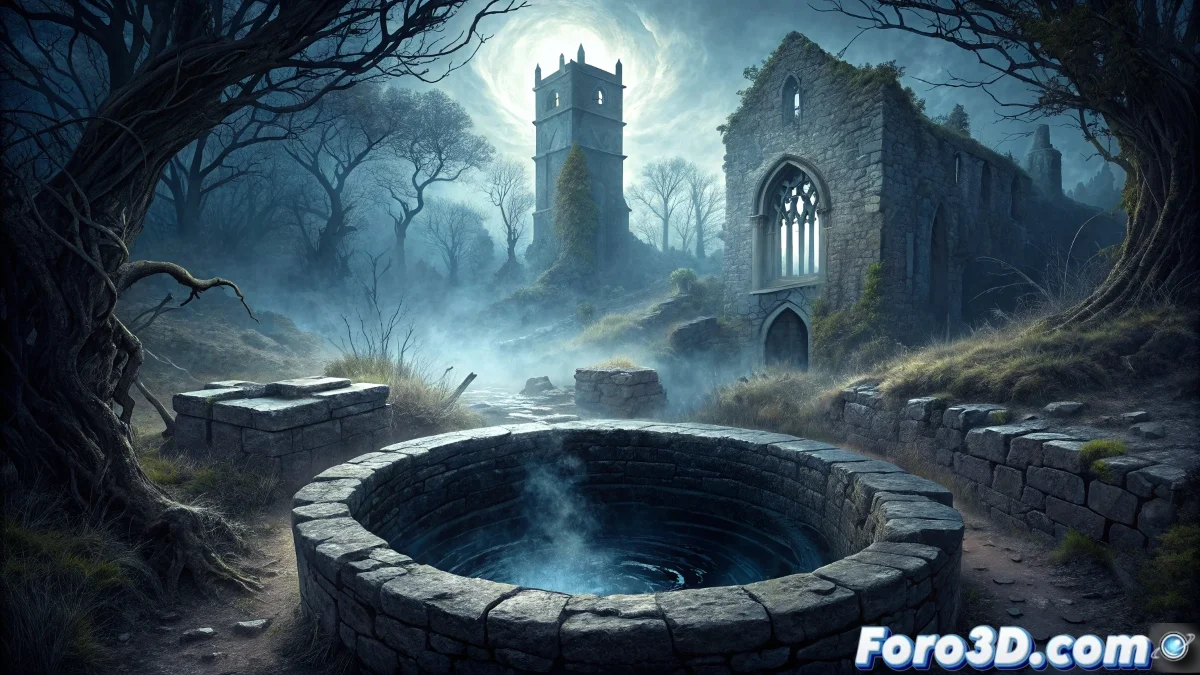
3D Reconstruction of the Black Pearl Well in Kiri Engine for Visionary Horror Scenes
The Black Pearl Well in western Ireland represents one of the most unsettling aquatic mysteries of Celtic folklore, where an ancient well near a ruined abbey contains a black, viscous substance that reveals personalized future visions to those who dare to gaze into it, offering the perfect case for mastering photogrammetry techniques for historical scenes and supernatural liquid reconstruction in Kiri Engine. 🕳️
Mythological Context and Visionary Horror
This rural Irish legend connects to the ancient Celtic tradition of sacred wells, but with a sinister twist where knowledge of the future is not a gift but a curse. The "black pearl" functions as a mirror of destiny, showing not possibilities but certainties so terrible that they destroy the observer's mental sanity, creating an existential terror that transcends conventional physical threats.
Characteristic elements of the phenomenon:- Black viscous substance with anomalous reflectivity
- Personalized visions of the observer's future
- Progressive madness effect after the vision
- Location in abbey ruins with a tragic history
- Physical properties that defy natural explanation
If gazed into fixedly for a long time, the well's darkness reveals visions of a terrible and personal future to the observer - Supernatural property of the well
Photogrammetric Research and Historical Documentation
It is essential to gather comprehensive photographic material from Irish abbey ruins, study medieval monastic architecture, investigate the optical properties of non-Newtonian fluids, and develop capture techniques that capture both historical accuracy and the supernatural atmosphere of the site.
Essential research areas:- Irish abbey architecture from the 12th-15th centuries
- Historical well construction techniques
- Optical properties of black and viscous liquids
- Photogrammetry in variable lighting conditions
- Deterioration patterns in exposed limestone
Step by Step: Reconstruction in Kiri Engine
1. Preparation of the Photographic Dataset
Organize the capture images: - Collect 150-300 photographs of similar abbey ruins - Include angles from ground level to elevated - Capture stone texture details, moss, and lichens - Maintain consistency in lighting and exposure
2. Project Setup in Kiri Engine
Start Kiri Engine and configure parameters: - Select "High Quality" mode for maximum precision - Enable "Advanced Texturing" for surface details - Set automatic scale based on reference objects - Set output format to OBJ + MTL for materials
3. Point Cloud Processing
Run reconstruction algorithms: - Feature Matching: Identify common points between images - Point Cloud Generation: Create the 3D scene base - Mesh Reconstruction: Convert points into continuous surface - Texture Projection: Apply photos to the 3D mesh
4. Reconstruction of the Circular Well
Focus on the central element: - Ensure complete capture of the well edge - Reconstruct stone coping geometry - Develop wear textures on the edge - Preserve details of inscriptions or marks
5. Generation of the Black Substance
Create the supernatural liquid: - Develop reflective but non-transparent surface - Configure visual viscosity with normals map - Create infinite depth effect - Develop light distortion properties
6. Integration of Visionary Effects
Prepare for supernatural elements: - Create areas for future vision projections - Develop particle systems for effects - Configure shaders for light-liquid interaction - Prepare animations for vision sequences
7. Mesh and Topology Optimization
Refine the reconstructed geometry: - Simplify mesh while maintaining key details - Repair holes and problematic geometry - Optimize UV mapping for efficient texturing - Develop LODs for different distances
8. Specialized Materials and Shaders
Configure unique visual properties: - Develop shader for wet Irish stone - Create material for non-Newtonian black liquid - Configure subsurface scattering effects on moss - Develop shaders for vision effects
9. Export for Render Engine
Prepare for production pipeline: - Export model with 4K resolution textures - Generate normals and displacement maps - Preserve real scale for consistent integration - Include camera information for reference
10. Post-Processing and Final Effects
Perfect the reconstruction: - Combine with LiDAR scans if available - Integrate additional vegetation elements - Adjust lighting for dramatic atmosphere - Develop selective blur effects
Advanced Photogrammetry Techniques
For professional results, master the use of polarizers to reduce reflections, use HDR capture for high dynamic range, and develop multi-lighting techniques to eliminate problematic shadows. 📸
Recommended advanced techniques:- Polarizers for reflection control on wet surfaces
- HDR capture for details in shadows and highlights
- Multi-lighting for shadow elimination
- Focus stacking for maximum depth of field
Integration with VFX Pipelines
When exporting to Blender or Unreal Engine 5, configure PBR materials to exploit global illumination systems, develop blueprints for interactive vision effects, and create particle systems that simulate the viscosity of the "black pearl."
Reconstructing Forbidden Knowledge
Working with the Black Pearl Well in Kiri Engine explores the intersection between historical reconstruction and metaphysical horror, demonstrating that modern photogrammetry can capture not only physical reality but also the emotional and psychological narratives embedded in legendary places, creating bridges between digital archaeology and supernatural experience. 🔮