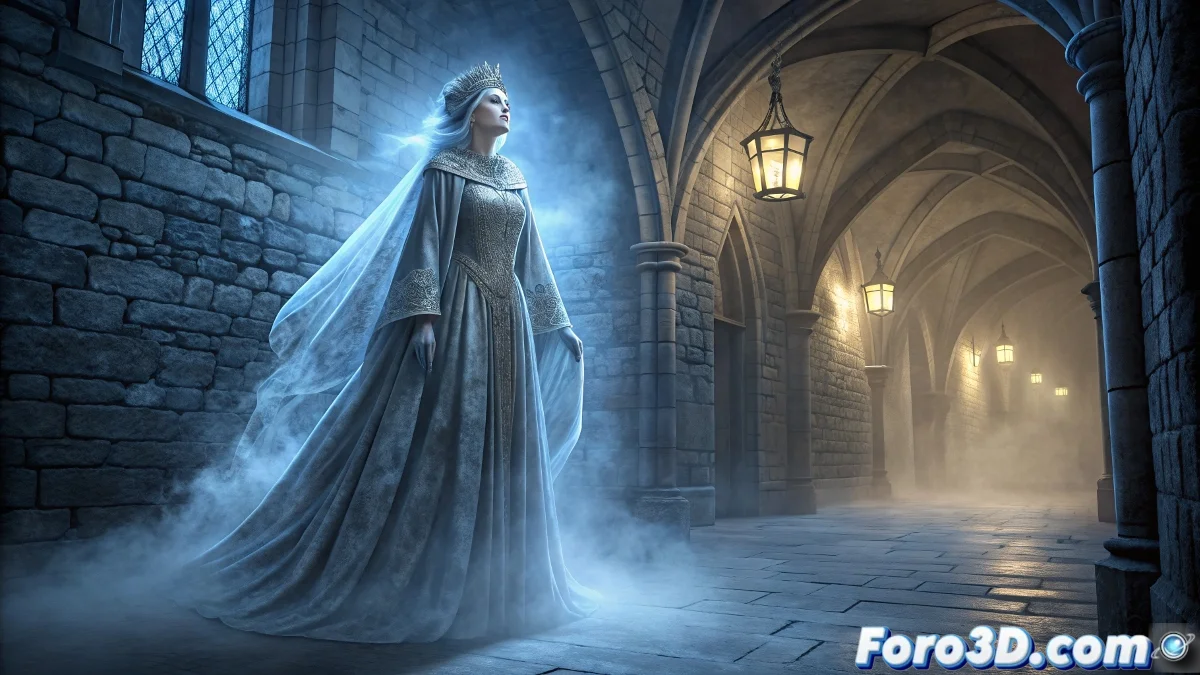
3D Reconstruction of Queen Matilda's Ghost in Meshroom for Historical Scenes
The Ghost of Queen Matilda in the Tower of London represents one of the most documented and emotionally charged historical apparitions in the United Kingdom, where the specter of Henry I's wife eternally wanders through passages and basements searching for her murdered son, announcing her presence through a sudden glacial cold and a heart-wrenching wail of sorrow, offering a unique case for the application of advanced photogrammetry in Meshroom. 👑
Historical Context and Spectral Phenomenology
This documented royal apparition is distinguished by its non-threatening but deeply moving nature. Matilda of Scotland, 12th-century Queen Consort of England, searches post-mortem for the son taken from her, creating a ghostly presence that generates empathy and terror through the raw emotion of her eternal maternal pain rather than through conventional physical threats.
Documented Characteristics of the Phenomenon:- Female figure dressed in authentic medieval garments
- Sudden temperature drop upon appearance
- Vocal wail described as "the saddest sound"
- Repetitive searching behavior in the same corridors
- Translucent appearance with anguished facial expression
A prolonged and heart-wrenching wail described as the saddest and most desperate sound a human being can hear - Historical testimony
Photogrammetric Research and Historical Documentation
It is essential to gather exhaustive photographic material from the Tower of London, study Norman architecture, research 12th-century royal attire, and develop capture techniques that preserve both historical accuracy and the spectral atmosphere of the location.
Essential Research Areas:- Architectural photography of the Tower of London's interiors
- Medieval royal attire and 12th-century textiles
- Natural and artificial lighting in historical spaces
- Acoustics of stone passages and reverberation effects
- Photogrammetry techniques in low-light conditions
Step by Step: Reconstruction in Meshroom
1. Preparation of the Photographic Dataset
Organize the capture images: - Collect 200-500 photographs of the target passages - Maintain 60-80% overlap between consecutive images - Include varied angles (high, medium, low) - Preserve EXIF metadata for camera calibration
2. Meshroom Project Setup
Launch Meshroom 2021 and configure parameters: - Set quality to "high" to preserve architectural details - Configure depth descent to 8 levels - Enable ambient lighting estimation - Prepare cache on SSD for fast processing
3. Structure from Motion Processing
Run reconstruction algorithms: - FeatureExtraction: Detects keypoints in all images - ImageMatching: Establishes correspondences between photographs - CameraInit: Estimates camera positions and parameters - PrepareDenseScene: Prepares for dense reconstruction
4. Dense Point Cloud Reconstruction
Generate precise 3D geometry: - DepthMap: Computes depth maps per image - DepthMapFilter: Removes outliers and noise - Meshing: Converts point cloud to 3D mesh - Texturing: Applies textures from original photographs
5. Integration of the Spectral Element
Prepare the Matilda figure: - Capture photogrammetry of actor in medieval costume - Process separately in Meshroom - Combine environment and ghost point clouds - Adjust scale and proportions for historical integration
6. Mesh and Topology Optimization
Refine the reconstructed geometry: - Apply filters to reduce noise on surfaces - Simplify mesh while maintaining architectural details - Repair holes and problematic geometry - Optimize UVs for efficient texturing
7. Material and Texture Generation
Develop historically accurate shaders: - Export texture atlas from Meshroom - Develop PBR materials for stone and wood - Create special shaders for spectral effect - Adjust reflectivity and roughness for medieval materials
8. Atmospheric and Environmental Effects
Implement supernatural properties: - Develop volume for glacial cold effect - Create breath particles in cold air - Implement distortion effects from thermal difference - Apply color grading for gloomy color palette
9. Export for Render Engine
Prepare for production pipeline: - Export mesh as OBJ or FBX with materials - Generate normal and displacement maps - Preserve real-world scale information - Include camera data for compositing
10. Post-Processing and Refinement
Perfect the final reconstruction: - Combine with LiDAR data if available - Integrate scans of historical objects - Adjust lighting for spectral atmosphere - Develop progressive fading effects
Advanced Photogrammetry Techniques
For professional results, master the use of masks to exclude moving elements, use controlled lighting for consistency, and develop multi-scale reconstruction techniques to capture from fine details to large-scale structures. 📸
Recommended Advanced Techniques:- Masking to exclude visitors and modern elements
- Controlled lighting for texture consistency
- Multi-scale reconstruction for architectural details
- HDR capture for high dynamic range
Integration with Historical VFX Pipelines
When exporting to Unreal Engine 5, configure Nanite for complex geometry, use Lumen for dynamic global illumination, and develop materials that respond to the sudden cold conditions characteristic of Matilda's apparition.
Resurrecting History through Photogrammetry
Reconstructing the Ghost of Queen Matilda in Meshroom represents the convergence between technology and legend, demonstrating that modern 3D capture techniques can give tangible form to ethereal stories, preserving not only historical architecture but also the emotional narratives that inhabit it, creating bridges between the documented past and the experiential present. 🏰