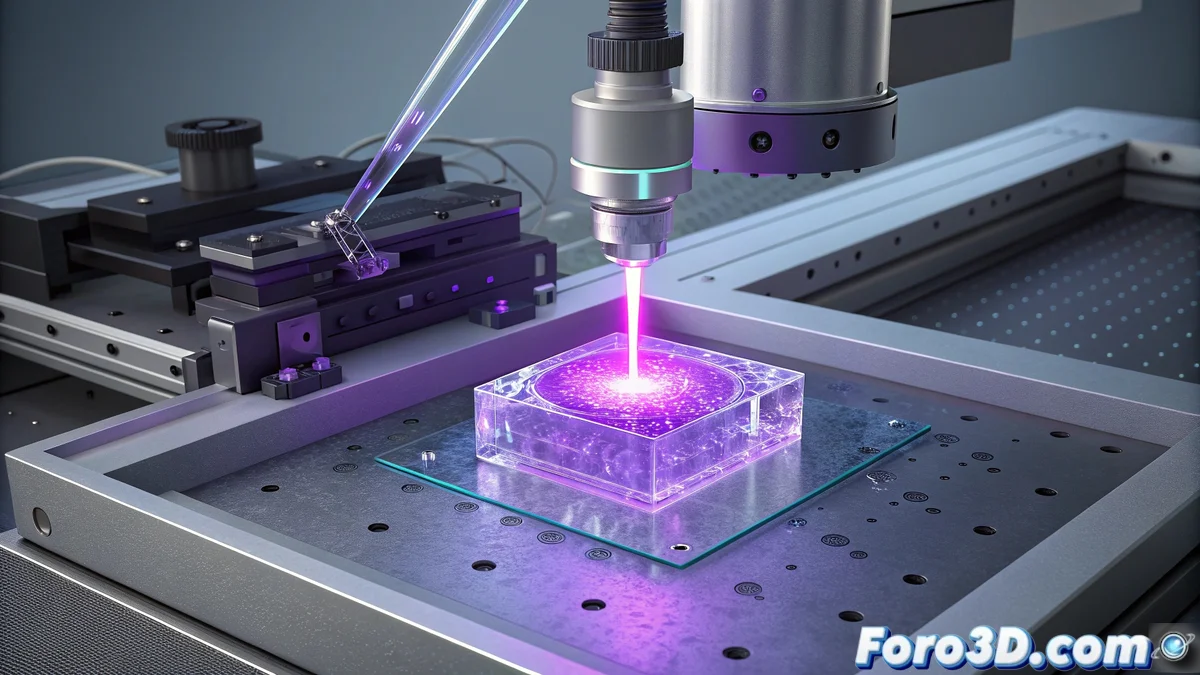
The Magic of Transforming Liquid into Glass Through Light
3D printing with special resins represents the most sophisticated and chemically complex approach to creating glass objects through additive manufacturing. This technique uses photosensitive resins loaded with silica nanoparticles that, after a controlled baking process, transform into pure glass. A true modern alchemy that combines the precision of stereolithography with the unique properties of vitreous material.
The Delicate Material Transformation Process
The success of this methodology depends entirely on the precise control of two distinct phases: the initial photopolymer printing and the subsequent thermal conversion. During the first stage, the liquid resin is solidified layer by layer using ultraviolet light, creating a green body that maintains the shape but lacks the properties of glass. The real magic happens in the oven, where high temperatures eliminate the polymer and fuse the silica particles into a homogeneous structure.
Critical Manufacturing Stages
- Printing by photopolymerization of the loaded resin
- Cleaning of uncured material residues
- Controlled baking to remove the polymer
- Final sintering to fuse the silica particles
Advantages of the Chemical Approach
This method surpasses extrusion-based or laser sintering techniques when it comes to achieving maximum surface detail and intricate geometries. The liquid nature of the initial resin allows reproducing microscopic features with a fidelity that other processes cannot match. The resulting transparency is usually superior from the start, requiring less post-processing to achieve optical quality.
High-Precision Applications
- Microfluidic devices for medical analysis
- Components for telecommunications systems
- Custom lenses and optical elements
- Scaffolds for tissue engineering
A technology that demonstrates how the most advanced chemical processes can ally with digital manufacturing to create materials that seem straight out of science fiction.
For researchers and medical technology developers, this technique means being able to create glass devices with internal channels finer than a human hair and complex three-dimensional geometries. The inherent biocompatibility of glass makes it the ideal material for applications requiring sterility and transparency 🔍.
And all this while the resins patiently wait in their dark bottles, knowing their ultimate destiny is to sacrifice themselves on the thermal altar to be reborn as pure glass... although the process is probably so expensive that you'll need a Hollywood movie budget to print a simple glass 😅.