3D Printing with Polymers Redefines Executive Aviation Interiors
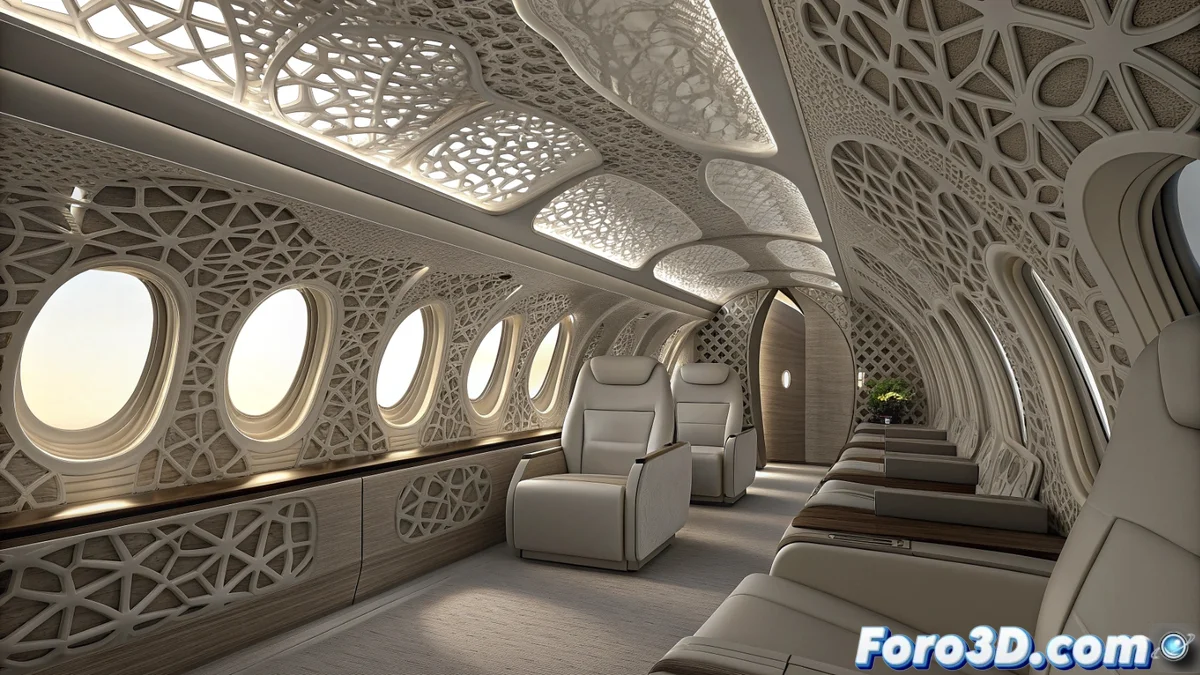
Additive manufacturing is profoundly changing how spaces inside private aircraft are conceived and produced. Leading firms, such as Lufthansa Technik with its AeroLiner3000 project, are adopting this technique to generate cabin panels, dividers, and furniture pieces with shapes impossible for conventional methods. This evolution enables customizing each element according to each client's aesthetic and operational demands, from aerodynamic profiles to surfaces with nature-inspired textures. ✈️
Optimizing Weight through Intelligent Structures
A primary advantage of these 3D-printed bionic components is the drastic reduction in mass. By distributing material only in areas requiring strength, lightweight and resistant assemblies are achieved, emulating the efficiency of natural bone structures. This direct weight savings contributes to reducing the aircraft's fuel consumption. At the same time, the process eliminates multiple parts and assembly stages, streamlining the logistics chain and shortening timelines for manufacturing luxury interiors or demonstration aircraft.
Main Impacts of Bionic 3D Printing:- Reduce Total Weight: Optimized geometries use material only where strictly necessary.
- Simplify Assembly: Functions are integrated, reducing the number of parts and joints.
- Accelerate Production: Manufacturing timelines for complex components are significantly shortened.
The geometric freedom of 3D printing allows transferring the efficiency of natural structures to aeronautical industrial design.
Specialized Polymers Are the Key
The performance of these parts depends entirely on the advanced polymers selected. Materials are chosen for their excellent strength-to-weight ratio, durability against vibrations and thermal fluctuations, and compliance with stringent regulations on flammability and cabin emissions. The versatility of additive design enables incorporating cable channels or anchor points directly into the part, improving functionality and the polished appearance of the interior.
Critical Material Characteristics:- High mechanical strength with minimal density.
- Ability to withstand the operational environment of an aircraft (vibrations, temperature).
- Compliance with aeronautical safety standards (FAR, EASA).
From Aviation to Domestic Inspiration
This technology, which today transforms executive aviation, also serves as inspiration. Some 3D printing enthusiasts aspire to apply bionic design concepts in their homes, although initial projects tend to be more modest, such as redesigning an electronic accessory. This flow of ideas demonstrates how high-level innovations can trickle down and motivate creativity in other fields. 🛠️