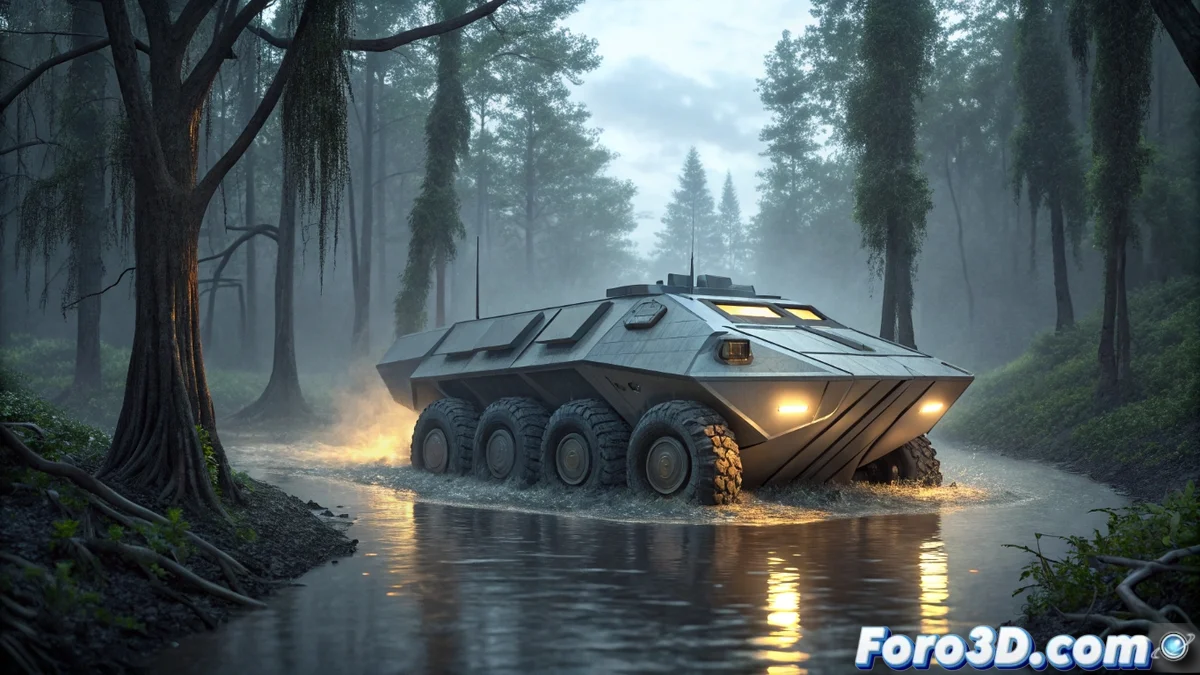
3D Printing Shapes the Amphibious Salamandra Prototype
Additive manufacturing continues to expand its horizons, demonstrating potential that transcends workshops and design studios to materialize in advanced engineering projects. A brilliant example of this evolution is the development of the Salamandra prototype in Poland, an off-road vehicle with amphibious capabilities whose chassis and body elements have been created using 3D printing. This project is not just a design exercise, but a practical validation of how geometric optimization allows reconciling contradictory demands such as buoyancy and extreme robustness. 🚙💨
Complex Geometries for a Dual Challenge
The heart of the Salamandra's success lies in the design freedom offered by 3D printing. Manufacturing critical parts with traditional methods would have been extremely costly or directly unfeasible due to the necessary internal shapes. Using probably high-performance polymers or composite materials, engineers have been able to integrate internal honeycomb or alveolar structures. These configurations provide exceptional rigidity with minimal weight, an absolutely crucial factor. Lightness is vital for staying afloat, while the internal architecture of the parts is calculated to distribute stresses optimally during movement over rough terrain, ensuring the durability of the assembly.
Key Advantages of Additive Design in the Salamandra:- Topological Optimization: Allows creating shapes that maximize strength only where strictly necessary, eliminating superfluous material and reducing total weight.
- Function Integration: Several components that previously required assembly are now printed as a single complex piece, increasing robustness and reducing weak points.
- Rapid Iterations: Design adjustments can be implemented and physically tested in record time, greatly accelerating the prototype development cycle.
3D printing drastically reduces the time and cost of prototype development, enabling rapid design iterations for military, rescue, or scientific applications.
Beyond the Prototype: The Future of Agile Manufacturing
The Salamandra project serves as a powerful technology demonstrator that points the way for manufacturing specialized vehicles. This methodology is ideal for producing low series or highly customized units, where the economies of scale of traditional automotive production are not applicable. Sectors such as defense, logistics in extreme environments, or scientific research could greatly benefit from the ability to produce vehicles adapted to very specific missions without enormous tooling investments.
Potential Applications of This Technology:- Rescue Vehicles: To access flooded disaster zones or areas with difficult land access.
- Scientific Exploration: Designed to operate in wetlands, tundra, or other sensitive ecosystems.
- Military Logistics: Lightweight and versatile units for reconnaissance and support across multiple terrain types.
A Lesson in Versatility for the Maker Community
So, the next time you face a common problem with your printer, like warping deformation or first layer adhesion, remember the potential you have in your hands. The same principles of design for additive manufacturing and the pursuit of the perfect setup that you apply in your projects, scaled and refined, are what enable creating engineering marvels like the Salamandra. This amphibious prototype is an inspiring reminder that 3D printing is a tool limited only by our imagination and our ability to master its technique. 🌊⛰️