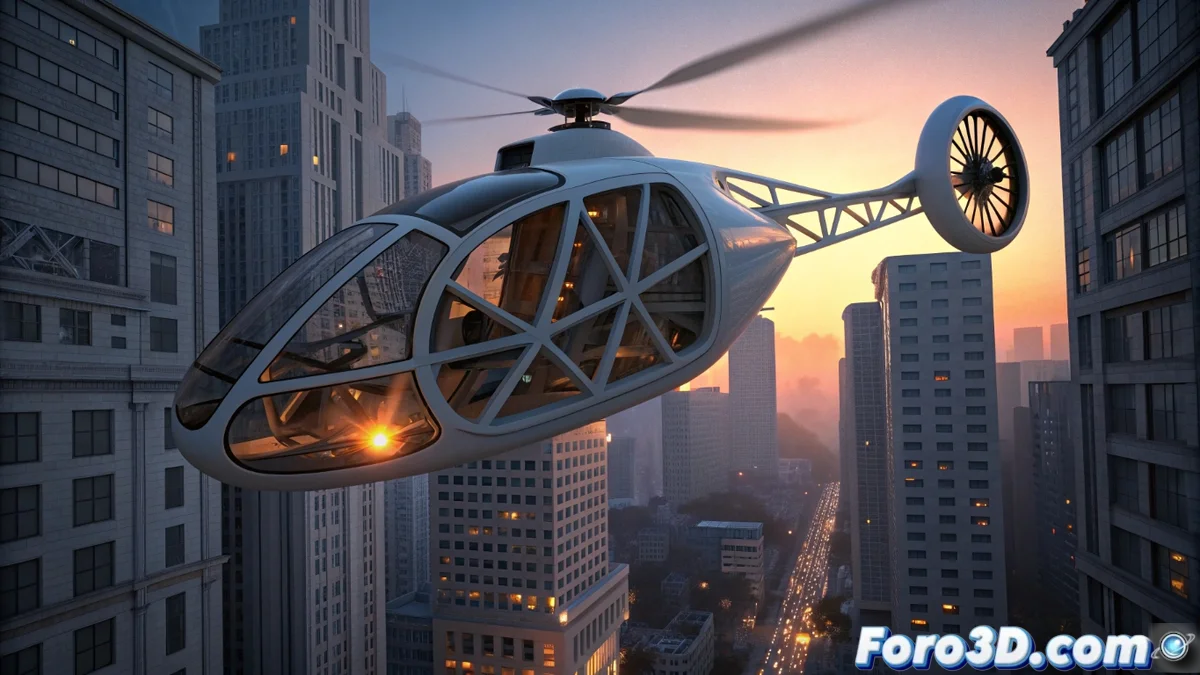
3D Printing Optimizes the Autonomous Flying Vehicle Cormorant
The Cormorant represents a new concept in urban air mobility. It is a vertical takeoff and landing (VTOL) vehicle that dispenses with conventional wings. Its compact design integrates rotors within ducts in the fuselage, a configuration designed to operate safely in confined spaces between buildings. Developed by Urban Aeronautics, its main mission is to transport patients or medical supplies quickly. 🚁
Manufacturing with Less Weight and More Geometric Freedom
Additive manufacturing is key to building this vehicle. This process allows the production of structural and aerodynamic components that would be unfeasible or very costly with traditional methods. By creating parts with organic and hollow geometries, a significant weight reduction is achieved. This savings directly translates into greater capacity to carry payload or extend mission range.
Key Advantages of 3D Printing in the Cormorant:- Produce rotor ducts with internally optimized shapes to guide airflow more efficiently.
- Manufacture complex assemblies in a single piece, eliminating joints and reducing potential failure points.
- Allow rapid iteration and testing of new component designs during the development phase.
Additive manufacturing not only lightens the vehicle but also materializes aerodynamic designs that previously only existed in simulations.
A Safe Propulsion System for the City
The heart of the Cormorant is its ducted internal rotors. This architecture encloses the rotating blades within channels, providing several crucial advantages for urban flight. It protects people and nearby infrastructure from exposed propellers and reduces noise. However, designing the aerodynamics of these ducts is a complex engineering challenge.
Propulsion Design Features:- The ducts protect the rotors from impacts and allow operation very close to obstacles.
- The internal shapes of the ducts are optimized to minimize drag and maximize thrust.
- 3D printing is the only viable way to manufacture these ducts with the required curves and continuous surfaces.
Integrating the Sky into the Urban Landscape
The development of the Cormorant goes beyond the technical challenges of making it fly. Its true integration into the city involves considering operational logistics. Finding safe and dedicated spaces for takeoff, landing, and parking in dense urban cores is as important an obstacle as the engineering of the vehicle itself. Projects like this explore how advanced design and manufacturing can shape the future of emergency and cargo transport in our metropolises. 🏙️