When 3D Printing Reaches Superconductivity
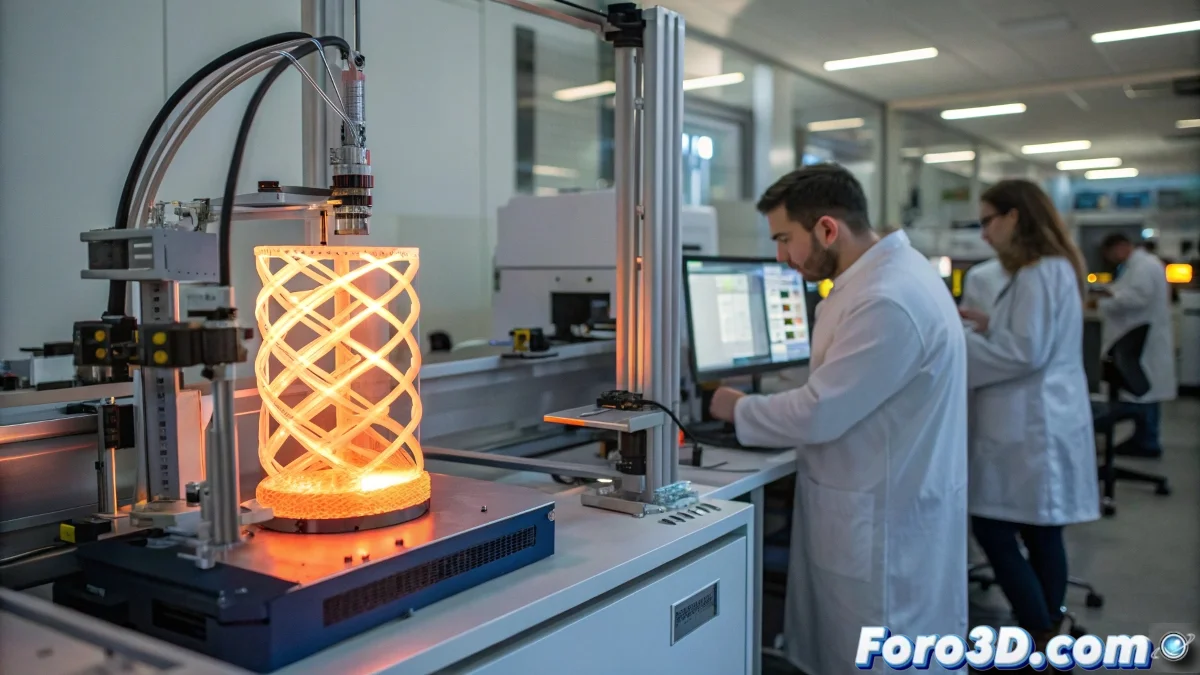
A team of researchers from Cornell University has revolutionized the field of superconducting materials with a 3D printing method that seems straight out of science fiction. 🔬 This innovative technique allows the production of superconductors with enhanced properties through a single-stage process that eliminates the complex traditional manufacturing steps. Using a special ink composed of copolymers and inorganic nanoparticles, the material self-assembles during printing and is then subjected to a thermal treatment to form a perfectly structured crystalline superconductor.
The true magic of this process lies in its ability to operate on three different scales simultaneously. At the atomic scale, atoms align in a perfect crystal lattice; at the mesoscopic scale, copolymers guide the formation of ordered structures; and at the macroscopic scale, 3D printing generates complex shapes like coils or helices that are impossible to create with conventional methods. 🌀 This multiscale approach represents a monumental advance in the manufacturing of advanced materials.
A quantum leap in materials manufacturing that could redefine multiple industries.
Record Performance and Transformative Applications
When applied to niobium nitride (NbN), the printed superconductor achieved a critical magnetic field resistance of between 40 and 50 teslas, the highest value ever recorded for this compound. ⚡ This exceptional performance opens doors to revolutionary applications in superconducting magnets for magnetic resonances, high-efficiency energy storage systems, and advanced quantum devices. The technique can be adapted to other transition metal compounds, offering almost unlimited potential to customize materials according to specific needs.
The most promising applications include:
- Superconducting magnets for medical magnetic resonance equipment
- High-efficiency energy storage systems
- Quantum devices with miniaturized ion traps
- Electronic components with complex custom geometries
The Future of Advanced Materials Manufacturing
This method not only radically simplifies the manufacturing of superconductors but also democratizes access to these high-performance materials. 🎯 The ability to print complex 3D shapes opens up possibilities that previously existed only in theory, allowing the creation of devices with geometries optimized for specific applications. From ultrasmall electronic components to large-scale energy storage systems, the implications of this technology could transform multiple industries in the next decade.
With this advance, superconductors could soon print the circuits that need them themselves… or at least that's what the researchers hope as they watch their printers create what was previously impossible. 🚀 Another demonstration that the boundary between materials science and 3D printing is fading rapidly.