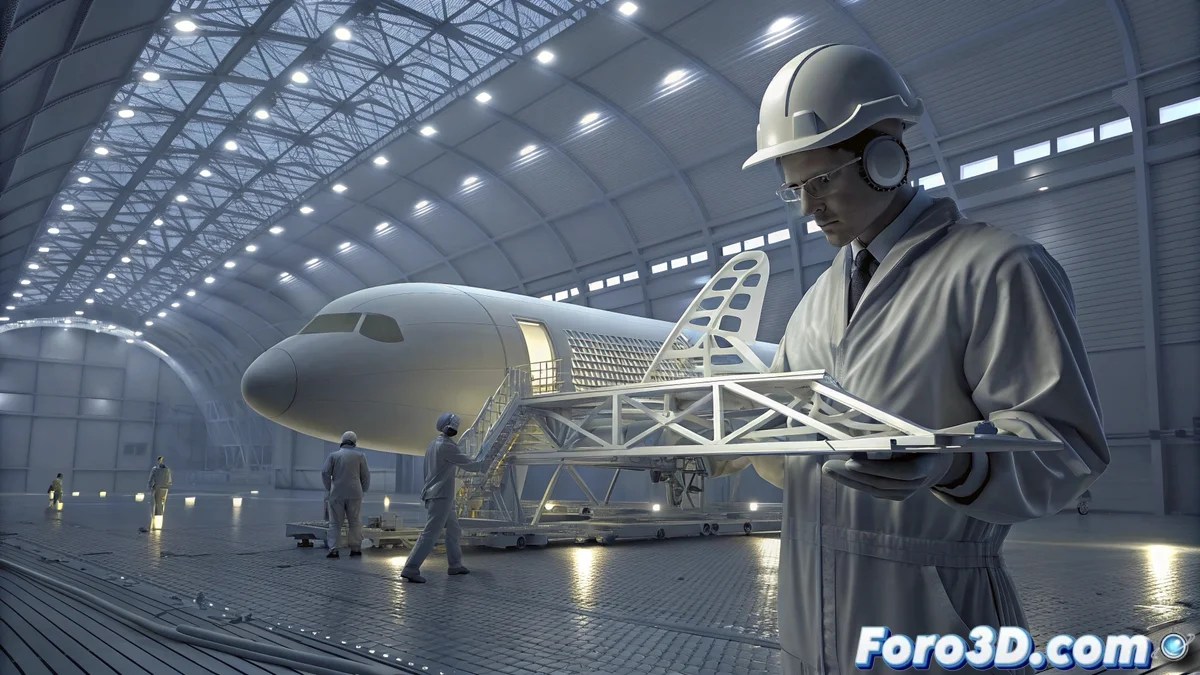
3D Printing Manufactures Tools for Assembling Airplanes
The aerospace industry leads the adoption of advanced technologies. Giants like Boeing and Airbus systematically incorporate additive manufacturing to create essential auxiliary components. This methodology transforms how aircraft assembly lines are prepared and executed 🛠️.
Materials and Operational Benefits
Materials are selected based on the tool's function. For uses that do not require withstanding large forces, polymers like ABS are used. When maximum robustness and longevity are needed, it is printed directly with metal alloys of aluminum or titanium. This criterion eliminates the need to maintain a vast stock of generic tools. By digitizing designs and producing them only when required, factories free up space and gain unprecedented flexibility to adapt to design changes.
Concrete Applications in the Hangar:- Drill Templates: Guide with absolute precision where to drill fuselage panels, eliminating measurement errors.
- Custom Mounting Supports: Hold components with curved or irregular geometries during their final installation.
- Alignment Tools: Ensure that large aircraft sections fit perfectly before their permanent joining.
The true luxury in modern manufacturing is not having a large warehouse, but being able to print the exact key for a screw that hasn't been invented yet.
Impact on Efficiency and Precision
Manufacturing these auxiliary parts on demand generates a perfect fit to the complex geometries of wings, stabilizers, and fuselages. This drastically shortens the wait time to obtain a tool and, consequently, accelerates the complete cycle of assembling each aircraft. Customized solutions reduce error-prone manual intervention, improve process repeatability, and ensure that every plane is built to design specifications to the millimeter ✈️.
Key Advantages of This Approach:- Radical reduction in lead times for obtaining specialized tooling.
- Minimization of human errors and increase in assembly consistency.
- Ability to redesign and produce a new tool in hours if the aircraft component changes.
The Future of Aeronautical Tooling
The lightest, most complex, and specific tool for a singular task is no longer sought in a catalog, but is printed on demand. This paradigm prioritizes agility and precision over the accumulation of physical inventory. 3D printing consolidates its role as an indispensable pillar for optimizing and streamlining the manufacturing of the world's most complex machines, demonstrating that innovation often lies in the process details 🚀.