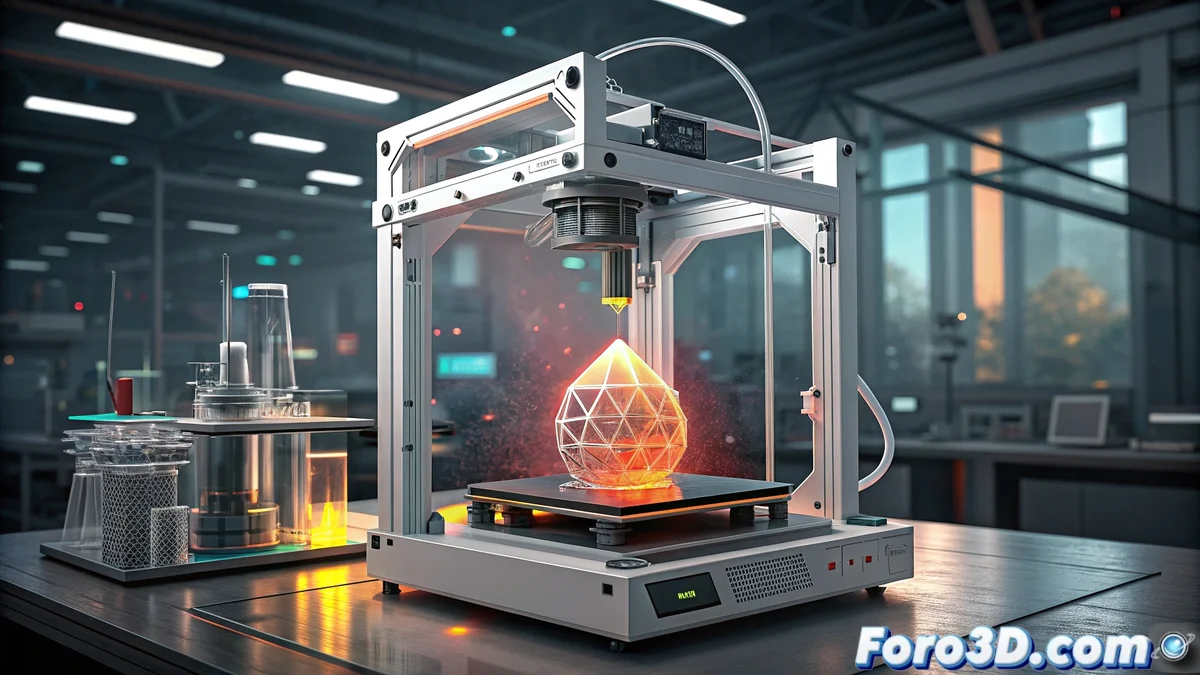
Glass Leaves Traditional Methods Behind
While most associate 3D printing with plastics or metals, glass has emerged as one of the most challenging and fascinating materials for additive manufacturing. This millennial material, traditionally worked through blowing or casting in molds, is experiencing a technological revolution that allows creating shapes previously impossible. A leap from ancestral artisanal techniques toward the precision of 21st-century digital technology.
The Three Methods That Are Changing the Rules
3D glass printing has developed mainly through three distinct technical approaches, each with its specific advantages and limitations. From the direct extrusion of molten glass to the use of special resins that transform into glass through baking, researchers have found multiple paths to tame this temperamental material. The choice of method fundamentally depends on the required balance between size, detail, and final cost.
Main Glass Printing Techniques
- Extrusion of molten glass at high temperatures
- Laser sintering of silica powder
- Photopolymerization of resins with glass particles
- Thermal post-processing to eliminate internal stresses
Technical Challenges Overcome
The main obstacle to printing glass has always been its extreme thermal behavior. It requires temperatures above 1000 degrees Celsius to reach a liquid state and is prone to developing internal stresses during cooling. A millimeter-precision thermal ballet that can now be controlled through specialized software and high-efficiency heating elements.
Applications That Justify the Effort
- Custom optical components for industry
- Sterile medical and laboratory devices
- Architectural elements with complex geometries
- Artistic sculptures with impossible transparencies
A demonstration of how the most traditional materials can be reinvented through technology, expanding their applications into unexplored territories.
For designers and architects, this technology means being able to incorporate glass into projects with organic shapes or complex patterns that would be unfeasible with conventional methods. The possibility of creating lattice structures or panels with internal channels opens up an unprecedented creative spectrum 🔮.
And all this while demonstrating that, although glass remains as fragile as ever, at least now we can print spare parts quickly when something breaks... although the printer probably costs more than replacing the piece manually 😅.