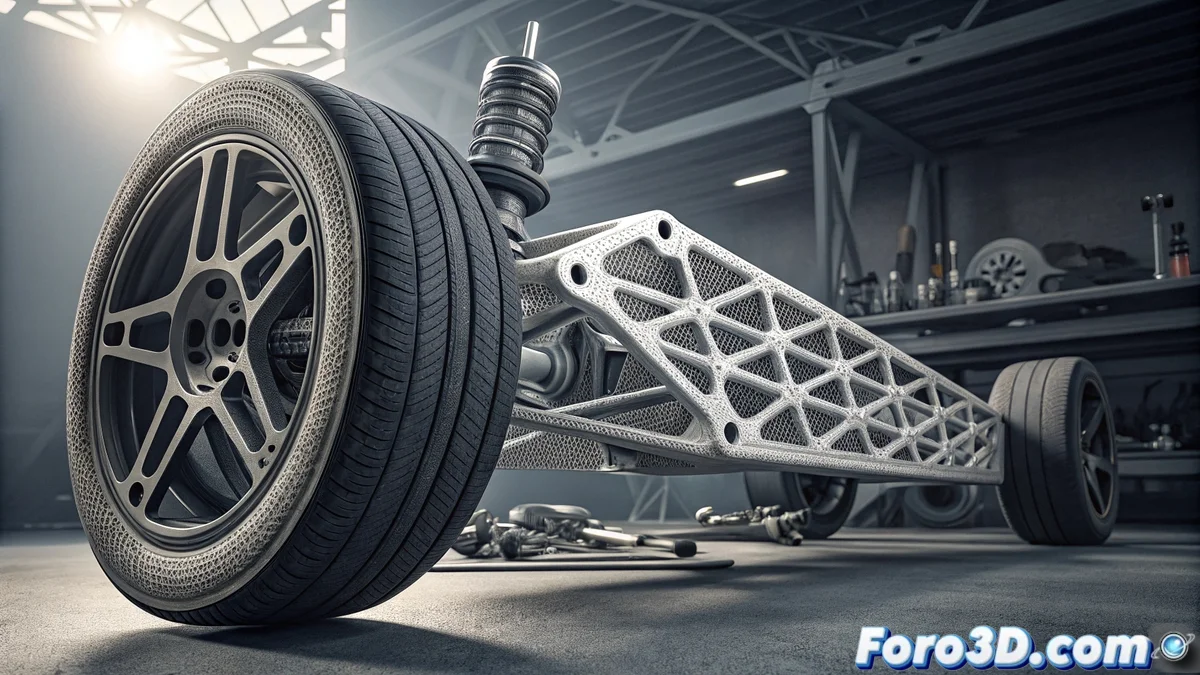
3D Printing to Manufacture Suspension Components in Competition Automotive
In the world of rally vehicles and experimental prototypes, 3D printing has become a fundamental ally. This technology allows the manufacture of fully customized suspension components, such as control arms or shock absorber mounts, that fit specific chassis geometries. The key lies in being able to modify the weight and strength of each part to meet the unique demands of a race, something that standard parts cannot offer. 🏁
Materials and Processes That Make the Difference
For these critical structural parts, not just any material will do. Filaments of nylon reinforced with carbon fiber or special resins for stereolithography are used. The process begins with a CAD design that seeks the optimal topology, generating organic and lightweight shapes that are only possible with additive manufacturing. After printing, the parts require post-processing that may include curing, sanding, or applying coatings to ensure their durability and performance.
Key Advantages of Additive Manufacturing in Competition:- Total Customization: Each part is designed for a specific chassis and conditions.
- Complex Geometries: Shapes are achieved that optimize the weight-strength ratio, impossible with traditional methods.
- Advanced Materials: Use of high-performance composites to withstand great stresses.
3D printing radically shortens development cycles, allowing concepts to be validated in metal more efficiently.
Adaptation and Speed: The Great Assets
The main utility of this technique is its ability to iterate quickly. If handling issues are detected during track tests, a team can modify the design of a suspension arm and have the new version ready in a matter of hours. This contrasts with the longer lead times of traditional manufacturing, which relies on molds and machining. It thus becomes an indispensable tool for developing and testing concepts before series production.
Typical Workflow for a Component:- Design in CAD with topological optimization.
- 3D print with high-strength composite material.
- Post-process the part (cure, sand, coat).
- Test on the vehicle and evaluate performance.
- Re-design and repeat the cycle if necessary.
A Realistic Balance of the Technology
Although it is a powerful tool, it is not infallible. The search for the lightest and most efficient design sometimes clashes with the reality of competition, where an accidental encounter with an obstacle can test the limits of the material. It serves both to gain seconds on the track and to learn from failures before definitive production. 3D printing in competition automotive is not just about making parts, but about accelerating the innovation process and learning by iterating at unprecedented speed. 🔧