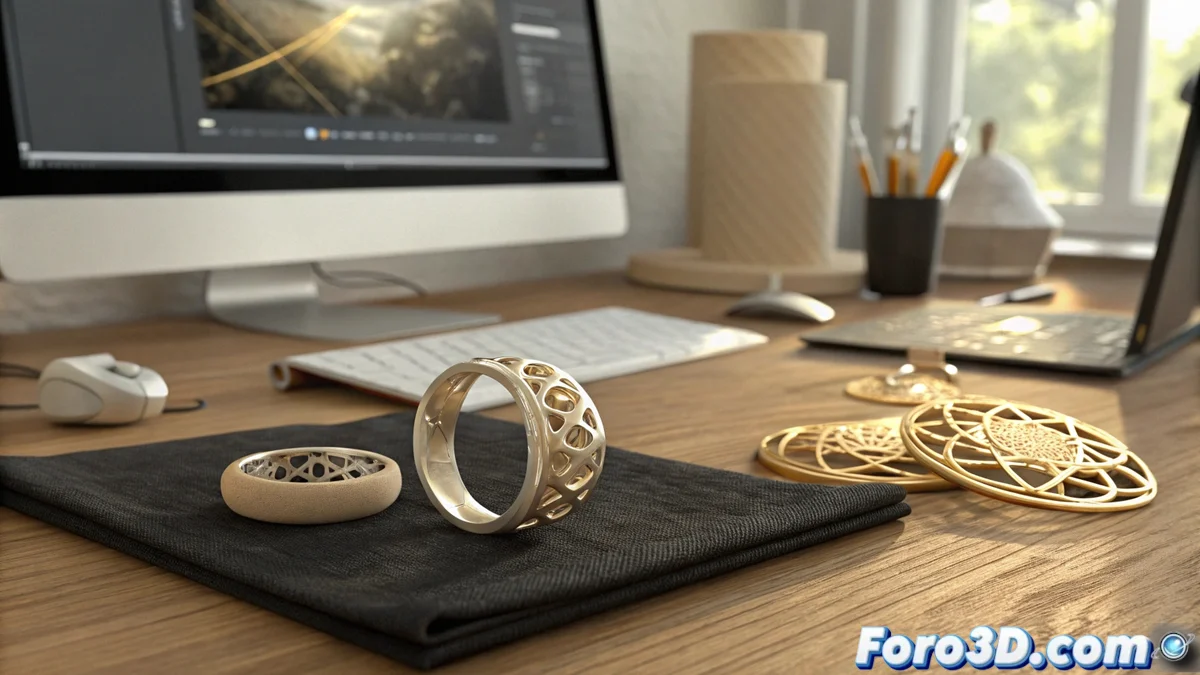
3D Printing for Manufacturing Custom Jewelry
3D printing technology radically changes how custom-made jewelry is conceived and produced. It allows anyone to design their own pieces, such as rings or pendants, from scratch, moving away from mass production to focus on objects with individual meaning. 🛠️
Starting with Digital Design
The first step is to model the jewelry in a 3D design program. Tools like Blender, Rhino, or ZBrush are commonly used for this task. The resulting file must be prepared for printing, ensuring that the geometry is solid and optimized. The design can include texts, symbols, or complex shapes that are difficult to carve by hand.
Advantages of 3D Modeling:- Create intricate and customized geometries that would be impossible with traditional methods.
- Test and adjust the design digitally before materializing it, saving time and resources.
- Integrate elements like texts or symbols with high precision directly into the model.
3D printing democratizes access to custom jewelry, putting the power of design in the user's hands.
From Resin to Metal: The Casting Process
The designed piece is printed with a special burn-out resin. This resin is completely burned in a kiln, leaving a perfect cavity in a refractory plaster mold. Then, molten metal, such as silver or gold, is poured into that space. After cooling and breaking the mold, the metal jewelry is obtained, ready for polishing. 🔥
Key Casting Steps:- Print the master model in high-definition burn-out resin.
- Incinerate the resin in a kiln to create the negative mold in plaster.
- Pour the molten metal into the mold cavity and let it solidify.
- Break the mold, recover the raw metal piece, and apply final finishes like polishing.
A New Paradigm in Jewelry
This method allows materializing unique ideas without depending on catalogs or mass production. The ability to design and manufacture locally pieces that exactly fit the user's vision represents a significant change in the industry. Thus, the challenge is no longer to find, but to create. ✨