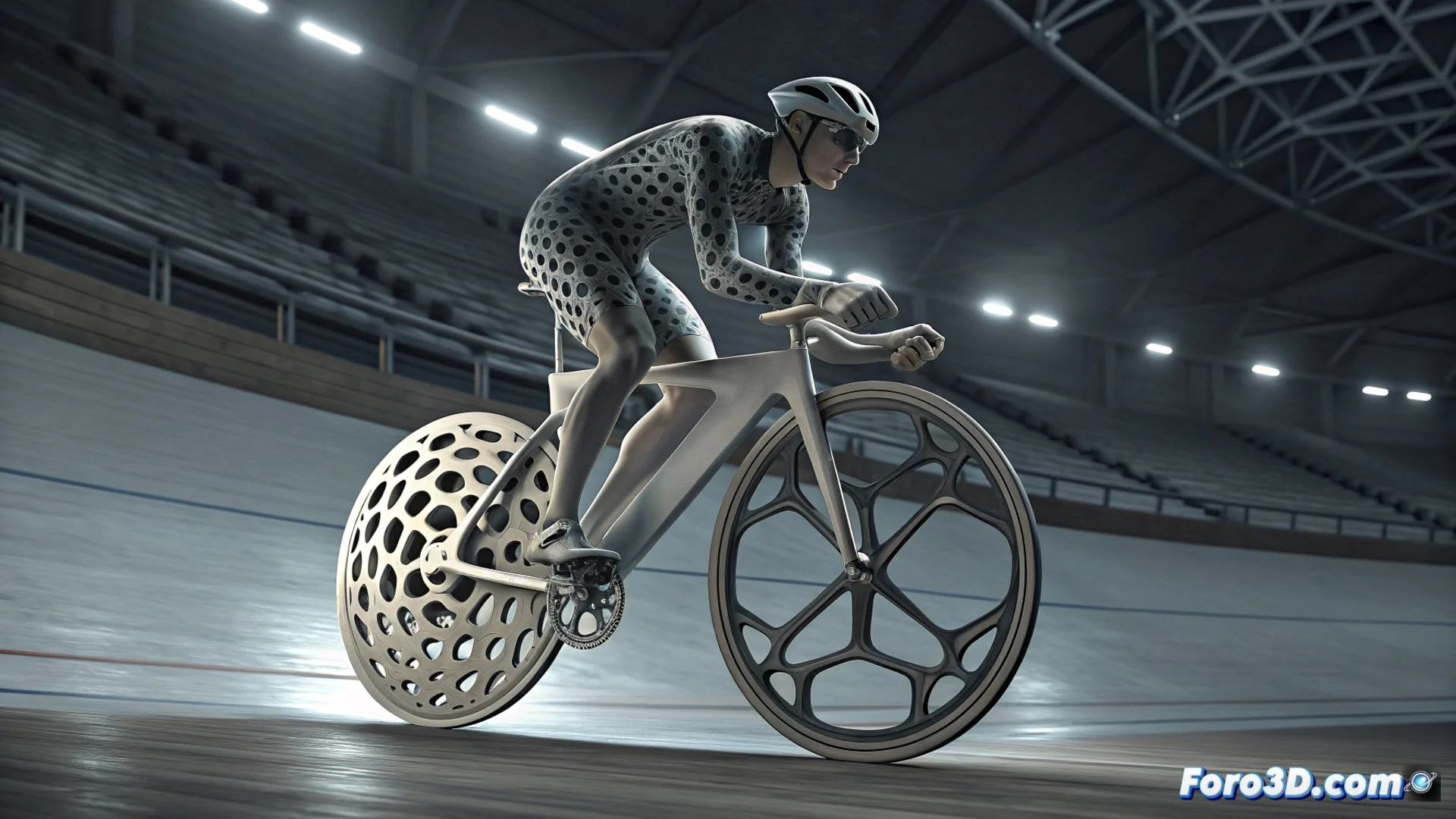
3D Printing Customizes Titanium Handlebars for Elite Cyclists
In professional cycling, winning or losing depends on tiny details. British Cycling, together with manufacturer Lotus, turns to additive manufacturing to produce titanium components tailored to each rider. This approach seeks to eliminate any aerodynamic disadvantage and extract maximum performance from both the machine and the athlete. 🚴♂️💨
Impossible Geometries Made Real
Metal 3D printing frees engineers from the limitations of traditional production methods. They can materialize designs with highly complex internal and external shapes. For these handlebars, titanium is used to achieve an exceptionally lightweight piece that doesn't yield under pedaling power. Airflow is digitally modeled to sculpt a geometry that directs it with minimal turbulence possible.
Key advantages of extreme customization:- Millimetric adaptation: The handlebar is modeled from a 3D scan of the cyclist's posture, fitting the contour of their arms and their specific grip.
- Aerodynamic efficiency: Reducing wind resistance is the main goal. Every curve and surface of the component is designed to cut through the air.
- Power transfer and comfort: A perfect fit not only makes the cyclist faster but also allows their energy to be transmitted better to the bike and reduces fatigue.
In a sport where differences are measured in hundredths of a second, customizing every component is a fundamental strategy to win.
From Scan to Podium
The process begins by capturing the athlete's exact position on their pursuit bike. This data feeds a digital model that engineers and designers iteratively optimize. The final piece is unique, manufactured in a single operation using powder bed fusion additive manufacturing. This contrasts with conventional methods that would require joining multiple parts.
Steps in component development:- High-precision 3D scan of the cyclist's posture.
- Design and computational fluid dynamics (CFD) simulation of the handlebar.
- 3D print the definitive piece in aeronautical-grade titanium.
- Finishing and verification of the final fit on the bike.
The Same Technology, Different Scale
This project demonstrates the potential of 3D printing when applied with high-level resources. While a home printer may struggle to make a simple pen holder, industrial systems manufacture critical parts to compete in the Olympics. The principle of building layer by layer is the same, but the materials, precision, and goals make the abysmal difference. 🥇⚙️