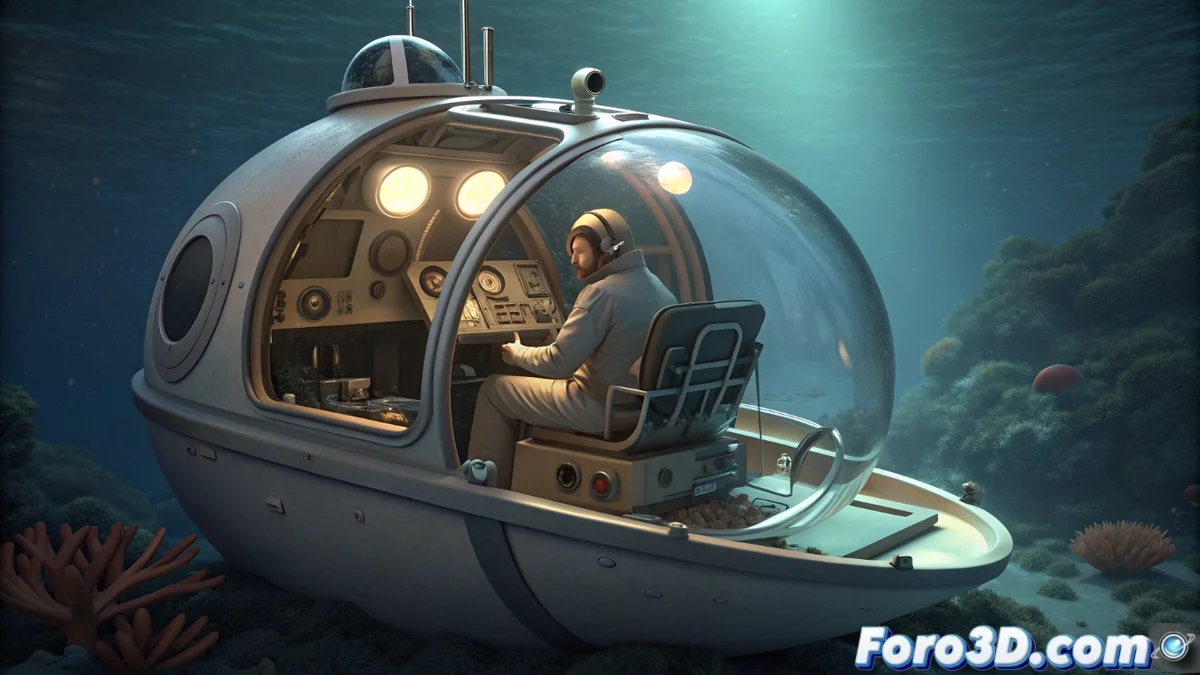
3D Printing Customizes the Interior of U-Boat Worx's NEMO Submersible
The Dutch company U-Boat Worx builds the personal submersible NEMO, a compact vehicle for ocean exploration. While its main acrylic hull withstands the pressure, additive manufacturing is essential for making the internal parts. This technology allows for rapid prototyping and producing final components that fit into the very small cabin. 🚤
Adapting the Space with Complex Design
Inside the NEMO, 3D printing manufactures supports for instruments, control panels, and various accessories. This method enables the creation of intricate and ergonomic shapes that fit the spherical geometry of the hull, something difficult to achieve with conventional manufacturing techniques. By producing parts only when needed, inventory is minimized, and each unit can be adapted to the client's specifications, improving the space for the pilot and their equipment.
Key Advantages of Integrating 3D Printing:- Create customized geometries that make the most of every centimeter of the spherical hull.
- Reduce inventory by manufacturing components on specific demand.
- Adapt the cabin to the ergonomic requirements of different pilots.
The biggest challenge is not printing a part, but telling the design software that it must fit in a space where barely an arm can fit, along with another hundred essential elements.
Accelerating Cycles and Manufacturing Efficiently
Using 3D printing shortens the development cycles for the submersible. Engineers can test versions of components and verify their fit and function in the real environment without requiring expensive molding tools. For parts that are not structural and do not withstand sea pressure, such as cable guides or electronics covers, additive manufacturing proves to be a flexible and effective process for short runs or unique pieces.
Main Applications in Production:- Rapid prototyping to evaluate assembly in the real cabin.
- Producing limited series of non-pressure-critical components.
- Iterating console and support designs without major investments in molds.
Ergonomics in an Extreme Environment
Underwater ergonomics takes on a different meaning inside the NEMO. Integrating all vital systems into such a reduced volume requires millimeter-precision design, where 3D printing becomes the indispensable tool to materialize custom solutions. This technology not only helps build, but redefines how space is organized and lived in the depths. 🔧