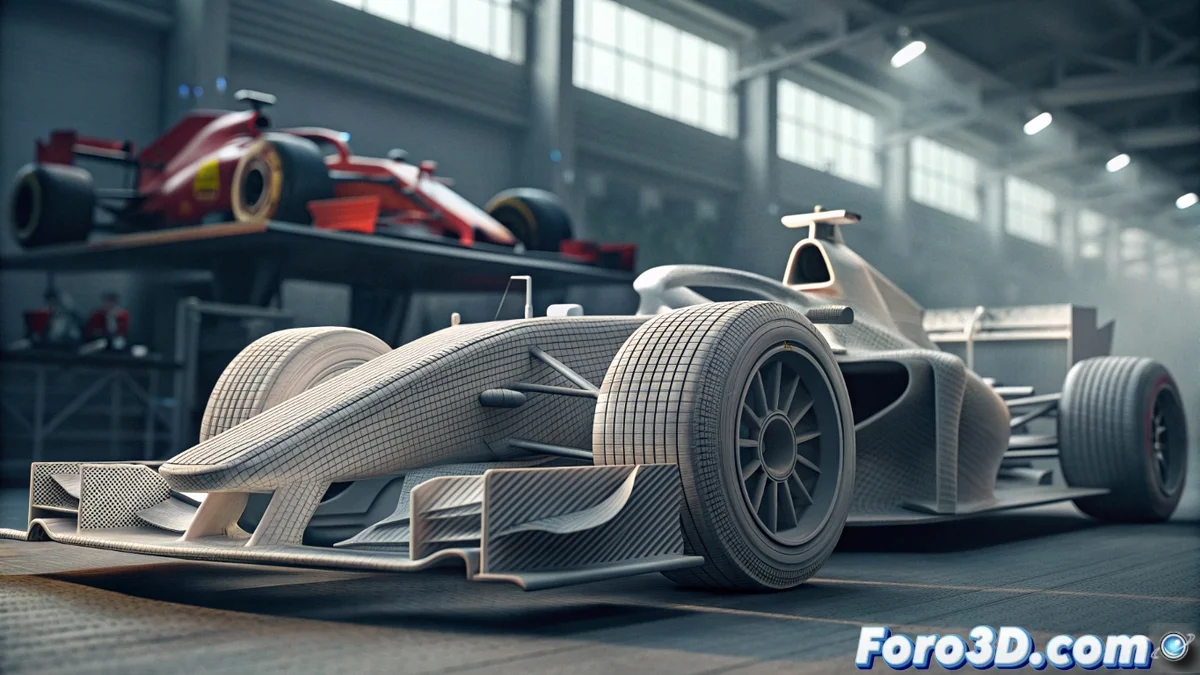
3D Printing as a Pillar of Innovation in the Alfa Romeo F1 Team
In the universe of Formula 1, where the difference between the podium and obscurity is measured in milliseconds, 3D printing has ceased to be an auxiliary technology to become a fundamental strategic asset. The Alfa Romeo F1 Team is a top-level exponent, using additive manufacturing to produce over three hundred parts annually that go straight to the race car. This approach revolutionizes design cycles, allowing rapid adaptation to the dynamic demands of the world championship. 🏎️⚙️
From Blueprints to the Track: Components Manufactured with Additive Technology
The application goes far beyond the creation of simple prototypes. These are elements that withstand the extreme conditions of competition, where every gram of weight and every millimeter of shape is decisive. The ability of 3D printing to materialize impossible geometries with traditional subtractive methods is its greatest advantage.
Critical parts manufactured using additive technology:- Cooling and fluid ducts: High-efficiency internal labyrinths to manage temperatures in the engine and electronic systems, optimizing airflow or liquid in ways unattainable with milling.
- Highly complex aerodynamic elements: Deflectors, fins, and low-profile components with organic surfaces that are constantly redesigned to squeeze every point of aerodynamic downforce.
- Precision tooling and tools: Custom mounting supports, verification templates, and alignment devices that streamline garage processes and ensure absolute repeatability, reducing human errors.
"Additive manufacturing gives us unprecedented design freedom and a reaction speed that is crucial in a schedule as tight as F1's." - Team development engineer.
Competitive Advantages that Make the Difference
The integration of this technology provides the Swiss team with a multidimensional advantage. It is not limited to manufacturing faster, but to innovating more boldly and efficiently.
Key benefits on the starting grid:- Ultra-fast iteration: A concept can go from the CAD screen to a functional part in the wind tunnel or on the car in a matter of hours, allowing testing of solutions between free practice sessions or during the scarce testing periods.
- Mass and aerodynamics optimization: The creation of lightweight and rigid structures with optimized topologies directly contributes to weight reduction and airflow efficiency, key factors for lap performance.
- Logistical flexibility and resilience: The capability of on-demand manufacturing minimizes spare parts inventories and allows responding to last-minute contingencies (such as damage from incidents) with an agility that redefines Grand Prix management.
Conclusion: An Indispensable Technological Ally
3D printing has established itself as the perfect ally for the Formula 1 philosophy. In a sport governed by constant innovation and relentless deadlines, it offers the unique combination of speed, design freedom, and precision. For the Alfa Romeo F1 Team, it is not just a manufacturing tool; it is a capability multiplier that allows challenging the limits of physics and logistics. After all, in the pursuit of perfection, having a revolutionary component ready in record time is always better than regretting not having it. 🏁✨