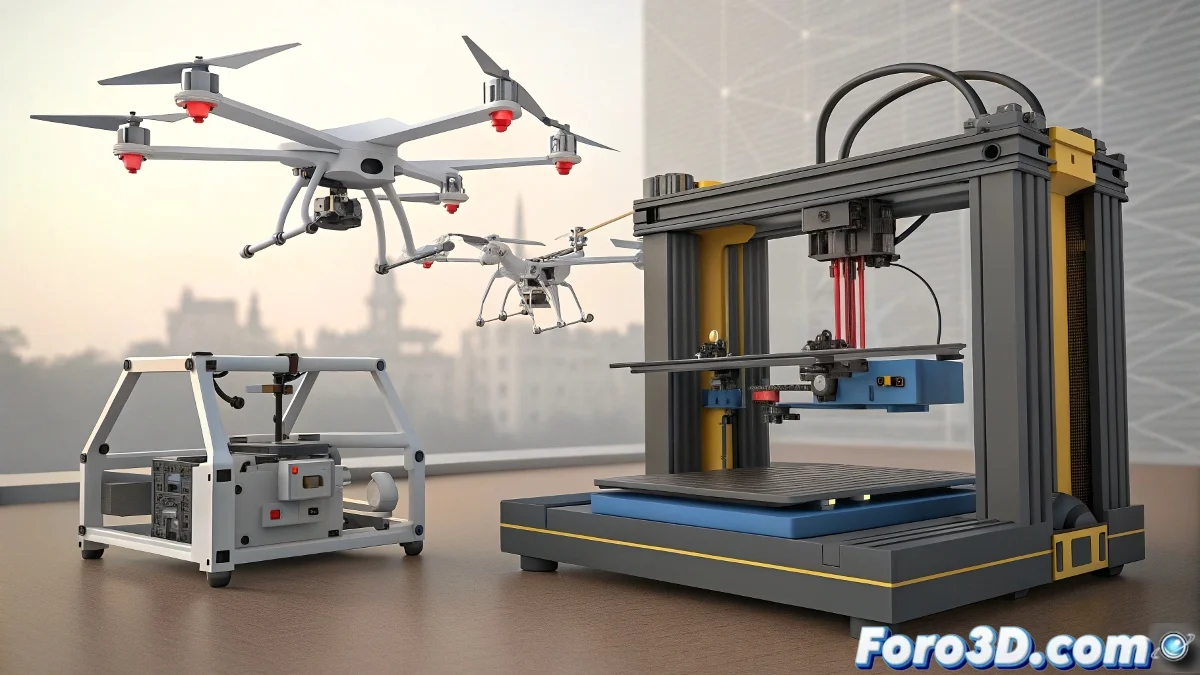
The Double-Edged Sword of 3D Printing: Drones for Defense and Ghost Guns for Crime
3D printers are proving to be a double-edged tool in modern conflicts, being used intensively in Ukraine to manufacture military drones while simultaneously fueling global concerns over the production of untraceable ghost guns. This technology, which democratizes manufacturing, is creating a completely new paradigm in armament production where anyone with a 3D printer and digital files can become a weapons manufacturer, bypassing traditional controls and posing unprecedented challenges for international security. 🖨️⚔️
The Ukrainian Phenomenon: 3D Printing as a Defense Weapon
In Ukraine, 3D printing has become a crucial component of the defensive effort, enabling the rapid and decentralized production of military drones that are proving vital in the conflict.
Military Applications of 3D Printing in Ukraine
The use of this technology has evolved from improvised solutions to organized production systems that supply critical components to the front lines.
FPV Drone Manufacturing
3D printers produce lightweight and customized structures for FPV attack drones, allowing rapid adaptations based on specific tactical needs and enemy countermeasures.
Specialized Components
From grenade launchers to release mechanisms for munitions, 3D printing enables the creation of parts that would be impossible to obtain through traditional channels under logistical blockade.
Demonstrated Tactical Advantages:- Distributed production resistant to attacks
- Rapid iteration of designs based on field lessons
- Independence from international supply chains
- Reduced costs compared to traditional manufacturing
The Dark Side: Ghost Guns and Organized Crime
Parallel to defensive use, the same technology is being exploited by criminal groups to produce untraceable weapons.
Untraceable Ghost Guns
These weapons, fully manufactured with 3D printing, lack serial numbers and traditional metadata, making it virtually impossible to trace them back to the original manufacturer or owner.
Decentralized Production
Digital files for printing weapons can be instantly shared via the internet, creating a global production network that evades all traditional border controls.
The same technology that allows Ukraine to defend its sovereignty also enables criminal organizations to arm themselves with impunity. 3D printing has broken the state's monopoly on weapons production.
Typology of 3D Printed Weapons
The spectrum of armament that can be produced via 3D printing is surprisingly broad and sophisticated.
Fully Functional Firearms
From single-use pistols to assault rifles, designs have evolved from rudimentary prototypes to reliable weapons capable of firing multiple rounds.
Critical Components
Even when barrels and certain metal parts still require traditional manufacturing, structural components and mechanisms can be printed, significantly reducing production complexity.
Challenges for Regulation and Control
The distributed nature of this technology challenges existing regulatory frameworks designed for an era of centralized manufacturing.
Limitations of Traditional Controls
Gun control laws based on manufacturing, importation, and sales are ineffective when anyone can become a manufacturer in their own home.
Detection and Prevention
The detection of these weapons in security checks is complicated by the use of plastic materials that can evade traditional scanners designed for metals.
Identified Security Issues:- Impossibility of traditional ballistic tracing
- Evasion of metal detectors
- Instant global distribution of designs
- Anonymous and decentralized production
Legislative and Technological Responses
Governments and international organizations are developing strategies to address this new challenge.
Regulatory Initiatives
Some countries are considering licensing requirements for capable 3D printers or criminalizing the possession of files for printing weapons.
Mitigation Technologies
Specific detection systems for high-density plastics and software that can identify weapon designs in digital files are being developed.
Geopolitical and Security Implications
The democratization of weapons production through 3D printing has profound consequences for the global balance of power.
Empowerment of Non-State Actors
Insurgent groups, criminal organizations, and terrorist actors can now produce their own sophisticated weapons without relying on state sponsors or black markets.
New Types of Conflicts
The ease of production could lead to more distributed and harder-to-contain conflicts, where escalation does not require complex industrial infrastructures.
The Future of 3D Printing in Conflicts
The trend suggests that the role of 3D printing in war and crime will continue to expand and become more sophisticated.
Advanced Materials
The development of more resistant composites and metal-plastic composite materials will enable the production of more reliable and durable weapons.
Production Automation
Integration with assembly robots and automated quality control systems could create fully autonomous and distributed weapons factories.
3D printing has opened a new frontier in armament production that presents both unprecedented opportunities and threats. While in Ukraine it represents a vital tool for national defense, globally it poses fundamental challenges for international security and arms control. The global community faces the difficult task of finding a balance between harnessing the benefits of this technology and mitigating its dangers, in a context where traditional solutions may prove insufficient against a manufacturing revolution that puts the power to make weapons within anyone's reach. 🌐⚠️