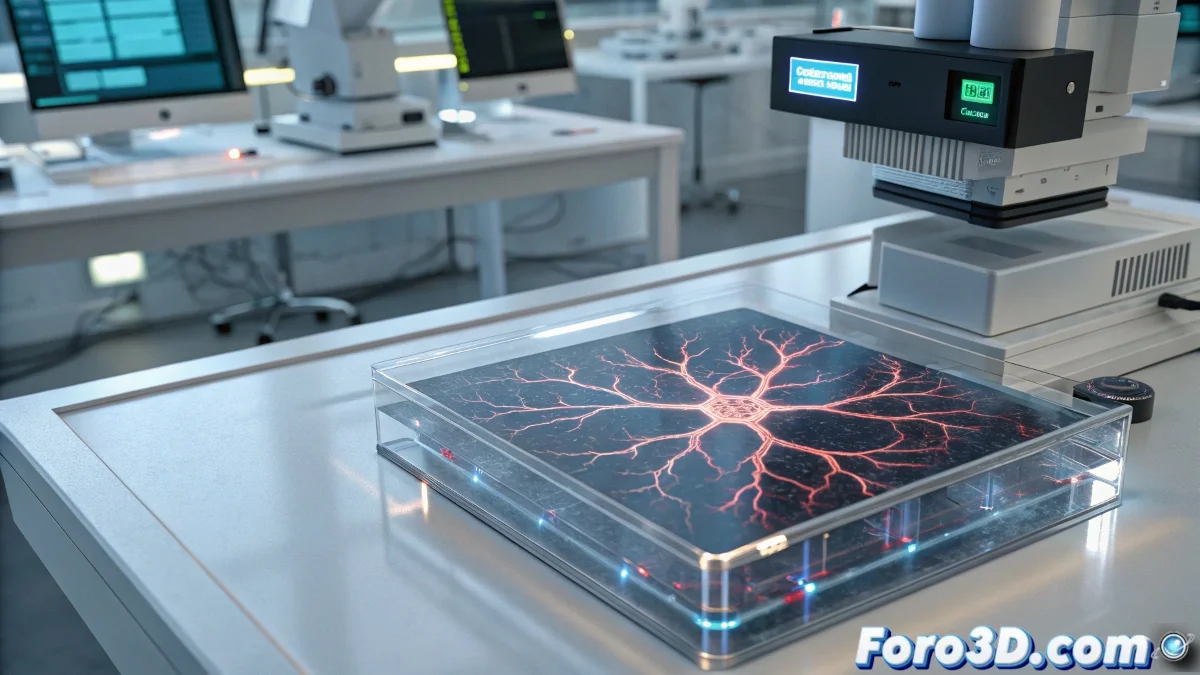
3D-Printed Neural Networks That Mimic the Human Brain
The prestigious KAIST has taken a giant leap at the intersection of biology and 3D technology. Its new platform allows printing neural networks using hydrogels that not only replicate the texture of brain tissue, but also measure electrical activity. 🧠⚡
It's like having a miniature brain that thinks… though probably only in differential equations.
Biological Modeling with Science Fiction Precision
The system uses high-precision 3D printing to create multilayer structures that keep neuronal cells alive. Unlike other methods, here the shape of synaptic connections is controlled, allowing the recreation of a functional brain environment. For 3D artists, this sounds like the ultimate challenge in organic modeling. 😅
If you work with Blender or similar tools, imagine trying to recreate this with:
- Branching procedural geometry
- Particle systems with organic growth
- Custom shaders to simulate electrical activity
A Brain That Not Only Looks Real, But Acts Like One
The real magic is that these printed networks are not just static sculptures. Researchers can observe how electrical impulses propagate in real time, something that could revolutionize the study of neurodegenerative diseases. And all this while you're still fighting with the vertices of your latest 3D model. 😂
Among the potential applications are:
- Drug testing without risk to patients
- Advances in brain-machine interfaces
- New approaches to treating Alzheimer's or Parkinson's
So the next time your 3D software crashes, think at least you're not trying to make an artificial brain work. That's a real existential bluescreen. 🤖💥