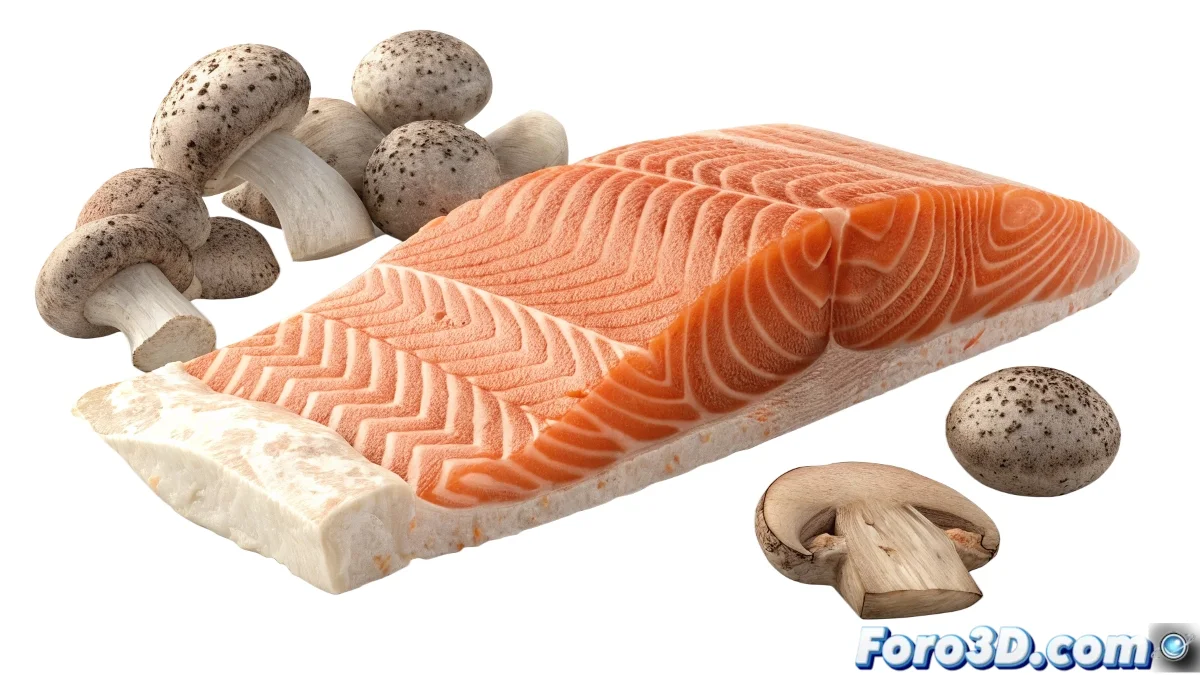
Salmon 3.0: The Mushroom Fillet That Tricks the Palate and Saves the Oceans
The revolution in sustainable foods reaches a new milestone with the development of a salmon fillet created through 3D printing based on mushroom mycelium, an innovation that promises to transform the fishing industry. This biotechnological advance not only replicates the scaly and juicy texture of real salmon, but also reproduces its complete nutritional profile, including omega-3 fatty acids, through precision fermentation processes. The result is a convincing alternative to traditional fish that requires a fraction of the resources and does not contribute to overfishing. 🍄🐟
The Science Behind Fungal Salmon
The development combines advanced mycology with 3D bioprinting technology to create a structure that mimics the complex muscle fibers of salmon. The mycelium —the root network of fungi— is cultivated in specialized bioreactors where it is stimulated to develop specific textures before being processed as "ink" for 3D food printing.
Creation Process of the Printed Fillet
The production of mushroom salmon involves a multi-stage process that combines biology and precision engineering.
Cultivation of Specialized Mycelium
Specific fungal strains are selected for their nutritional profile and textural properties, then cultivated under controlled conditions that favor the development of fibrous structures similar to fish muscle.
Precision 3D Bioprinting
Specialized 3D printers deposit the biomaterial layer by layer with specific orientation, recreating the scaly texture and characteristic fat veins of wild salmon.
Process Stages:- Selection and cultivation of specific fungal strains
- Fermentation in bioreactors for textural development
- Formulation of food "ink" with nutrients
- 3D printing with temperature and humidity control
Nutritional and Sensory Characteristics
Mushroom salmon not only seeks to imitate the fish experience —it surpasses certain nutritional aspects while maintaining gastronomic pleasure.
Enhanced Nutritional Profile
Through biofortification, the product contains optimized levels of omega-3, complete protein, and vitamin D, with the additional advantage of being naturally low in heavy metals and oceanic contaminants.
Authentic Sensory Experience
Consumer tests reveal that the fillet replicates the scaly texture, characteristic pink color, and umami flavor of real salmon, even flaking similarly when cooked.
We are not growing fish in tanks —we are cultivating its essence from nature's oldest roots, using fungi as microscopic factories of flavor and nutrition.
Environmental Advantages and Sustainability
The positive impact of this technology on the environment represents one of its most transformative aspects.
Reduction of Oceanic Pressure
Each fillet produced means less capture of wild salmon and reduction of the problems associated with intensive aquaculture, including antibiotic pollution and impacts on local ecosystems.
Resource Efficiency
The process requires 95% less water and 90% less land than conventional salmon production, while generating significantly fewer greenhouse gas emissions.
Applications and Commercial Potential
This technology opens new possibilities for the food industry beyond salmon replacement.
Industrial Scalability
The process is highly scalable and reproducible, with potential to establish itself as a standard method for producing alternative proteins in the next decade.
Nutritional Customization
3D printing allows adapting the nutritional profile to specific needs —from enriched versions for athletes to pediatric formulations— something impossible with traditional fish.
Competitive Advantages:- Production independent of weather conditions
- Absence of parasites like anisakis
- Consistent quality and year-round availability
- Possibility of local production near markets
Technical Challenges Overcome
The development faced and resolved significant challenges in engineering and food science.
Replication of Complex Texture
The layered structure of salmon muscle was particularly difficult to imitate, requiring the development of specialized printing algorithms that control fiber orientation at the microscopic level.
Cooking Stability
Ensuring that the fillet maintains its structural integrity when cooked represented another major challenge, solved through the use of natural binders derived from algae.
The Future of Food Bioprinting
The success of the mushroom salmon fillet ushers in a new era in protein production.
Expansion to Other Species
The technology is being adapted to replicate other fish and seafood such as tuna, shrimp, and scallops, with prototypes showing promising results.
Integration with Other Technologies
Future iterations will combine bioprinting with cell cultivation and precision fermentation to create hybrid products that offer even closer experiences to the original.
The 3D-printed mushroom-based salmon fillet represents more than a scientific curiosity —it is a crucial step toward more resilient and ethical food systems. By offering a convincing alternative to traditional fish, this technology has the potential to relieve pressure on marine ecosystems while providing high-quality nutrition for a growing global population. In the not-too-distant future, the best salmon on the market might not come from the ocean, but from bioreactors that transform humble fungi into sustainable gastronomic delights. 🌱🔬