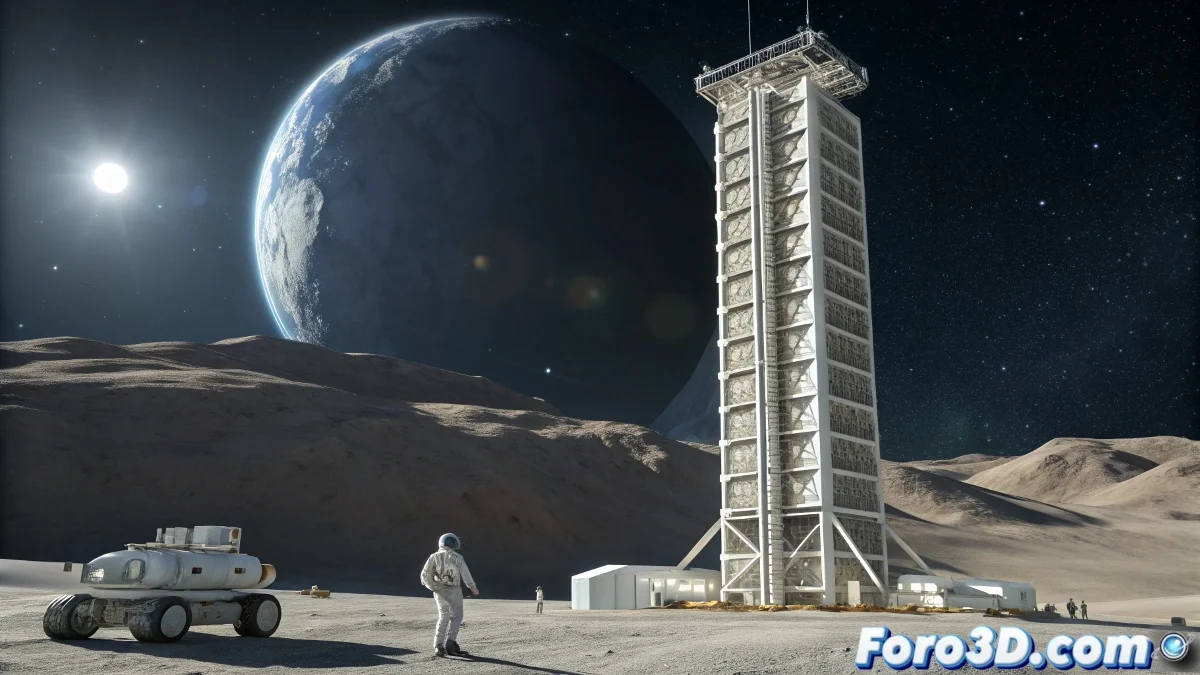
When 3D Printing Reaches New Heights... Literally
Foster + Partners has taken architecture where no architect has gone before: designing a 50-meter lunar skyscraper to be printed with Moon dust 🚀. While on Earth we're still arguing about building permits, they're already solving how to build in reduced gravity with printers that operate at -173°C. Take note, earthlings.
Extraterrestrial Engineering in 3 Steps
- Local Material: Lunar regolith (that dust Armstrong stepped on) becomes printing ink
- Adapted Technology: Modified 3D printers to function in a vacuum and extreme temperatures
- Integrated Energy: Curved solar panels that are structural skin and power source
"We are not building a structure, we are printing an entire ecosystem" - explains the team behind the project that will make Earth's skyscrapers look like child's play.
How to Model a Lunar Dream from Earth
While the printers travel to space, 3D artists can already work on:
- Structural Simulations: Load analysis in 1/6 gravity with plugins like Karamba3D
- Atmospheric Renderings: Lunar lighting without atmospheric scattering in V-Ray/Arnold
- Regolith Textures: PBR libraries for that gray dust that sticks to everything
- Construction Animations: Timelapses of printing in extreme conditions
Data That Defies Gravity
| Parameter | Value | Technical Challenge |
|---|---|---|
| Height | 50m | Equivalent to 300m in Earth's gravity |
| Printing Time | ≈3 Earth months | Only during the lunar day (14 continuous Earth days) |
| Wall Thickness | 1.2m | Protection against radiation and micrometeorites |
Lessons for Earthbound Architects
This project teaches:
- Organic structures inspired by biological forms for maximum strength
- Total integration of systems (energy, life support, structure)
- Radical use of local materials (zero material transport)
- Parametric design taken to the extreme
The Cosmic Irony
While lunar architects solve how to print in a vacuum, many studios on Earth still struggle with 3D printers that can't handle a draft. Perhaps the real technological leap isn't reaching the Moon... but making our tools work as well as they will up there. 🌕
So now you know: the next time your client asks for something "out of this world," you now have literal references. Just remember that on the Moon there's no building code... but mistakes cost oxygen.