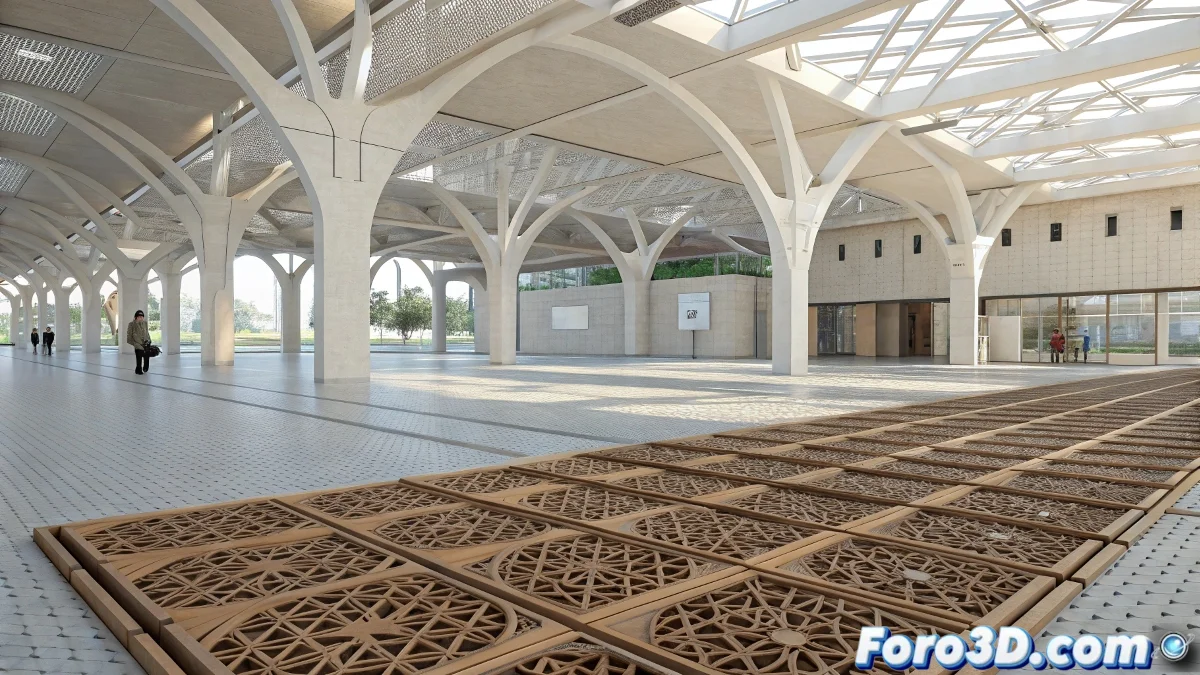
When 3D Printing Redefines the Foundations of Construction
Autodesk Research, in collaboration with Additive Tectonics, has developed a revolutionary 3D printed floor system that challenges the conventions of traditional construction. 🏗️🌱 This innovative approach combines additive manufacturing, generative design, and alternative materials to create efficient floor structures that significantly reduce concrete usage and the associated carbon footprint. The project represents a crucial step toward more sustainable and technologically advanced construction methods.
Revolution in Materials and Manufacturing
The system uses sustainable composites that partially replace traditional cement—material responsible for approximately 8% of global CO2 emissions. 🔄 Additive manufacturing enables the creation of structures with optimized geometries that maximize strength while minimizing material volume, using alveolar and organic patterns inspired by biomimetic principles. This structural optimization is impossible to achieve with conventional construction methods.
This Autodesk Research project exemplifies how the convergence of computational design, digital manufacturing, and materials science can transform traditional industries toward sustainability without compromising structural performance.
Technical and Environmental Advantages
The system offers multiple benefits that address critical challenges of modern construction: 📊 Reduction of up to 40% in material usage compared to traditional slabs, decrease in waste through precise additive manufacturing, and the possibility of using local and recycled materials in the composites. Modular prefabrication accelerates construction times and reduces on-site disruption.
Practical Applications and Scalability
- Modular Building: Prefabricated floor panels for rapid and efficient construction.
- Industrial Flooring: Lightweight and resistant solutions for logistics warehouses and storage facilities.
- Urban Infrastructure: Applications in urban furniture, plazas, and public spaces.
- Architectural Customization: Designs adapted to specific project needs.
Integration with Digital Tools
The workflow incorporates Autodesk tools for generative design and simulation, allowing engineers to optimize panels for specific loads and local conditions. ⚙️ Performance data is used to iteratively refine design algorithms, creating a virtuous cycle of continuous improvement. Digitization of the process facilitates mass customization and quality control through scan-to-BIM verification.
Future of Sustainable Construction
This development positions 3D printing as a viable technology for primary structural applications, not just decorative or non-critical elements. 🚀 The ability to print with alternative materials opens possibilities for circular economies in construction, where demolition waste can be reused as raw material for new structures, potentially transforming the entire industry.
Thus, as the construction industry seeks to reduce its environmental impact, innovations like this demonstrate that the future can be both sustainable and technologically advanced… although your feet probably won't notice the difference between traditional concrete and cutting-edge composites. Because in the construction of the future, the only thing that should leave a footprint is innovation, not carbon. 😉