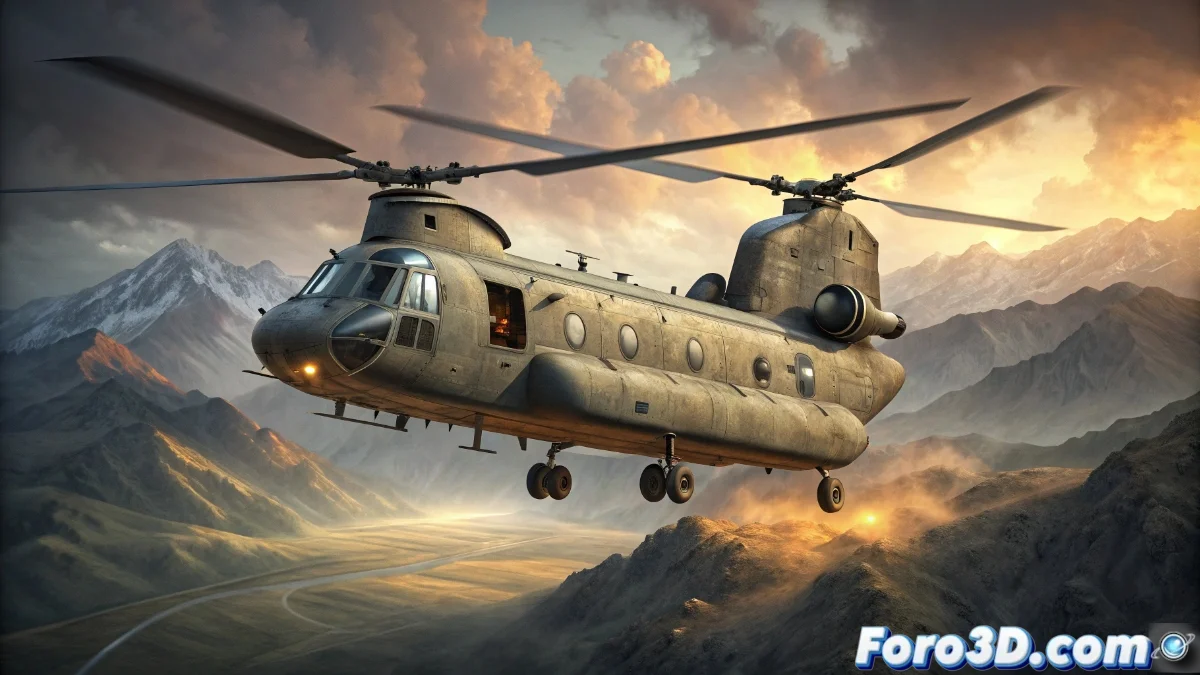
3D Modeling of the CH-47 Chinook Helicopter: Dimensions and Technical Specifications
The CH-47 Chinook represents one of the most iconic heavy-lift helicopters in American aviation, with impressive dimensions that must be meticulously replicated in any 3D modeling project. Its main fuselage reaches 15.4 meters in length, while the total rotor span is 30.1 meters and a height of 3.78 meters 🚁.
Fundamental Structural Configuration
The Chinook's architecture is distinguished by its tandem rotor system, an ingenious solution that provides exceptional lifting capacity for heavy loads. The integrated rear ramp is another crucial element, allowing rapid loading and unloading operations for both personnel and specialized military equipment.
Critical Dimensional Elements:- Main fuselage of 15.4 meters with reinforced composite materials
- Counter-rotating rotor configuration that eliminates torque effect
- Hydraulic rear ramp with full-opening mechanisms
Dimensional precision is not just a matter of measurements, but of understanding how each component contributes to the helicopter's operational functionality.
Defensive Systems and Their 3D Representation
For scenarios requiring defensive capability, the Chinook can be equipped with mounted machine guns in side positions and on the rear ramp. The main options include the 7.62 mm M134 Minigun, recognized for its devastating rate of fire, and the versatile same-caliber M240, widely used across multiple military platforms.
Considerations for Armament in 3D:- Exact location of mounting points on fuselage and ramp
- Operation mechanisms and ammunition feed systems
- Precise scale between armament and main helicopter structure
Advanced Three-Dimensional Modeling Techniques
Developing a professional 3D model of the Chinook requires meticulous attention to technical details such as the counter-rotating rotor configuration and the complex hydraulic mechanisms of the rear ramp. Texturing must faithfully capture the different materials of the fuselage, from composites to metal alloys, while animations can incorporate realistic rotor movements and loading operations.
The consistent scale between all components is fundamental to maintaining the visual integrity of the model in any application, demonstrating that the capacity to transport massive loads depends on precise engineering where each element fulfills a specific function ✈️.