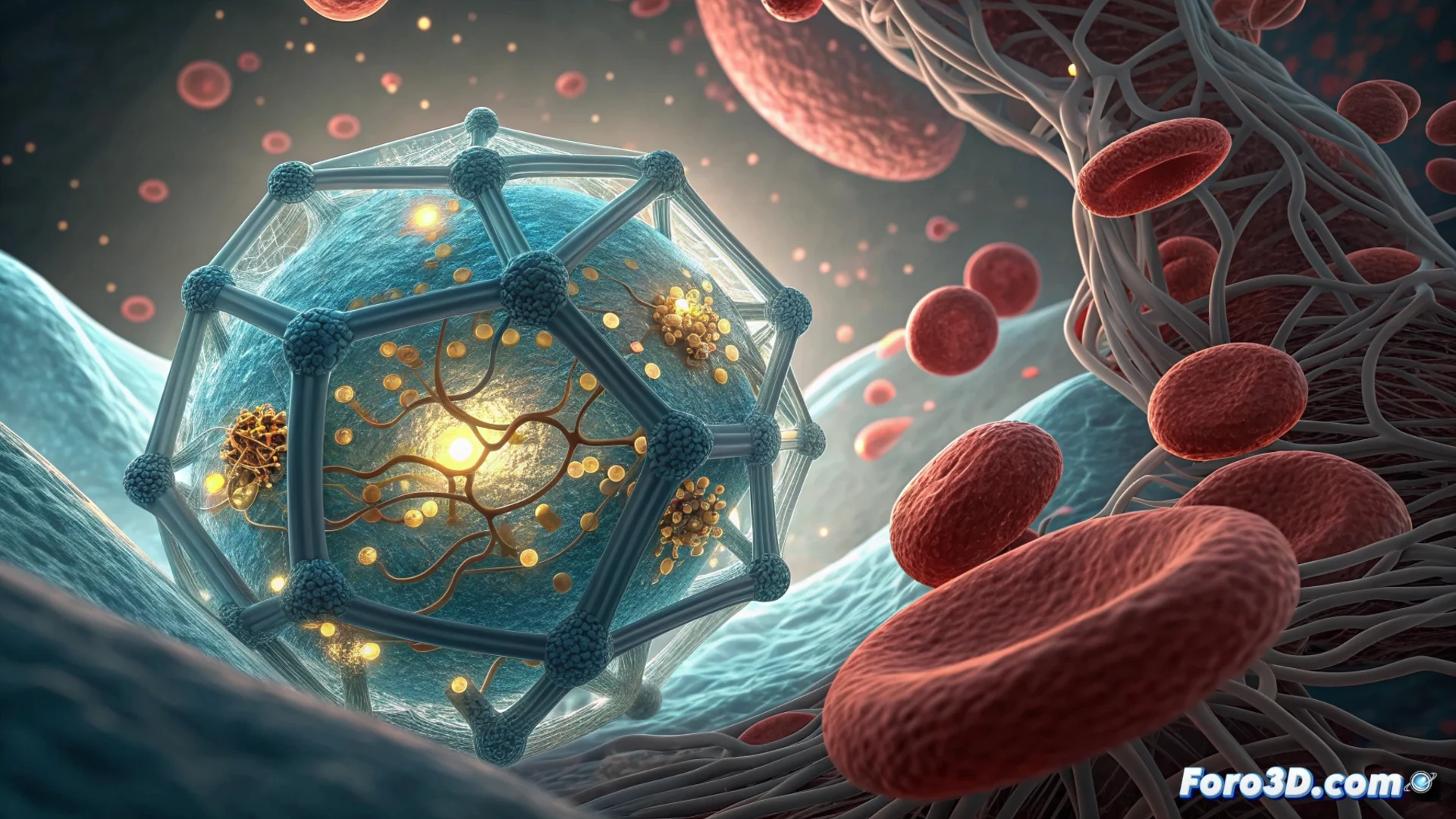
3D Hydrogel Transistors Speak the Language of Cells
Traditional electronic technology, which is dry and rigid, encounters a fundamental barrier when trying to connect with the biological environment, which is wet and malleable. To bridge this gap, scientific research now fabricates three-dimensional transistors using hydrogels. These materials, which resemble programmable gelatin, incorporate water and polymers capable of transporting both ions and electrons. This dual property enables them to communicate directly with the signals of living beings, which are often ionic in nature, while also processing electronic data. In this way, these components establish an essential link between silicon circuits and organisms. 🔬
The 3D Architecture Replicates the Nature of Living Tissues
Unlike conventional flat chips, these devices are built with porous three-dimensional architectures. This design allows nutrients, signaling molecules, and even cells themselves to flow through the device. The properties of the hydrogel can be altered to react to specific stimuli, such as changes in acidity (pH), temperature, or the detection of specific biomolecules. By integrating various layers and types of 3D transistors, scientists can design circuits that mimic the functions of basic tissues, approaching a genuine fusion between the artificial and the organic.
Key Features of the 3D Structure:- Allows the flow of vital substances and cells through its porous matrix.
- Can be programmed to respond to environmental changes such as pH or temperature.
- Facilitates combining multiple types of transistors to emulate simple tissues.
We are leaving behind the era of inflexible silicon to adopt an electronics that literally adapts and softens.
Applications Focus on Connecting with Biological Systems
The main field for applying this innovation is bioelectronics and tissue repair medicine. Implantable sensors are envisioned that continuously monitor health indicators and administer medications autonomously. In the field of soft robotics, these transistors could function as artificial nerves to direct movement in elastic materials. Their use is also being explored to create more biocompatible brain interfaces, which would reduce the inflammatory reaction of neural tissue to the implant. 🧠
Main Fields of Application:- Bioelectronics and implantable medical devices for monitoring and treatment.
- Soft robotics, providing neural control to flexible materials.
- Safer brain-machine interfaces with better biological integration.
A Future of Perfect Integration
Imagine a future where repairing a damaged organ involves attaching a smart hydrogel patch that not only closes the wound but also regulates functions and transmits information. It sounds like science fiction, but it's the direction in which progress is being made. This advance represents a crucial step toward abandoning cold electronics and adopting systems that can interact organically with life itself. The bridge between machine and biology is being built with materials that understand both languages. 🌉