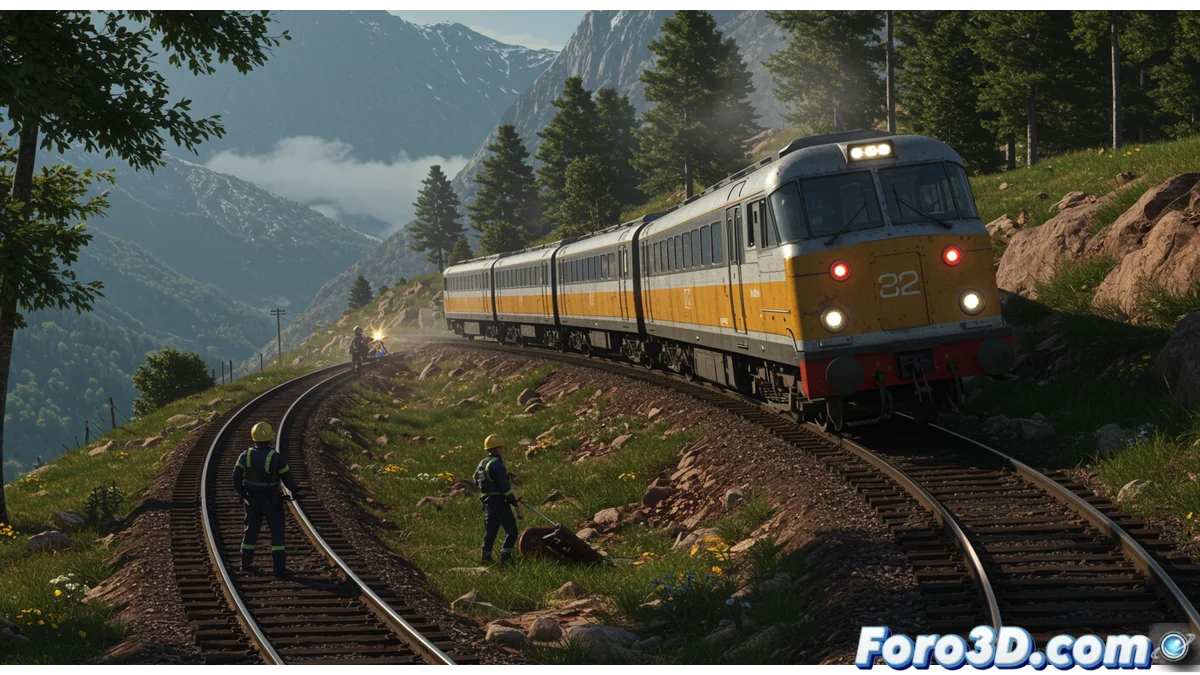
3D Forensic Reconstruction of Railway Derailments
When a railway accident occurs in mountainous curves, conventional investigative methods show serious limitations in reproducing the exact circumstances of the event. Three-dimensional digital forensics emerges as an advanced technological solution that provides irrefutable evidence through precise capture of the physical reality. 🚄
Documentation via Precision Laser Scanning
The process begins with Trimble TX8 equipment that records every detail of the scene with millimeter accuracy. These scanners capture the complete geometry of the tracks, bogies, and related components, documenting everything from wheel wear to post-accident deformations. The resulting three-dimensional information constitutes an objective factual basis that eliminates speculation about the physical state of the involved elements.
Forensic Laser Scanning Advantages:- Millimeter-accurate recording of the real geometry of tracks and components
- Objective documentation of wheel wear and rail conditions
- Digital preservation of the accident scene for subsequent analysis
"3D technology allows us to see what the human eye cannot perceive: the hidden patterns behind every derailment"
Advanced Multibody Dynamic Simulations
Using the precise three-dimensional models as a base, multibody simulations are executed on platforms like Virtual Crash and LS-DYNA. These specialized tools digitally recreate the derailment event under multiple possible scenarios: excessive speed in curves, structural failures in bogies, or track irregularities. The simulations reveal how each variable influences the dynamic behavior of the train, identifying critical points and failure sequences that led to the accident.
Aspects Analyzed in Simulations:- Complex interactions between track and train under different conditions
- Identification of critical points and failure sequences
- Analysis of multiple causal scenarios of the derailment
Forensic Visualization for Judicial Expert Reports
Blender transforms complex technical data into comprehensible visual representations for experts and courts. The complete scene is reconstructed with animations showing the exact moment of the derailment, highlighting failed components using color schemes and transparencies. These visualizations facilitate the understanding of complex spatial relationships and communicate technical findings intuitively, being crucial for determining responsibilities between track maintenance, train operation, or manufacturing defects. 🎯
The Technological Paradox in Accident Investigation
It is ironic that we need such sophisticated technology to prove what any passenger intuitively senses: that trains must stay on the rails. However, this 3D forensic approach provides the compelling scientific evidence necessary to prevent future incidents and assign responsibilities on a solid technical foundation. The combination of laser scanning, dynamic simulations, and forensic visualization represents the new standard in railway accident investigation. 🔍