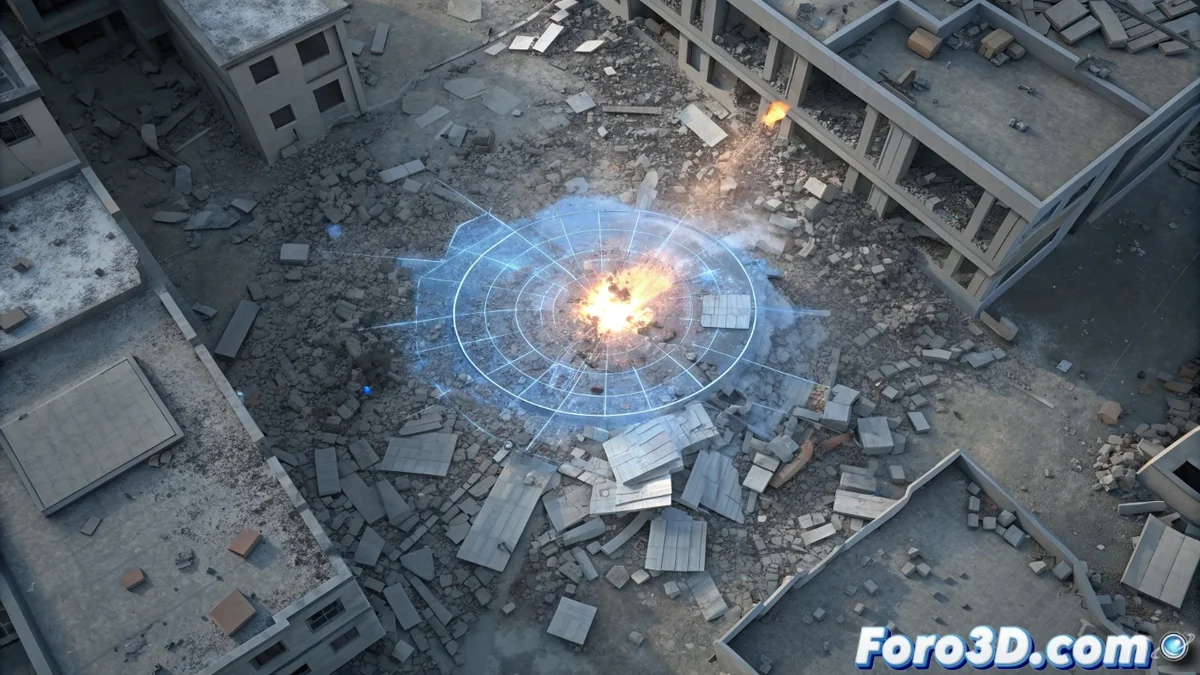
3D Forensic Reconstruction of Explosions: From Debris Chaos to Virtual Simulation
When an explosion occurs, the scene appears as absolute chaos. However, for specialists in digital forensics, those scattered debris are an open book written with the laws of physics. The key to reading it is a methodology that combines high-precision 3D capture, inverse computational analysis, and immersive visualization, creating an irrefutable technical narrative. 🔍
Photogrammetry: The First Step to Digitize Reality
The process begins with a thorough documentation of the site. Specialized teams take thousands of overlapping photographs of all fragments and damage within a wide radius. These images are processed in photogrammetry software, such as Agisoft Metashape, which generates a georeferenced 3D model with millimeter precision. This model becomes the definitive spatial database, allowing investigators to analyze the placement of each key piece without moving a single piece of debris from the original physical scene.
Key Advantages of the Photogrammetric Model:- Forensic Precision: Captures the exact location, orientation, and size of each significant fragment.
- Scene Preservation: Creates a permanent and unalterable digital record of the post-event state.
- Collaborative Analysis: Allows multiple experts to study the same scene remotely and simultaneously.
"What is a disaster for others is, for us, a perfectly ordered dataset by physics, waiting for us to give it a very powerful Ctrl+Z." - Forensic Explosives Expert.
Inverse Analysis and Shockwave Simulation
With the 3D debris model as a reference, investigators perform an inverse analysis or 'backwards analysis'. They study patterns such as dispersion vectors, fracture types in metals, and structural deformation. This data is fed into explosion simulation software like BlastFX. The method is iterative: different hypotheses about the epicenter (ground zero) location and charge power are tested. The software simulates the shockwave and fragment projection. The hypothesis whose simulation generates a virtual dispersion pattern most similar to the real 3D model is the one validated, determining with great accuracy the point of origin and the energy released in the detonation. 💥
Stages of the Simulation Process:- Physical Data Collection: Deformations, burn marks, debris direction.
- Parameter Setup: Explosive type, mass, confinement, and hypothetical location.
- Iteration and Validation: Constant comparison between the simulated result and the real photogrammetric model.
Immersive Visualization for Court Presentation
The final link in this forensic chain is the effective communication of the findings. For this, real-time rendering engines like Unreal Engine are used. First, the building or space is digitally reconstructed in its pre-explosion state. Then, the debris model and the validated explosion simulation are integrated. The result is an immersive cinematic visualization that shows the complete sequence: from the moment of detonation at the calculated epicenter to the final debris configuration. This tool allows judges, juries, and other experts to "walk through" virtually the scenario and understand the event's dynamics in a way that static reports could never achieve. 🎬
This digital forensic pipeline closes a complete cycle: from the faithful capture of the devastated reality, through the scientific validation of a physical hypothesis, to the clear and compelling communication of the technical truth. It demonstrates how 3D technology not only serves to create fantasy worlds but also to reconstruct and explain the most critical events in our real world.