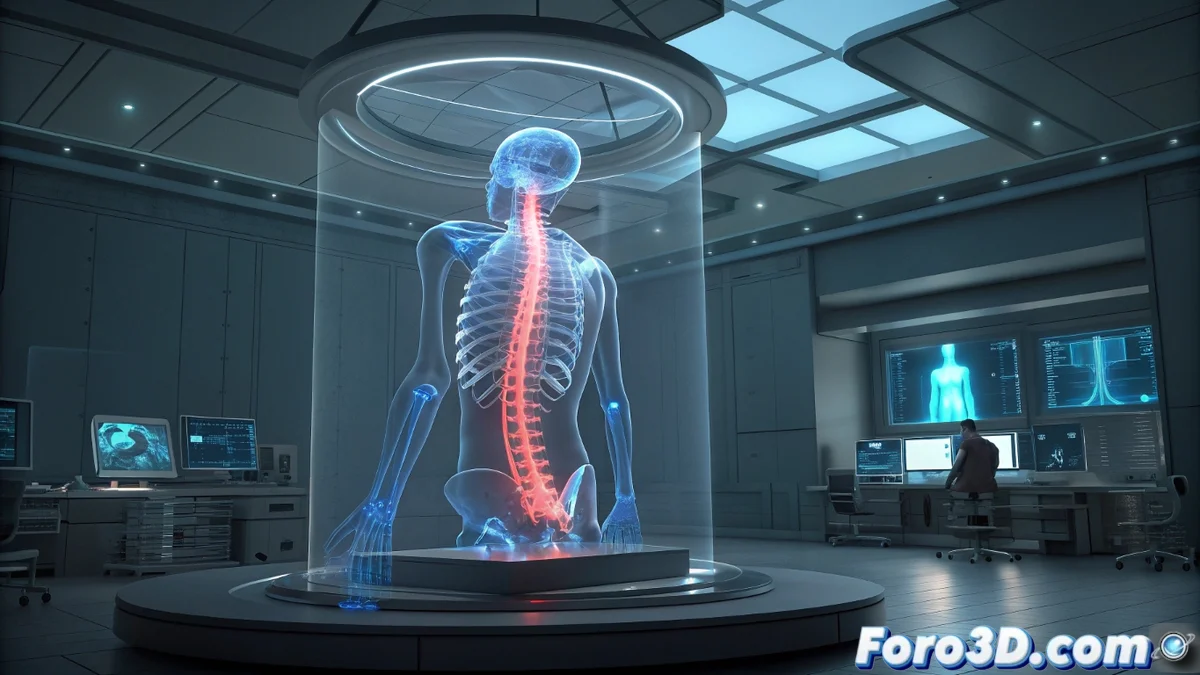
3D Forensic Reconstruction in Medical Procedures
In the legal field of medicine, an emerging area combines digital technology with expert investigation. This is forensic reconstruction of surgical interventions, where three-dimensional visualization has become an indispensable tool for clarifying responsibilities. This process transforms medical data into objective visual evidence. 🔬
The Technical Pipeline: From Data to 3D Model
The core of the process begins with medical image fusion. For a specific case, such as a lawsuit for nerve damage, preoperative Magnetic Resonance Imaging (MRI) volumes and postoperative Computed Tomography (CT) are integrated. The goal is to generate a unique and accurate 3D anatomical model of the patient, which will serve as the definitive digital scenario for forensic analysis.
Key Processing Phases:- DICOM Segmentation: Using software like 3D Slicer, InVesalius, or Horos, critical structures (bones, tissues, nerves) are isolated and extracted from the scans.
- 3D Mesh Creation: Each segmented structure is converted into a three-dimensional mesh faithful to the patient's anatomy at the time of each study.
- Export to General Environments: These meshes are prepared for import into 3D creation platforms for simulation and analysis stages.
The truth of a millimeter movement that changed a life is now sought in pixels and vertices.
Simulation of the Surgical Trajectory
The fused 3D model is taken to environments like Blender or Unity, sometimes with scientific visualization plugins to preserve real scale and coordinates. In this digital space, experts reconstruct the reported instrument trajectory (scalpel, needle, etc.), based on the surgical report and testimonies.
Forensic Analysis and Validation:- Animation and Overlay: The instrumental trajectory is animated and overlaid on the patient's 3D anatomical model.
- Deviation Measurement: It is verified with precision whether there was a deviation from the preoperative planning.
- Spatial Correlation: It is determined whether that deviation matches the location of the documented nerve injury in the postoperative study.
Conclusion: A Powerful Tool
This methodology creates powerful and objective visual evidence for the courts. The irony lies in the fact that digital tools created for entertainment or design, like Blender, are now fundamental for analyzing medical acts. 3D forensic reconstruction demonstrates how computer graphics technology transcends its origin, seeking justice through millimeter precision in a digital anatomical scenario. ⚖️