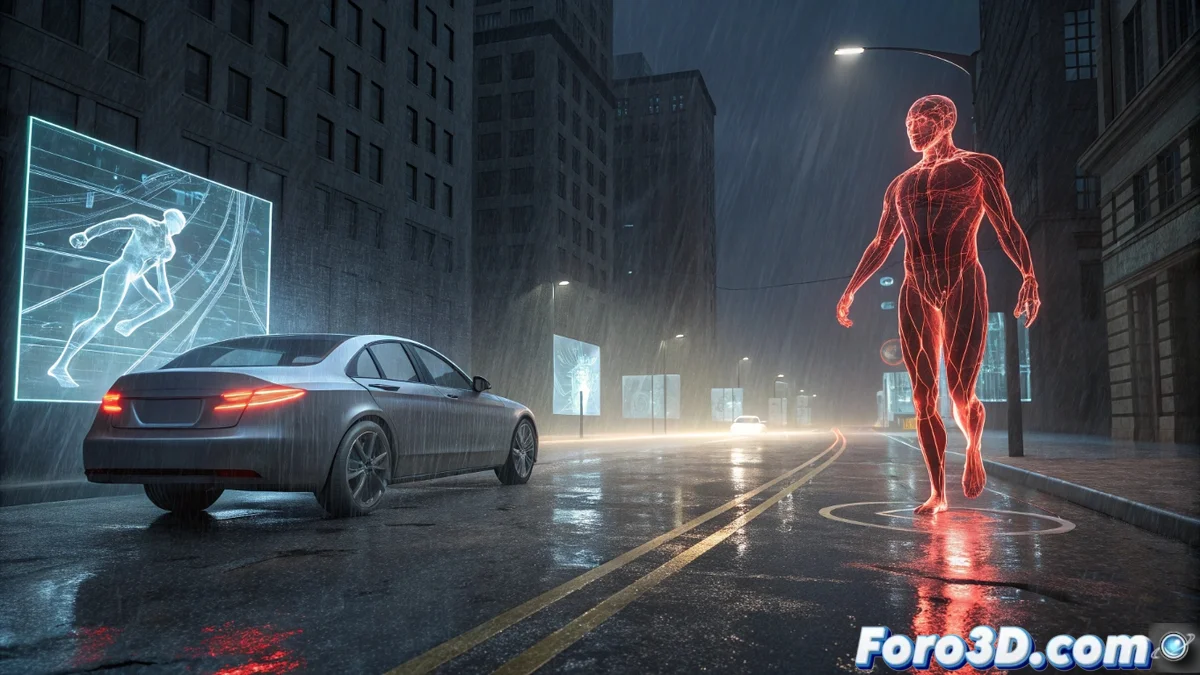
3D Forensic Reconstruction as a Key Weapon Against Simulated Hit-and-Runs
In the field of traffic accident investigation, three-dimensional forensic reconstruction has emerged as a disruptive technology to clarify complex and potentially fraudulent cases. One of the most common scenarios is the simulated hit-and-run, where a pedestrian claims severe injuries after minimal-speed vehicle contact, a narrative that often collides with the principles of physics. To uncover the truth, experts deploy a comprehensive digital pipeline that transforms real-world data into irrefutable scientific evidence. 🕵️♂️
From the Real World to the Virtual Environment: Scene Capture
The meticulous process begins with the millimetric documentation of all involved elements. Using high-precision laser scanners, the suspect vehicle and the entire accident scene are digitized, from tire marks on the asphalt to vertical signage. This digital twin serves as the objective and immutable foundation upon which the entire subsequent investigation is built, eliminating ambiguities about distances and positions.
Initial phases of digital reconstruction:- 3D scanning digitization: Capture of point clouds from the car and environment to create exact virtual models.
- Modeling and preparation: Processing of scanned data to generate optimized 3D meshes usable in simulation software.
- Establishment of initial parameters: Recording of all known variables declared by the parties, such as the point of impact and final positions of the bodies.
The fidelity of the 3D scene model is the pillar upon which the scientific credibility of the entire forensic reconstruction rests.
Simulating Impact Physics: The First Coherence Filter
With the virtual models ready, the next step is to recreate the collision dynamics. Specialized tools like PC-Crash take center stage here. Experts input the documented parameters—declared speed, collision angle, braking distance—and the software performs calculations based on the laws of mechanics. The result is a simulation that reveals the actual vehicle trajectory, the pedestrian kinematics in the first instants, and, most crucially, the actual impact speed and energy. These quantifiable values are the first objective indicator to assess the plausibility of the alleged victim's account. ⚙️
The Verdict of the Virtual Body: Biomechanical Analysis
The definitive piece of the forensic puzzle is the injury analysis. Is it biomechanically possible to suffer the alleged fractures or traumas with the calculated energy? To answer this, advanced computational biomechanics solutions, such as the Madymo software, are employed. In this environment, a detailed virtual human model, with simulated bones, joints, and tissues, is subjected to the exact forces derived from the previous simulation. The software analyzes stresses, accelerations, and forced movements, predicting with a high degree of certainty the expected type and severity of injuries. A flagrant discrepancy between the simulated injuries and those alleged constitutes powerful proof of simulation. 🦴
Key elements of analysis with virtual human models:- Validation of transferred energy: The impact force is compared with the known resistance of anatomical structures.
- Study of injury mechanisms: Analysis of how body movement during impact could generate specific damage patterns.
- Injury-speed correlation: Determination of whether the declared injuries are compatible with the scientifically calculated speed range.
From Data to Persuasion: 3D Animation as the Final Evidence
The final phase transforms complex scientific data into a comprehensible and compelling visual narrative. Using 3D creation programs like Blender, a forensic animation is generated that integrates all elements: the vehicle, the scanned environment, and the pedestrian model. This animation shows, sequence by sequence, the event's development according to the parameters validated by the simulation. Presented before a judge or court, it becomes an invaluable persuasion tool, clearly and irrefutably contrasting the version of events with the scientific reconstruction. Thus, a process that begins with a beam of laser light ends up being the definitive evidence in a trial, demonstrating that, against gravity and inertia, some stories simply do not hold up. 🎬