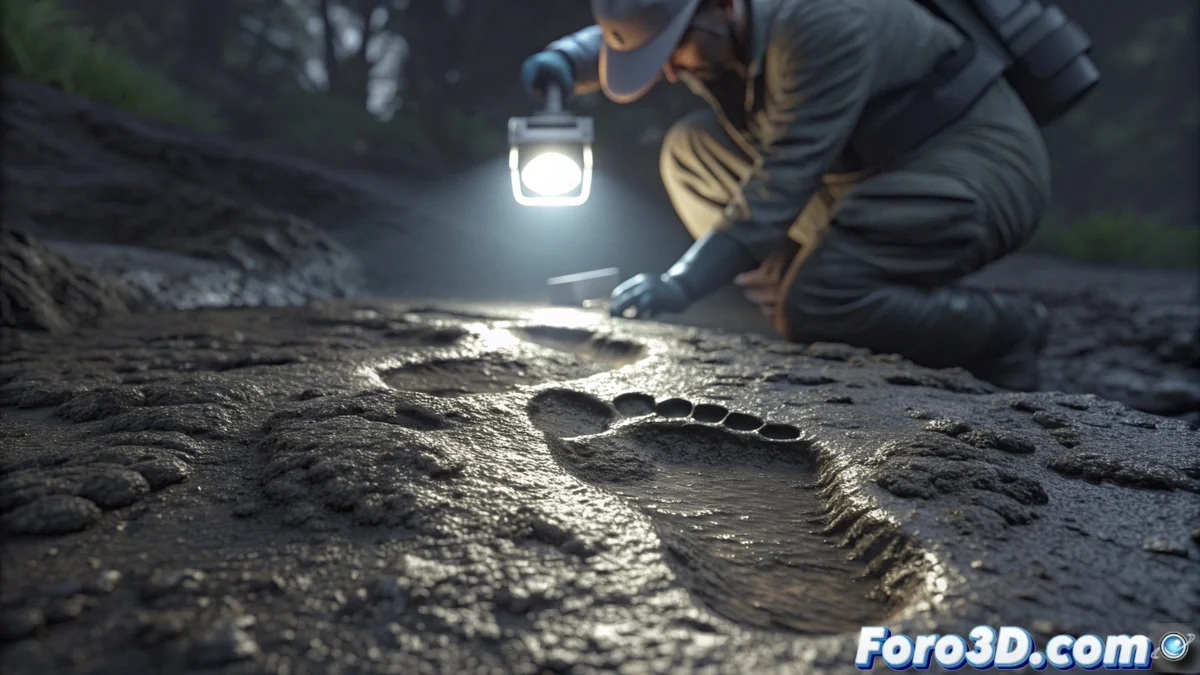
3D Forensic Analysis of Barefoot Prints in Mud
Imagine a crime scene where a simple footprint in the mud becomes a unique and irrefutable signature thanks to 3D technology. Instead of relying on flat photos that lose vital details, experts now use advanced scanners to capture every curve and depth with impressive accuracy. This not only elevates forensic investigation to a new level but adds a touch of technological innovation that fascinates 😎. In this article, we explore how these devices transform a footprint into compelling evidence.
Innovative Capture of Prints with 3D Scanners
In scenarios where wet mud preserves a barefoot print clearly, traditional methods like photography become obsolete compared to the power of a structured light 3D scanner. Tools like the Artec Space Spider or the Creaform Go!SCAN project light patterns onto the surface, and through high-resolution cameras, record the deformations to recreate a complete topography. This includes not only the depths and ridges, but also terrain variations that a 2D image could not reveal with absolute reliability, offering a three-dimensional perspective that enriches forensic analysis with hidden details 🚀.
Key steps in the scanning process:- Initial identification of the print in the mud, ensuring the environment is stable to avoid alterations.
- Setup of the 3D scanner to project light and capture data in real time, generating a dense point cloud.
- Immediate processing of the information to preserve the integrity of the evidence, avoiding natural degradation of the mud.
Unknowingly, the barefoot thief left more than a stain; he signed a detailed map of his anatomy in three dimensions.
From Point Cloud to Metrological Verification
Once the point cloud or polygonal mesh of the 3D model is obtained, the next step is to import it into specialized metrology software, such as PolyWorks Inspector. Here, forensics experts can precisely measure key morphological elements, such as arch curvature, pressure distribution, or distance between toes, and even detect scars or calluses. This approach allows superimposing the crime scene print model with a 3D scan of the suspect's foot, seeking detailed matches that go beyond a mere silhouette, adding a personal touch of scientific certainty 📏.
Advantages of digital comparison:- Exact measurement of distances, angles, and depths for an objective evaluation of anatomical features.
- Digital superimposition that facilitates the identification of unique patterns, such as specific foot deformations.
- Generation of visual reports that strengthen evidence in legal contexts, overcoming the limitations of two-dimensional methods.
Final Validation with Anthropometric Tools
To close the circle, the analysis deepens with anthropometry and forensic podiatry software, such as Anthro-Metric, which integrates biomechanical knowledge. These applications examine parameters like support morphology, height or weight estimation based on print dimensions, and combine precise data from PolyWorks with specialized interpretations. The result is a robust scientific report that confirms or rules out the suspect's connection to the scene, offering a much higher level of reliability than conventional approaches, all with an innovative touch that redefines modern justice 🌟.