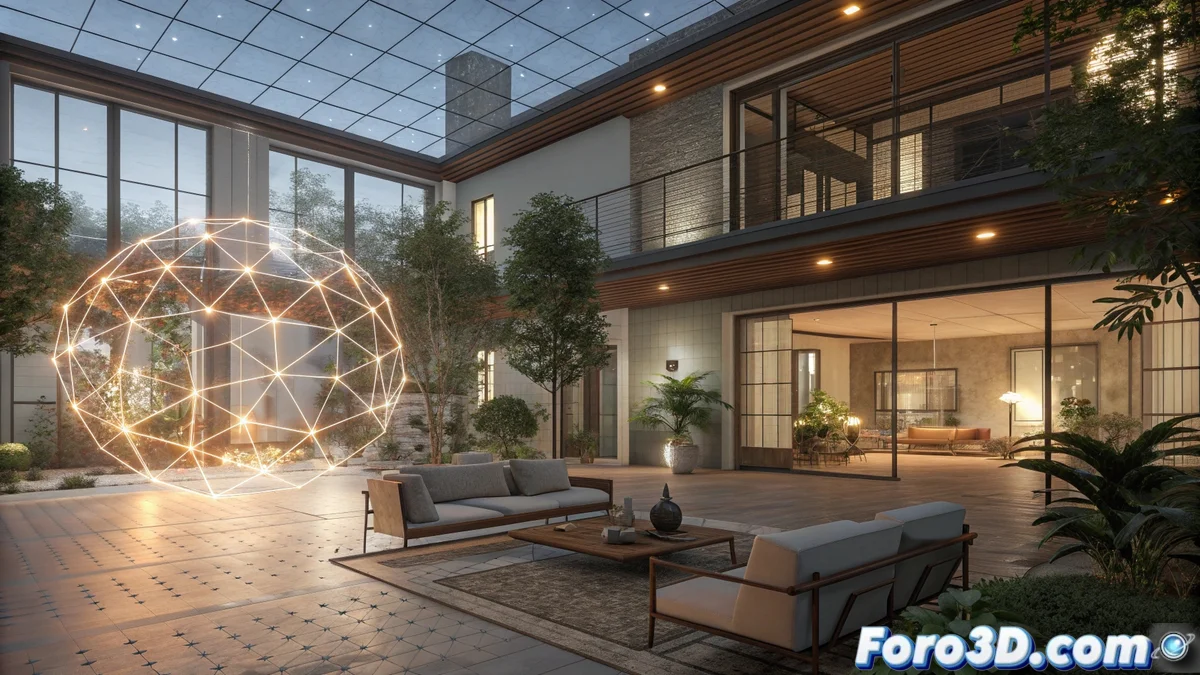
3D Creation Software Evolves Toward a Spatial Reasoning Core
The new generation of tools like Blender, Maya, 3ds Max, Unreal Engine, and Unity is no longer limited to manipulating geometry. Its core is now a system that reasons about space, organizing complete scenes autonomously and coherently. 🧠
A Core That Learns to Organize Space
These systems do not rely on predefined scene libraries. At their center, a trained object generator acts as a spatial reasoning engine. This core can place new elements in logical arrangements, even if it has never processed that specific type of scene. It analyzes geometry to understand fundamental relationships like proximity, support, alignment, and symmetry.
Key Advantages of This Approach:- Allows the user to interactively modify views and compositions without the program needing to recalculate the entire scene from scratch.
- Drastically reduces the need for manual adjustment of the position and scale of each individual element.
- Offers fast and fully automatic generation of credible scenes, starting even from a blank canvas.
The software becomes an intelligent system that understands and organizes space logically, not just renders isolated shapes.
Adaptability and Intuitive Workflow
This reasoning capability allows the software to adapt to unconventional layouts in architecture, video game development, or 2D illustration. Interaction with the artist is fluid: the user suggests or corrects, and the system responds while maintaining the global coherence of the scene.
How It Optimizes the Creative Process:- The artist focuses on artistic direction and the overall vision.
- The software resolves basic composition and spatial arrangement problems.
- The technology learns general organization principles, being able to extrapolate solutions to new scenarios without specific prior data.
The New Dynamic Between Artist and Machine
This advancement does not relegate the artist but redefines their role. Now they can discuss aesthetics and composition with the tool. Sometimes, the machine's proposed solution may be the most effective, generating fascinating reflection on the creative process and leading to rethinking traditional approaches. The tool emerges as a collaborator that understands space. 🤖