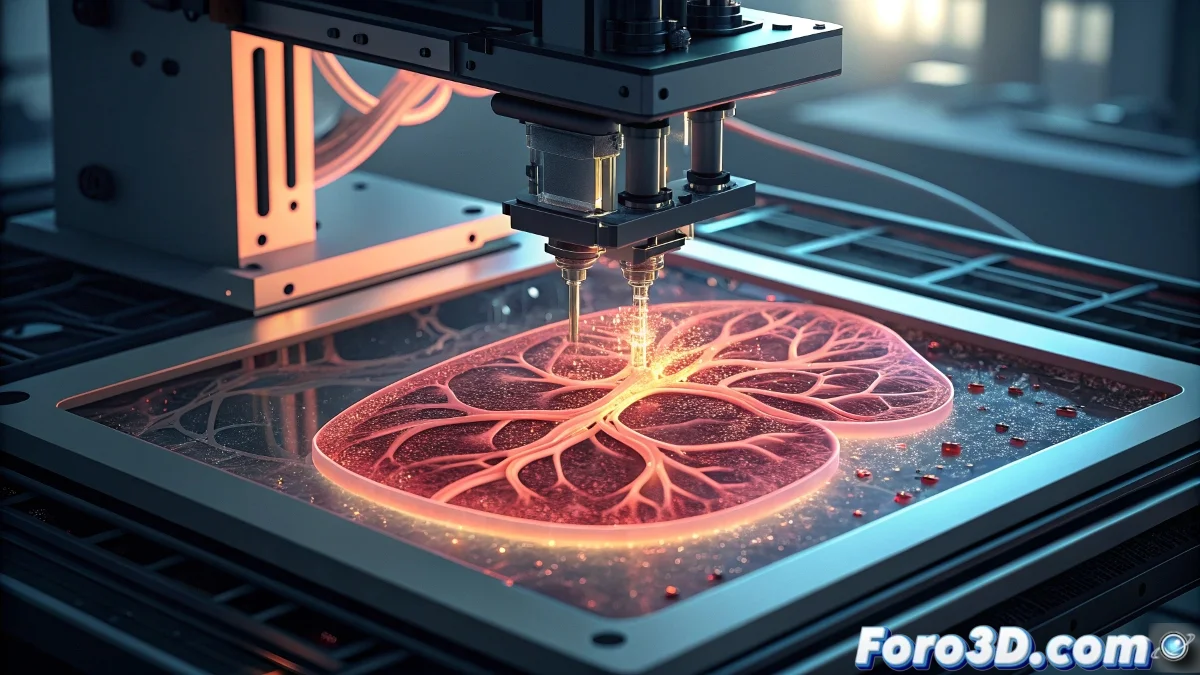
3D Bioprinting of Human Liver: Advances and Vascular Challenges
3D bioprinting is achieving revolutionary milestones in the fabrication of fully functional human liver tissue, specifically designed to evaluate the efficacy and safety of drugs under development. This progress facilitates a more accurate assessment of the toxicity and effectiveness of new medications, reducing the need for animal models and speeding up research cycles. However, a crucial obstacle hinders its use in transplants: the current impossibility of replicating the intricate vascular complexity of a native organ, which compromises the oxygenation and cellular nutrition in larger constructs 🧬.
Vascular Complexity as the Main Limitation
The central challenge lies in mimicking the dense mesh of blood vessels that defines a complete human liver. Although current bioprinted tissues perform basic metabolic functions at reduced scales, they lack the microvascular architecture essential to sustain a full-sized organ intended for implantation. This limitation directly impacts the long-term survival of the tissues, since, without an effective circulatory system, internal cells suffer from hypoxia and malnutrition, leading to necrosis within hours.
Critical Aspects of Vascularization:- Recreation of capillaries and veins with micrometer diameters to allow continuous blood flow
- Integration of endothelial cells that form stable and permeable conduits
- Ensuring vascular interconnection with the recipient's circulatory system in transplants
It is paradoxical that we can print tissues that simulate liver pharmacometabolism, but not the 'vital cables' that feed them, like having an advanced smartphone without a power outlet.
Innovative Strategies and Future Horizons
Scientists are investigating multiple tactics to overcome this barrier, such as bio-inks enriched with endothelial cells that promote vascular self-organization, and high-precision printing methods that enable the design of thinner and more branched vascular channels. Some groups are experimenting with biodegradable scaffolds that are progressively replaced by blood vessels generated by the host organism. While these approaches are promising in controlled environments, their transition to clinical practice will require years of refinement and exhaustive validation.
Promising Approaches Under Development:- Use of smart hydrogels that respond to biological stimuli to guide vascular formation
- Multi-material biofabrication techniques that combine liver and vascular cells in a single structure
- Pre-vascularized implants that integrate more quickly with the patient's circulatory system
Perspectives and Conclusions
3D liver bioprinting represents a transcendental advance for pharmacology and regenerative medicine, but its definitive success in transplants will depend on overcoming the vascular hurdle. The scientific community is focusing efforts on emulating the natural liver vasculature, an indispensable step for creating viable and long-lasting bioprinted organs. The near future could see the convergence of tissue engineering and nanotechnology to solve this challenge, paving the way for personalized, rejection-free transplants 🔬.