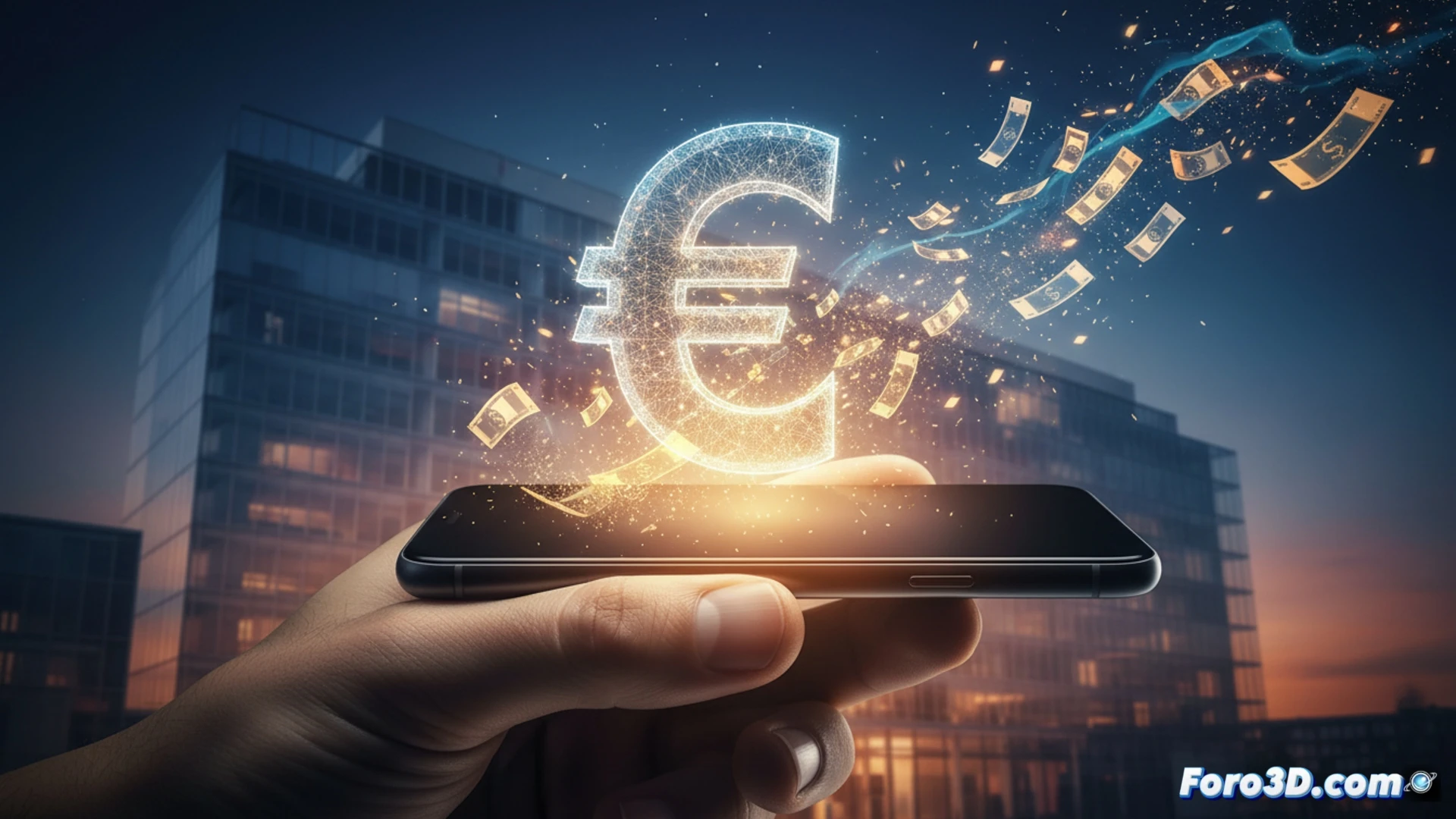
Your cash could be just a code on your mobile
Imagine paying for your coffee using your phone, but without your commercial bank acting as an intermediary. You could use digital euros issued directly by the European Central Bank. What seems like a futuristic scenario is in an advanced study phase, with a possible launch for 2026. This is not a volatile cryptocurrency, but the same official currency in a completely new format. 💶
The fundamental difference with current mobile payments
Today, when paying with an app, your money travels between accounts of private entities. The digital euro would change this paradigm, as it would represent a direct claim against the ECB, just like a physical bill. It would be public money in digital format, stored in a supervised digital wallet, not just an entry in a commercial bank's ledger.
Key features of the new system:- No banking intermediaries: The transaction occurs directly between your digital wallet and the merchant's, using central bank money.
- Public money: It is not a private deposit, so its value is 100% backed by the ECB, eliminating the risk of a commercial bank failure on these funds.
- Complement to cash: It is designed to coexist with coins and bills, not to completely replace them.
The digital euro would be like having coins in your pocket, but in a digital wallet supervised by the central bank.
Privacy and stability: two essential pillars
One of the most debated aspects is how to protect personal information. The European Central Bank has stated that it would not access individual payment data for commercial purposes. Additionally, to prevent people from massively withdrawing their savings from banks, a maximum holding limit per person is being evaluated.
Important details to consider:- Guaranteed privacy: The ECB could not track your daily purchases like some technology companies do.
- Holding limit: A cap on the amount that can be stored would avoid destabilizing the traditional financial system.
- Universal access: It would seek to be available to everyone, even those without a bank account.
A step toward the fusion of the real and the digital
This project marks a significant advance in how we understand money. The boundary between the physical and the digital blurs, integrating both realities into our daily lives. It is possible that, in a few decades, finding a euro bill in a drawer will be as strange and nostalgic an experience as discovering an old peseta is today. 🚀