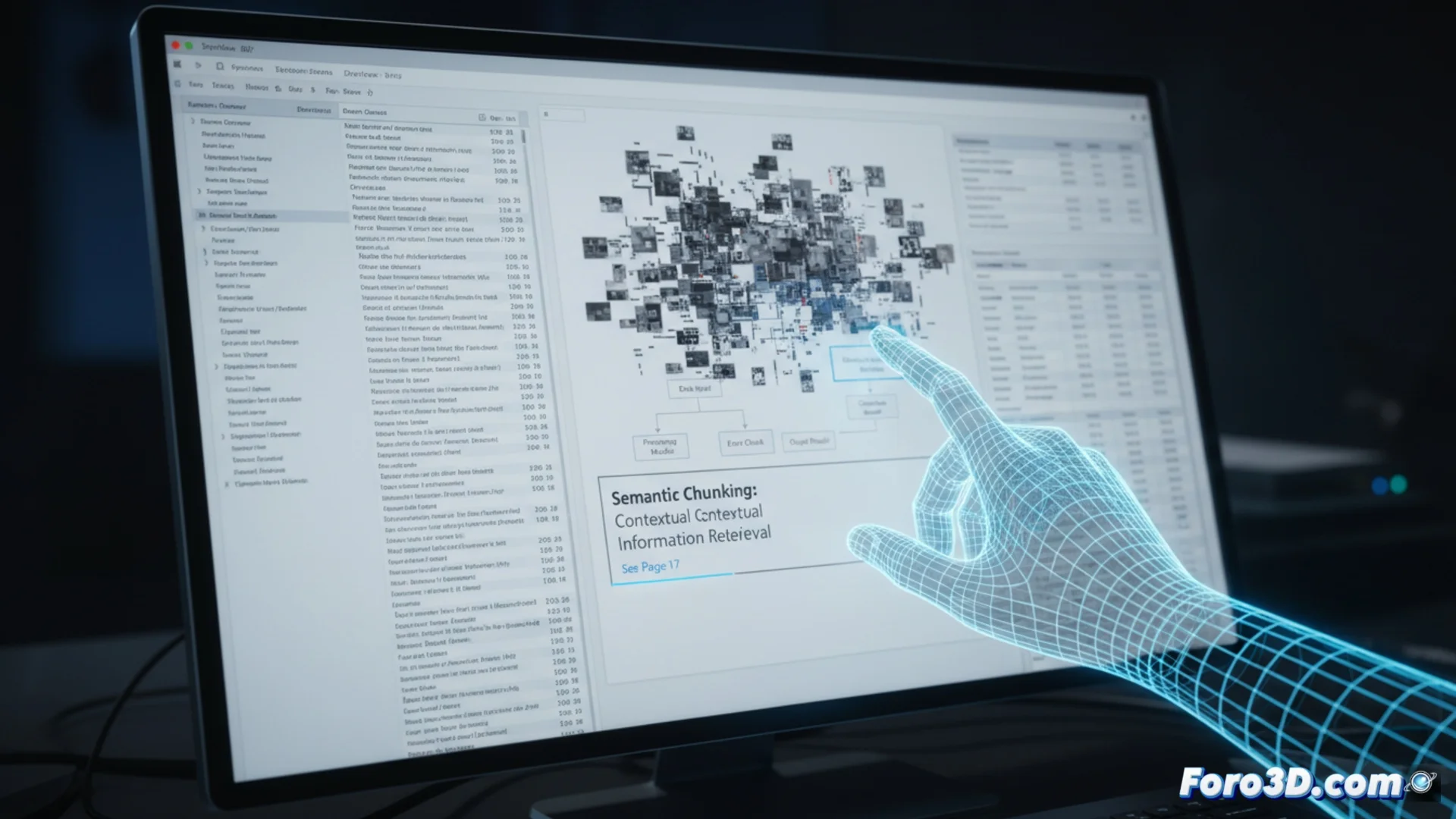
Why RAG Systems Fail When Processing Complex Technical Manuals
Retrieval-Augmented Generation (RAG) models face a significant challenge when working with complex documents, such as engineering manuals or PDFs with many graphical elements. Their usual method of dividing the text into fixed-size parts breaks the logical coherence of the document, separating crucial elements from their explanation. This leads the model to produce responses that seem valid but actually contain serious errors. 📄
The Error of Fragmenting Without Understanding the Structure
The central problem lies in how these systems process the document. They assume it is a continuous block of text and cut it into arbitrary segments. This action disconnects complete tables from their titles, separates diagrams from the descriptions that explain them, and breaks the logical flow between sections and chapters. Visual information, such as charts and images, is simply ignored, losing key data for understanding the topic.
Consequences of Incorrect Fragmentation:- The model generates responses that are formally correct but factually erroneous, due to lacking the complete context.
- It becomes impossible to cite the original source of a data point accurately, as the link to its location in the PDF is lost.
- The system's reliability decreases, as it seems to prefer inventing an elegant response rather than recognizing that it did not find the necessary information.
Fragmenting a technical manual without respecting its semantic structure is like reading an instruction book by randomly mixing all its pages.
Strategies for Correctly Processing Complex Documents
To overcome these limitations, it is essential to adopt an approach that respects the nature of the document. Instead of blindly cutting the text, the system must identify and keep together information units with their own meaning.
Keys to Effective Processing:- Fragment semantically: Respect the natural boundaries of the document, such as chapters, subsections, and keep complete tables or lists as a single data block.
- Preserve context and metadata: Maintain precise links between each fragment and its exact location in the source file, allowing referencing and verifying the information.
- Textualize multimodal elements: Convert diagrams, schematics, and charts into detailed and precise textual descriptions that can then be indexed and searched.
Integrate All Information for Precise Responses
By implementing these strategies, the RAG system can understand and utilize the entirety of the data present in a technical manual. Visual information stops being a decorative element to become indexable data. The result is a much greater capacity to retrieve precise information and generate responses that not only sound good, but are correct and verifiable, elevating the utility and trust in these artificial intelligence tools. 🚀