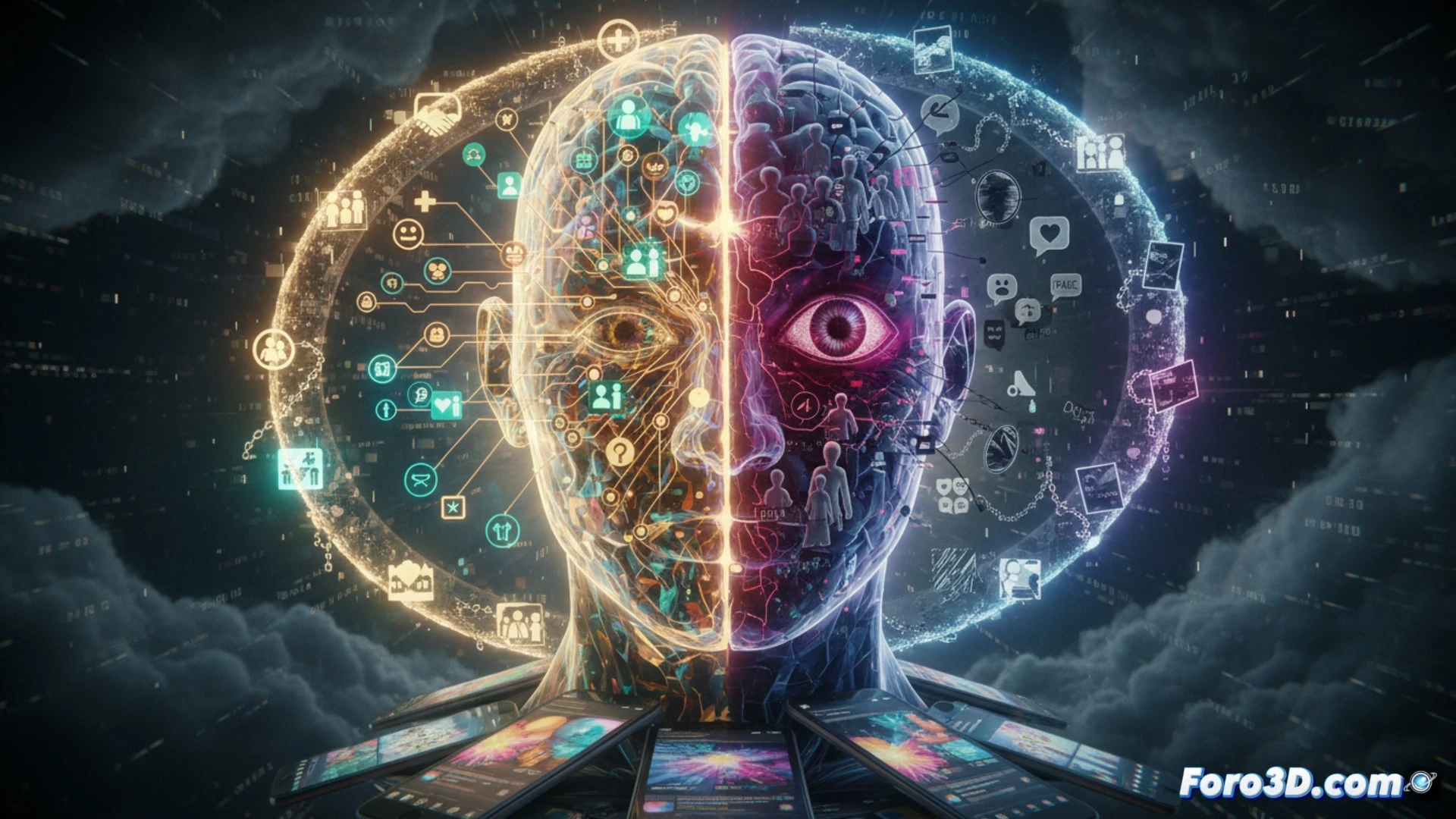
Why Keeping Your Social Media Active Makes Sense
Deciding to close your social media profiles might not be the most accurate option. Especially if your goal is to receive small frequent doses of reward, instant confirmation, and the security of being up to date with everything. Before acting, let's explore the reasons why continuing to use them feels so logical and persistent. 🧠
The Pillars of Design That Keep You Hooked
Platforms don't grow by accident. Their architecture is based on principles of behavioral psychology and interface design carefully studied to maximize the time you spend on them. These systems activate deep responses in our brain, making the act of disconnecting feel like a loss rather than a liberation. Understanding these mechanisms is key to interacting with them more consciously.
Key mechanisms that explain adherence:- The gratifying uncertainty: Each update offers new and unpredictable content. This variable reinforcement, identical to that used in slot machines, is extremely effective for consolidating a habit. Not knowing what comes next is what drives you to keep seeking.
- The confirmation of existence: A like, a comment, or a view are social signals that the brain interprets as validation. Historically, belonging to the group meant safety. Today, a notification activates similar neural circuits, offering a dose of approval.
- The void they fill: Apps are designed to occupy every moment of pause: waiting, commuting, moments before sleep. If they disappear, silence emerges, a sensation that can generate unease in an environment accustomed to constant stimulus.
The question is not whether you should close your social media. The question is whether you are deciding or the design is deciding.
The Social and Design Forces That Hold You Back
Beyond individual psychology, collective dynamics and user experience design elements operate that eliminate any friction to leave. These factors turn disconnection into an act that goes against the current, requiring deliberate effort.
Factors that increase dependency:- The fear of missing out (FOMO): It's a real emotion, not an exaggeration. Social media simulates a continuous flow of vital events. Not being present generates the feeling of losing the collective rhythm, even though most content loses relevance in hours.
- The illusion of effortless time: Infinite feeds have no clear end. This design eliminates the need to decide what to do next, making time pass without you noticing. Regaining control would imply facing the friction of choosing again.
- The pressure of the public square: Where the majority is, that's where we go. Abandoning social media can be perceived as leaving a social space full of people. The constant growth of users reinforces the norm that being inside is standard.
- The effectiveness of behavioral engineering: Platforms are not inherently good or bad; they are systems optimized to capture and retain attention. Entire teams work to keep you a few minutes longer, and their strategies work.
Regaining the Ability to Choose
After reviewing these reasons, a clear pattern emerges: none focus on your overall well-being, your ability to concentrate or rest deeply. All describe retention mechanisms. This is behavioral engineering applied on a massive scale, prioritizing immediate rewards, social validation, and fear of isolation. The path does not necessarily involve eliminating, but understanding. Knowing why you return, recognizing when the impulse comes from an optimized system and not from an authentic need. If, after this analysis, you choose to continue, it will be an informed decision. If you decide to limit, pause, or modify your use, also. The real difference does not lie in having or not having accounts, but in regaining agency to decide when and for what you use them. That is the true starting point toward a healthier relationship with technology. ⚖️