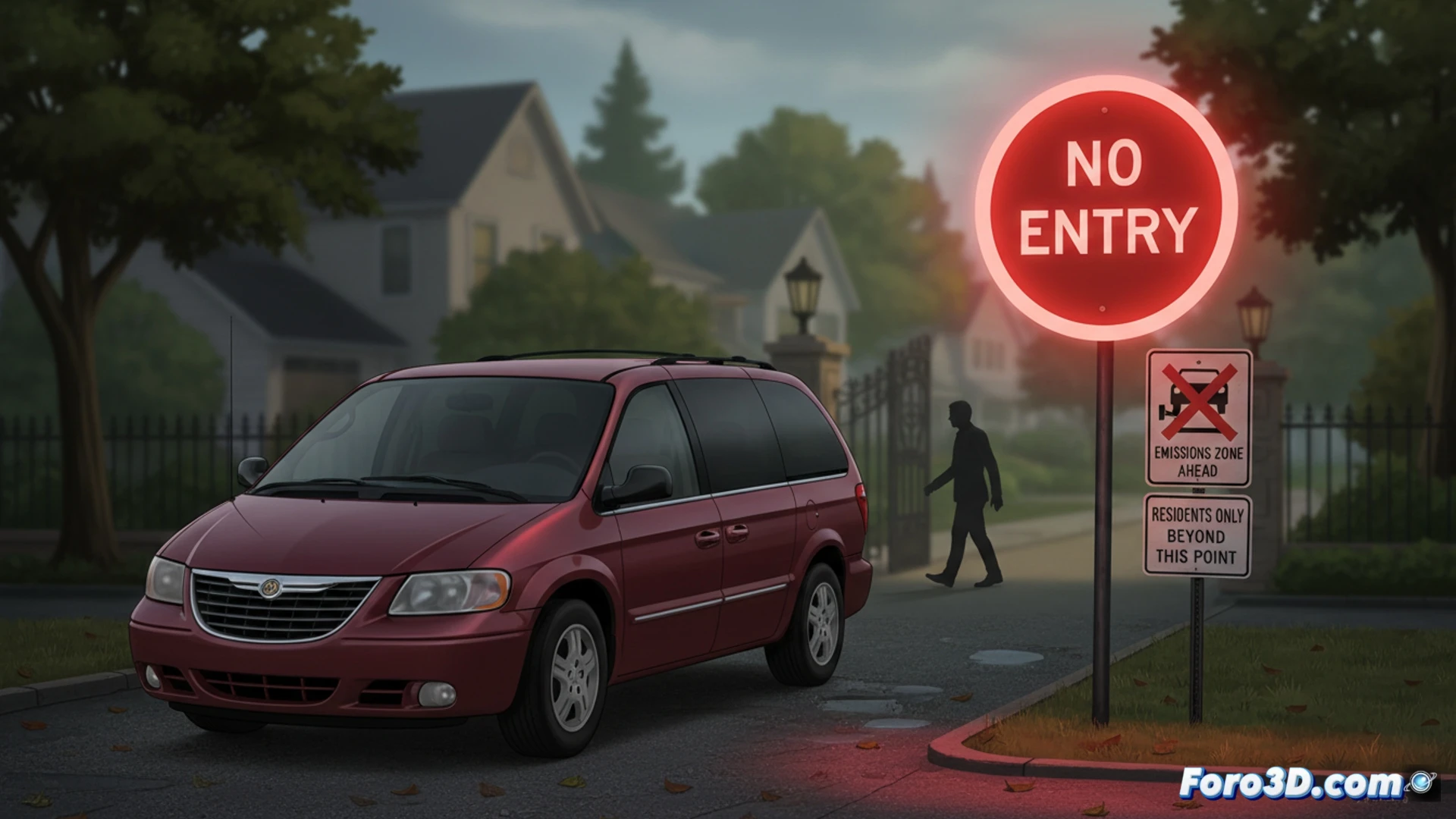
Why Does Your Car Face More Restrictions Than a Criminal?
Have you considered this situation? Your car, that companion in your travels, can be banned from the city for exceeding pollution limits. In contrast, someone sentenced for a serious crime could, legally, settle in your neighborhood without impediments. The comparison is shocking and invites us to reflect 🧐.
The Basis of Restricted Vehicle Areas
Low-emission zones are based on protecting public health. Their goal is to avoid a quantifiable and general harm: air pollution. Identifying the culprit is straightforward (the vehicle) and enforcing the rule is automatic. This regulation acts on objects, not individuals. Its purpose is to create a cleaner and healthier urban space for the entire population.
Key characteristics of this regulation:- It is based on objective and measurable criteria, such as levels of particulate matter.
- It applies in a general and impersonal manner, without considering the individual circumstances of the owner.
- It seeks to mitigate a collective environmental damage that affects the entire community equally.
It is a regulation on objects/vehicles, not on people. Its objective is clear: reduce harmful particles for everyone.
The Complexity of Legislating on People
When dealing with individuals, the framework becomes intricate. Our legal system starts from the premise that, after serving a sentence, the person has settled their debt with the community. Imposing permanent barriers on where they can live or work opposes basic principles such as the right to reintegration. Additionally, insurmountable practical dilemmas would arise: what distance is sufficient? Who would decide? Implementing such a system would be subjective and require a constant level of surveillance that is highly questionable.
Main challenges in restricting people:- It conflicts with fundamental rights and the principle of rehabilitation.
- Establishing fair and objective parameters is extremely complex and controversial.
- It could lead to systems of mass control and social stigmatization.
A Necessary Social Balance
This contrast reveals a dilemma of our time: we prioritize managing what is easy to quantify (like exhaust emissions) over what is vital but enormously complex (ensuring safety after a conviction). The solution is not to choose one aspect over the other, but to find intelligent mechanisms that simultaneously protect our environment and coexistence in urban spaces. The final challenge is to harmonize the defense of the common good with respect for individual rights 🤔.