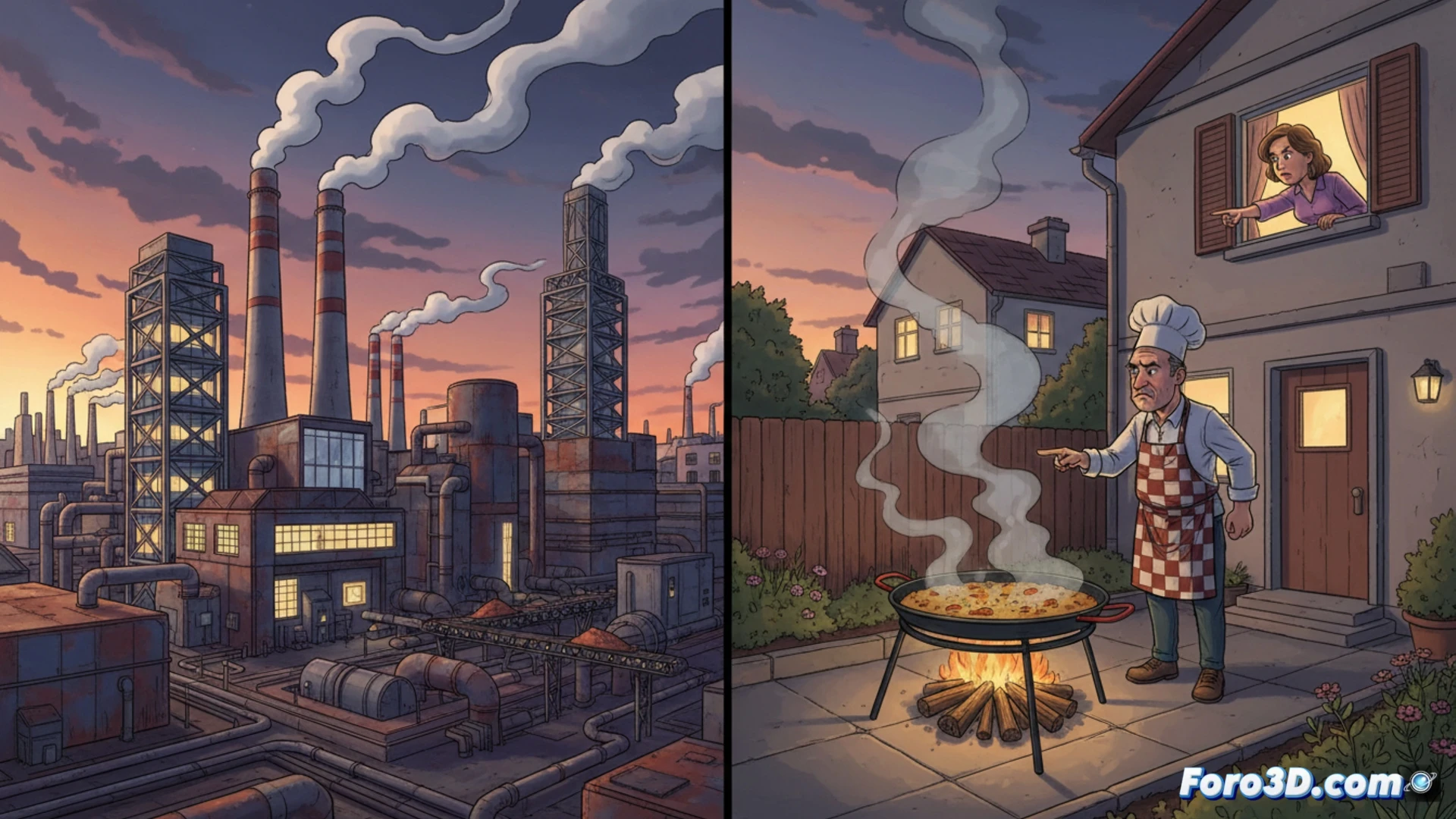
Why Does Your Barbecue Pollute and the Factory Not?
Have you ever wondered why the rules seem to apply differently depending on who breaks them? 🧐 It's like when an industry emits smoke constantly and it's called producing, but if you light wood to cook, you're pointed out as if you're harming the planet. Let's unravel this apparent contradiction.
The Decisive Factor: Context and Authorization
The main difference is not just in how much it pollutes, but in the framework where it happens. An industrial plant operates under a specific environmental permit. This document sets legal limits for what it can emit, transforming its activity into a regulated and supervised evil. Your bonfire, on the other hand, is a sporadic and uncontrolled source of emissions, whose effects (smoke, smell, particles) are felt immediately in a residential environment. The comparison is between a massive but bounded phenomenon and a localized and intense nuisance. 🌫️
Key Elements that Explain the Paradox:- Scale vs. Perception: A large factory pollutes more in total, but its impact is diluted in a designated area. The smoke from your garden, although smaller in volume, concentrates and directly invades others' space.
- Differentiated Regulation: The law distinguishes between regulated industrial pollution and nuisances to neighbors. The former is measured with equipment; the latter is judged by immediate impact on well-being.
- Tolerance Threshold: What is considered acceptable in an industrial zone becomes unacceptable in a residential area. It's the classic difference between the tolerable on a large scale and the unbearable next door.
“What is tolerable on a large scale in an industrial zone becomes unbearable on a small scale in your garden.”
A Fact that Clarifies the Picture
You might not have known: regulations handle separate concepts. Industry is required to measure its emissions continuously and respect legal ceilings. Your smoke, however, is framed as a punctual nuisance. The system doesn't judge only the quantity, but the type of disturbance and the place where it occurs. It's similar to being fined for stopping two minutes in a double yellow line, while a delivery vehicle obstructs the public road for hours without consequences. 🚗
What Defines Something as a Problem?- Control and Measurement: Industrial activity is subject to controls. Domestic activity is not.
- Environmental Expectation: In a residential area, clean air and tranquility are expected, not smoke.
- Prior Authorization: The factory has a permit that protects it (to a certain extent). Your barbecue does not.
Conclusion: More Than Volume, It's the Framework
In short, this apparent injustice is understood by analyzing the legal context, the scale of impact, and how nuisances are defined. It's not just a matter of who emits more, but where, how, and with what authorization it does so. Next time, perhaps the most practical solution is to opt for a gas paella pan... and save the wood anecdote to explain how complex the rules can be. 🔥