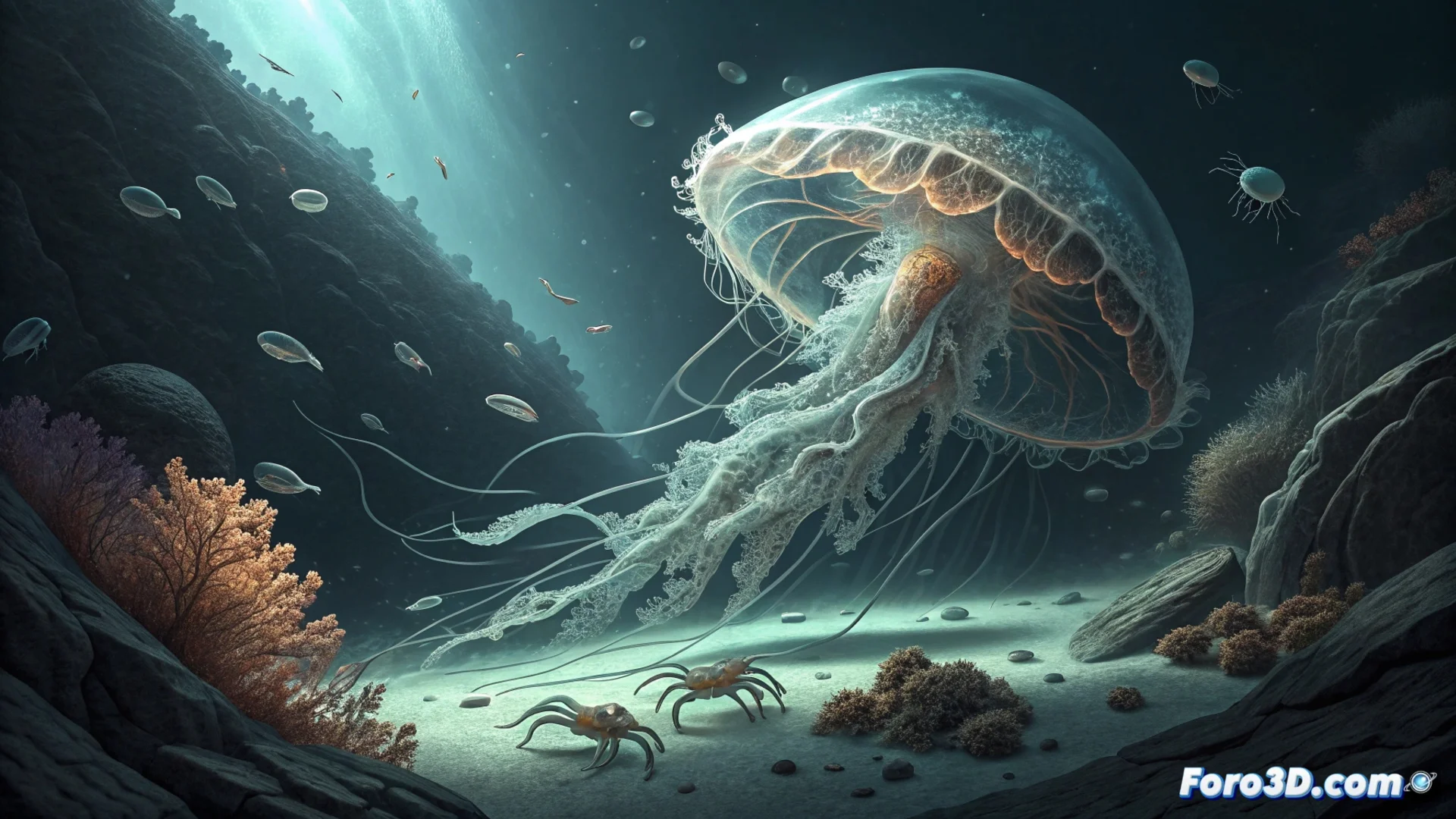
What if dead jellyfish are not useless waste?
Thinking of the ocean floor as a warehouse of inert remains is a mistake. The traditional view showed dead jellyfish as gelatinous masses that accumulated without purpose. However, the reality is very different and much more dynamic. 🌊
A feast in the dark zone
Researchers conducted a key experiment: they deposited jellyfish carcasses in deep waters to observe their fate. Contrary to expectations, they did not remain intact. Organisms like crabs and hagfish pounced on them to feed. It's like discovering that the ocean floor has an active cleaning service that recycles everything that falls from above. 🦀
Key findings from the experiment:- Jellyfish carcasses do not accumulate as inert waste.
- Crabs and hagfish are the main consumers in the depths.
- The decomposition process is rapid and active.
Dead jellyfish are a crucial food resource, not mere residue.
Rewriting the nutrient cycle
This discovery completely transforms our understanding. Jellyfish bodies act as an efficient vector to move carbon and other elements from the surface to the abyssal ecosystem. Thus, they fulfill a vital function in the oceanic carbon cycle, closing a link that was previously overlooked. 🔄
Impact on the marine ecosystem:- They transport organic matter and energy to lightless zones.
- They sustain scavenger populations in food-scarce habitats.
- They connect different levels of the water column through the food chain.
A new perspective
The next time you encounter a jellyfish, remember that it is not just a gelatinous structure. It represents a future nutritional contribution for the creatures of the darkness and an essential component for maintaining ocean balance. This finding reminds us that in nature, practically nothing lacks utility. 🌍