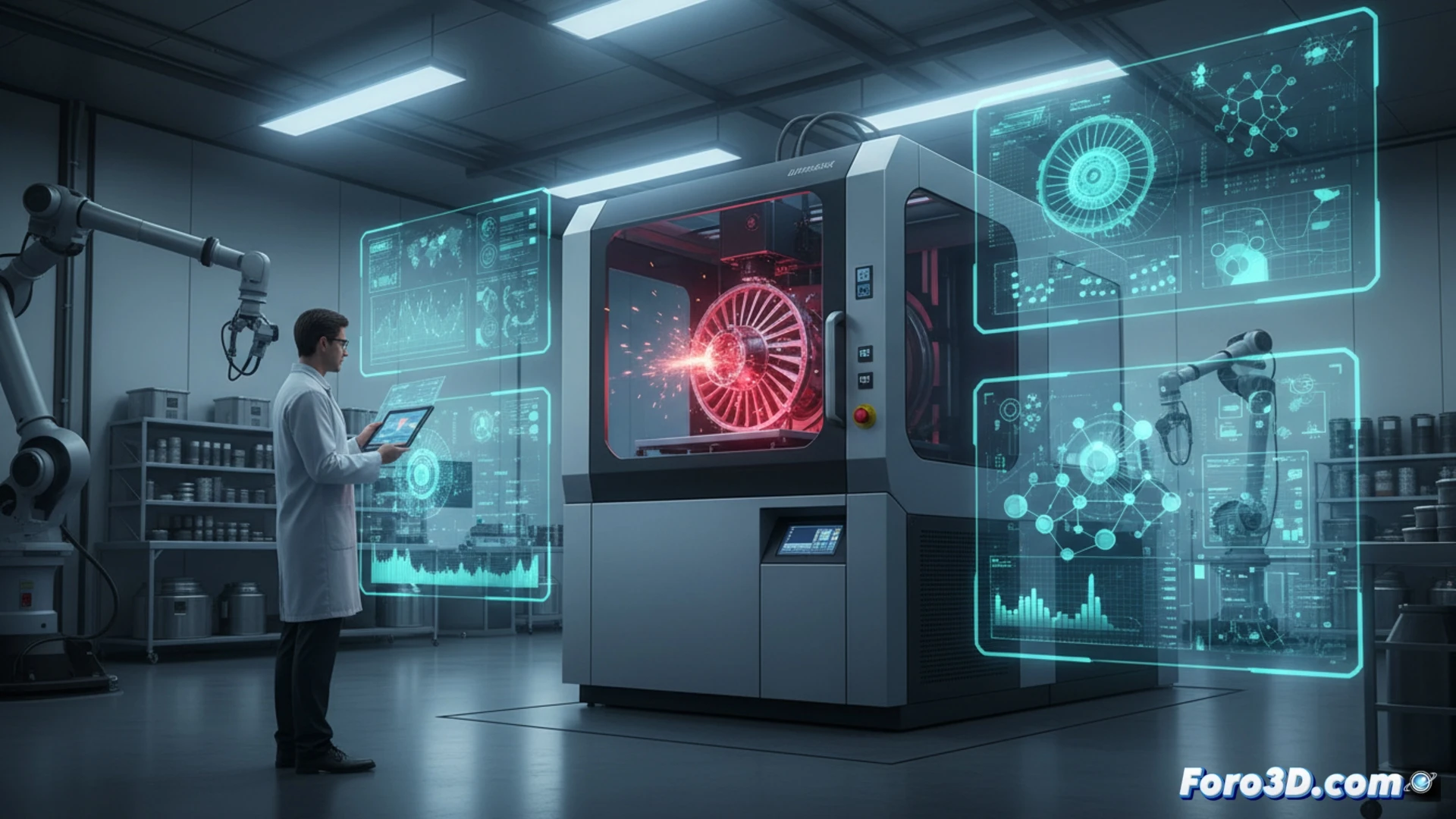
What if a 3D printer could predict the future?
Imagine manufacturing an extremely complex metal component, like those used in aircraft. Additive manufacturing builds these objects layer by layer, using a powerful laser. However, a major obstacle arises: the intense heat causes the material to distort, similar to what happens to a cake if overbaked. What if the machine itself could anticipate that problem and adjust the process on the fly? 🔮
The challenge of printing superalloys
This is the context where Inconel 718 stands out, an alloy with extraordinary capabilities. It withstands extreme temperature conditions and is highly corrosion-resistant, making it ideal for turbines and space thrusters. The difficulty lies in printing it with absolute precision using Laser Powder Bed Fusion (LPBF). The goal of a new initiative is to program a "digital twin" or computational model that accurately predicts how the part will warp during manufacturing, to counteract it in real time.
Key details of the challenge:- Focused on solving the thermal distortion problem in real time.
- Uses the LPBF technique to process the complex Inconel 718.
- Seeks to develop an automatic compensation algorithm during printing.
The advancement is not just theoretical; it has direct and urgent industrial application.
Competition for a practical solution
This proposal goes beyond the realm of research. It consists of a competition where groups from universities and technology companies will compete to solve this technical enigma. Incentives include recognition, prizes, and the real possibility that their method will be implemented in factories. It resembles a high-level hackathon aimed at saving costly metal parts from being ruined.
Potential impact of achieving prediction:- Drastically accelerate the rate of manufacturing essential components.
- Reduce costs by minimizing wasted material and rework time.
- Increase the reliability and consistency of the final parts.
A future that anticipates itself
It seems that the future of manufacturing is not limited to stacking material, but also to foreseeing the physical behavior of that material during the process. The ability to correct deformations on the fly represents a huge qualitative leap. Who would have imagined that industrial 3D printers would need digital oracle capabilities to perfect their work. 🚀