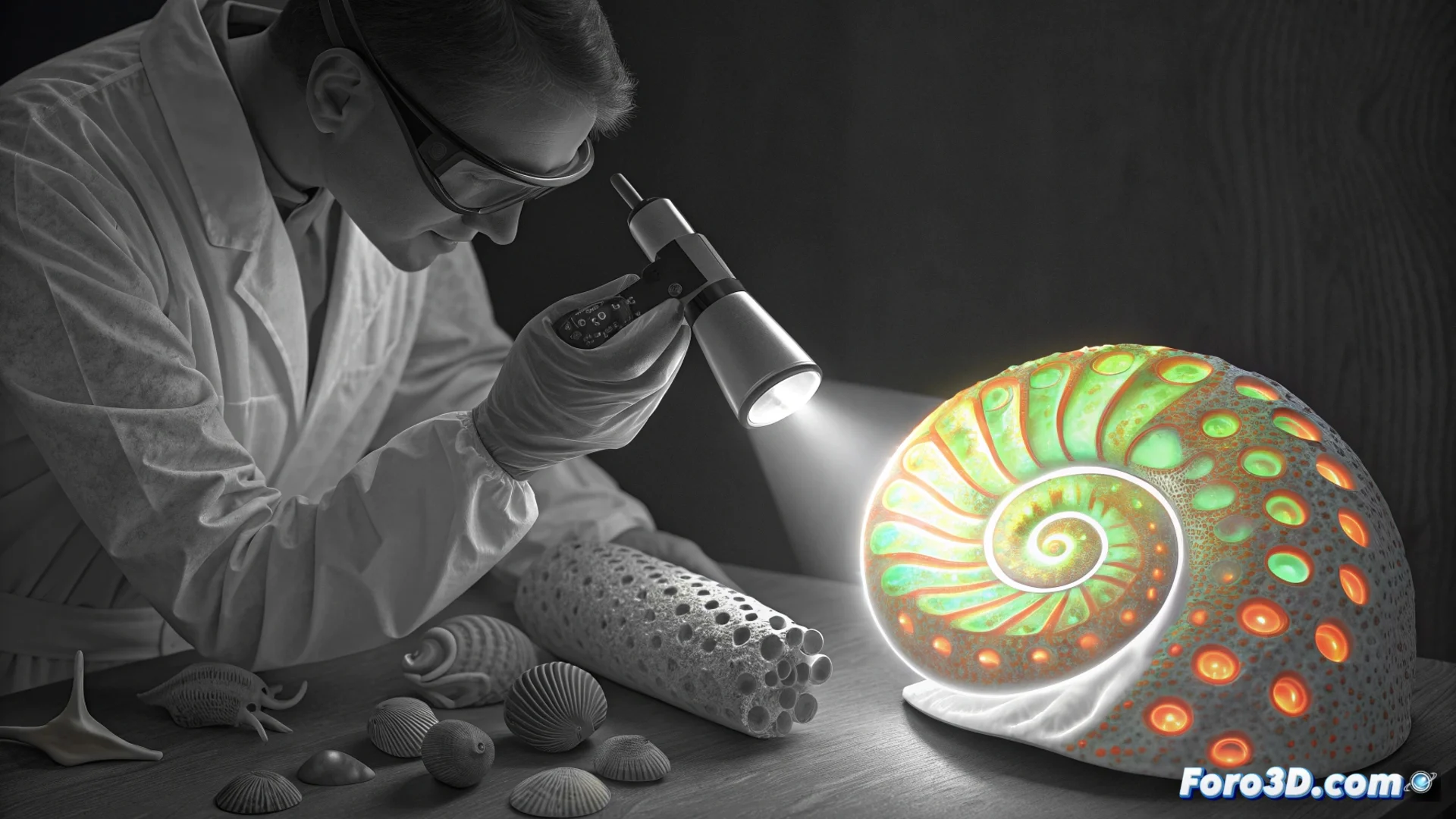
Were white fossils always like that? Ultraviolet light reveals their secret color
Do you think that the porcelain-like fossils in display cases always had that whitish tone? Reality is more vibrant. By applying an ultraviolet light lamp, similar to the one that detects fake bills, these millennial remains display a hidden range of spots and swirls of color. 🦴✨
A technique that acts like X-ray vision
For paleontologists, this method works like magic glasses. Under normal lighting, many fossilized conical snail shells appear pale and uniform. However, ultraviolet light causes certain minerals on their surface to activate and emit their own light, a process known as fluorescence. It's the same effect that makes a t-shirt glow in a disco, but applied to narrating the history of life on our planet.
What fluorescence allows to discover:- Identify new species among fossils that visually seemed identical.
- Observe that the intensity of the fluorescent glow is linked to how much oxygen interacted with the shell during its mineralization.
- Interpret these patterns as a chemical record of the specimen's millions-of-years journey.
With a simple lamp, we can unlock chapters of natural history that have been hidden since the age of the dinosaurs.
Beyond a mere visual spectacle
These bursts of color are not just a curious phenomenon. They constitute a powerful diagnostic tool. The fluorescent imprint acts like a chemical barcode, providing clues about the environmental conditions in which the organism was preserved.
Key applications of this finding:- Refine the taxonomic classification of fossilized marine invertebrates.
- Better understand fossilization processes and the diagenesis of carbonates.
- Access biogeochemical information that visible light cannot show.
The cover of a millennial book
It's fascinating to consider that accessible technology allows reading pages of a natural diary that remained sealed for geological eras. The next time you look at a white fossil, remember that you might only be seeing its cover. Its true story, full of color and data, awaits to be revealed under the right light. 🔍📖