Wangari Maathai's story transcends ecology to become a symbol of resistance. This Kenyan biologist, facing deforestation and poverty, founded the Green Belt Movement. Her strategy was direct: organize women to plant trees, combating erosion and empowering communities. Her peaceful struggle against an oppressive regime and her Nobel Peace Prize in 2004 show how local action generates global impact.
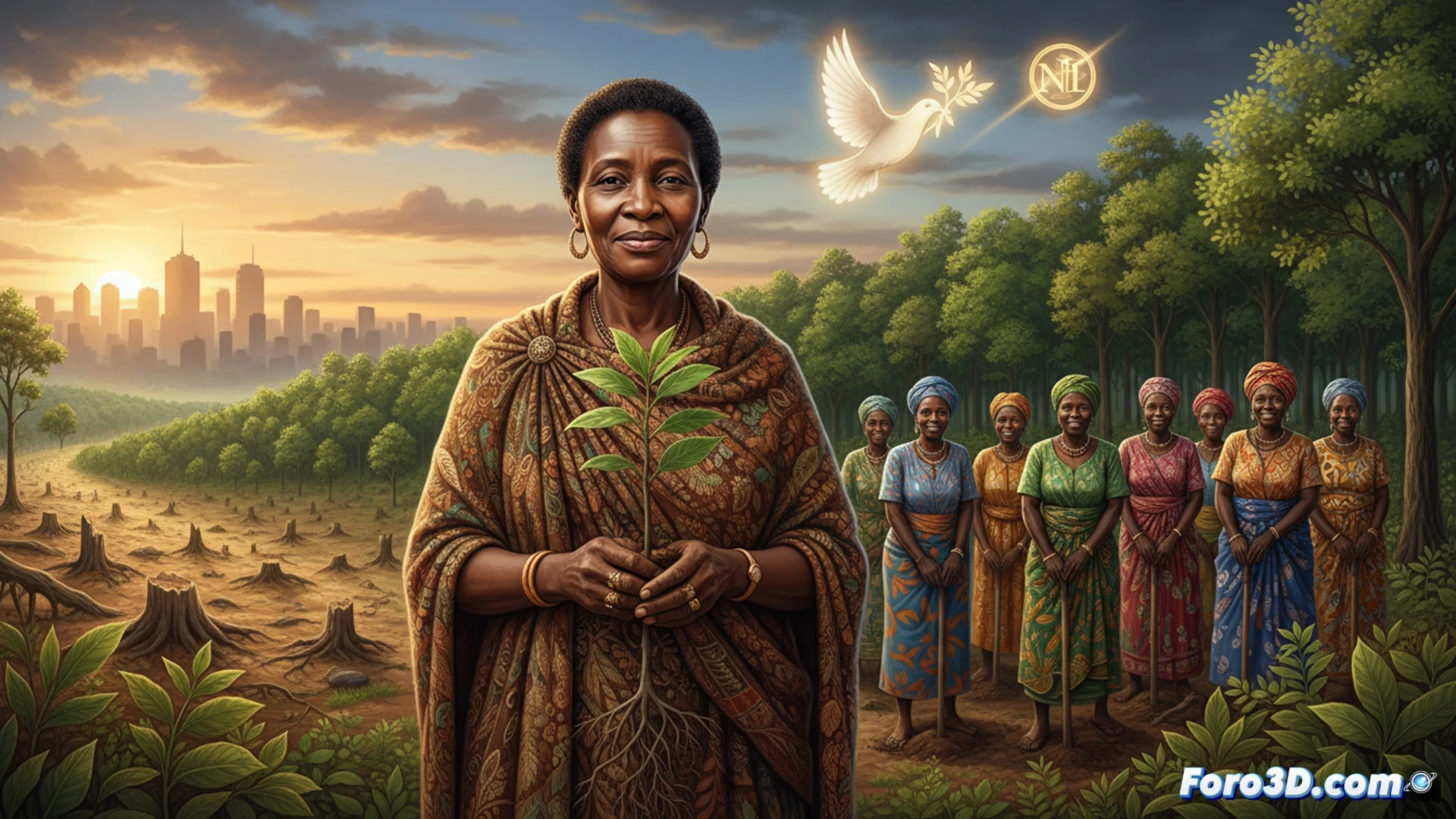
Rendering a Forest: The Seed as Particle and System 🌳
An animated adaptation of her life would allow for notable visual technical development. Each seed planted could be a luminous particle, a sprite with a procedural growth system. Upon germinating, this particle would become the root of a tree mesh that extends, with a shader that simulates sap as a data flow. The darkness of erosion could be represented with procedural geometry that retracts, while the advance of green is calculated as a cellular colonization system on the terrain.
The Bug the Government Couldn't Patch: Unauthorized Seeds 🐛
Imagine the face of corrupt officials when their greatest threat was not a coup d'état, but an avalanche of seedlings. Their weapon of mass disruption was a communal nursery. While they issued paper decrees that no one read, Wangari deployed ecological software updates directly in the field, with a bandwidth of shovel and watering can. The only allowed hack was that of the roots in compacted soil.