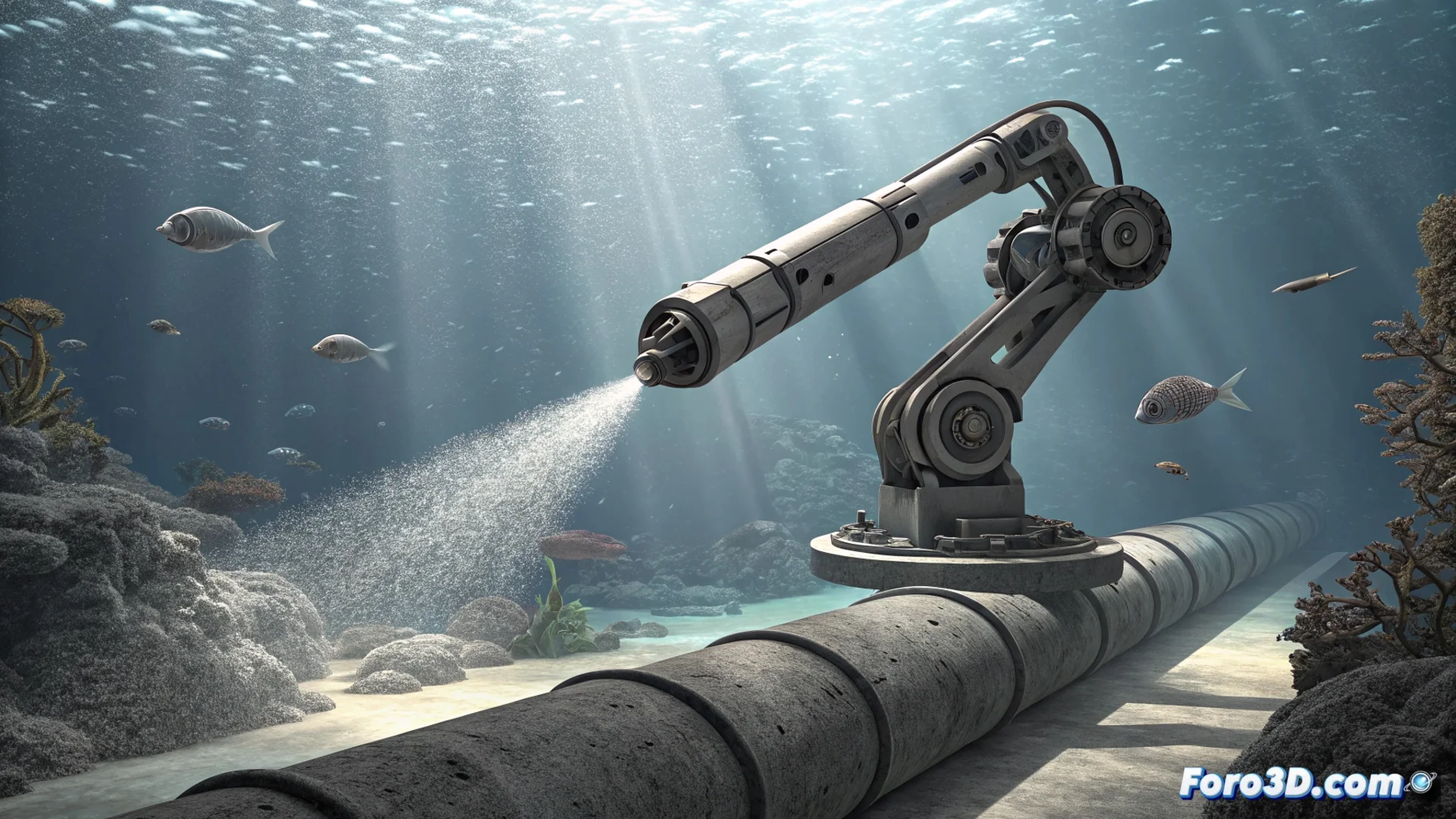
Underwater 3D Printing to Repair Marine Infrastructure
Can you imagine being able to fix a dike or wind turbine support without needing to dry the area or build expensive containment dikes? 👷♂️💧 This is what an innovative project from Cornell University, backed by DARPA, is pursuing. They are creating a 3D printing system that works in the ocean depths, an advancement that could transform how we maintain marine facilities.
The secret: a material that sets underwater
The main obstacle to using concrete underwater is that water dissolves and washes away the cement before it can harden. The team's solution is ingenious: they use two separate chemical components that combine just as they exit the printer nozzle. It's similar to how some two-part glue dispensers work. Upon mixing at the precise moment, the compound reacts and solidifies immediately upon contact with saltwater, allowing precise deposition of solid layers of material.
Key advantages of this method:- Speed and efficiency: Dramatically reduces the time to intervene in damaged infrastructure.
- Minimize impact: By avoiding large isolation works, the marine ecosystem is protected.
- Versatility: Not only for repairs, but also for creating new structures in hard-to-reach places.
It is the perfect convergence of advanced materials science, precision robotics, and 3D printing to master such a hostile environment as the deep sea.
Robots, the new ocean builders
Precision in such a complex environment is fundamental. That's why the underwater printer is not operated manually. It is controlled by robotic arms operated from the surface, which ensure millimeter-precise placement of the material, layer by layer. This technology allows planning and executing complex designs directly on the seabed.
Potential applications of this technology:- Repair submarine pipes and outfalls permanently.
- Reinforce foundations of offshore wind platforms and docks.
- Build artificial reefs or oceanographic research structures.
A wetter future for construction
This project brings us closer to a scenario where, instead of sending diver teams for dangerous and slow work, we will deploy swarms of robotic printers that manufacture underwater. The vision is clear: the next frontier for building and maintaining is not on dry land, but in the ocean depths. 🚀🌊