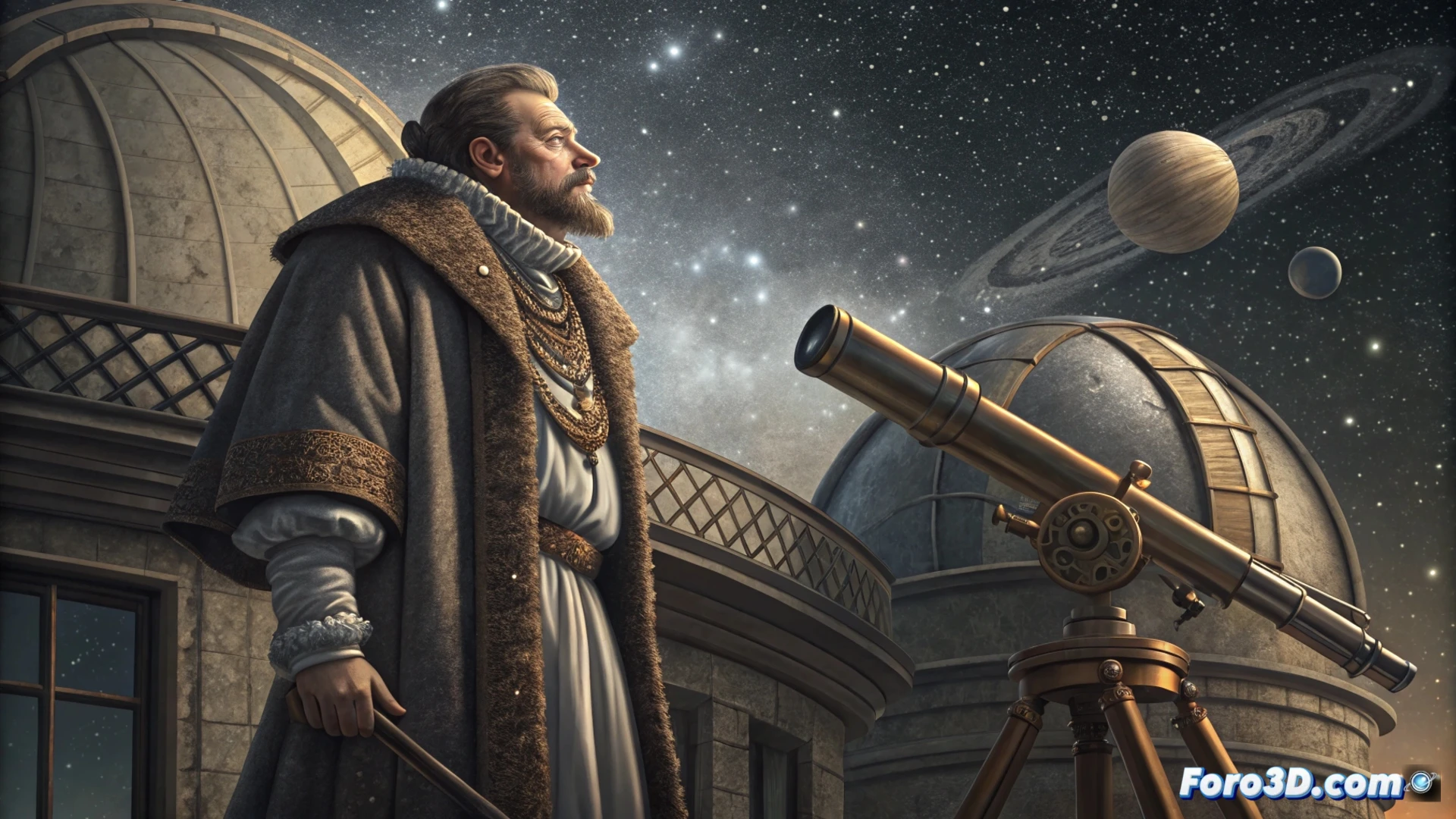
If Tycho Brahe, the 16th-century Danish astronomer, worked today, his obsession with mapping the sky would have a clear goal: space debris and uncatalogued asteroids. Faced with thousands of fragments in orbit and untracked nearby objects, his project would be the Celestial Census. A public network of observatories to map every object with precision and in real time, laying the foundations for safe space navigation.
Technical architecture of the observation network 📡
The system would integrate a constellation of microsatellites with optical and radar sensors, complemented by a global network of automated ground-based telescopes. It would use long-baseline interferometry to determine positions with millimeter accuracy. The data, processed with correlation algorithms and machine learning, would be published on an open platform. Funding would be obtained through a global micromecenazgo model and contributions from space agencies.
The definitive catalogue: so your satellite doesn't get an unexpected like 🎯
Imagine having the Waze of space. With this map, evasive maneuvers would no longer be a guessing game. You could check on your terminal if that spot on the horizon is a promising asteroid or just a piece of an old rocket. Even the geekiest could bet on which piece of junk will complete its orbit first. It would be the first time we knew, with certainty, what that thing that shines and moves strangely is... and if it's coming towards us.