How Japan Connects Its Submarines with a Network Similar to Video Games
Think about the precision and speed demanded by an online multiplayer strategy game, where every millisecond counts 🎮. Now, transfer that need to a real scenario: a submarine operating in the depths, which must coordinate movements with other elements of a fleet. Japan is building a system that applies the logic of resilient video game networks to the field of submarine defense.
The Hidden Military Internet on the Ocean Floor
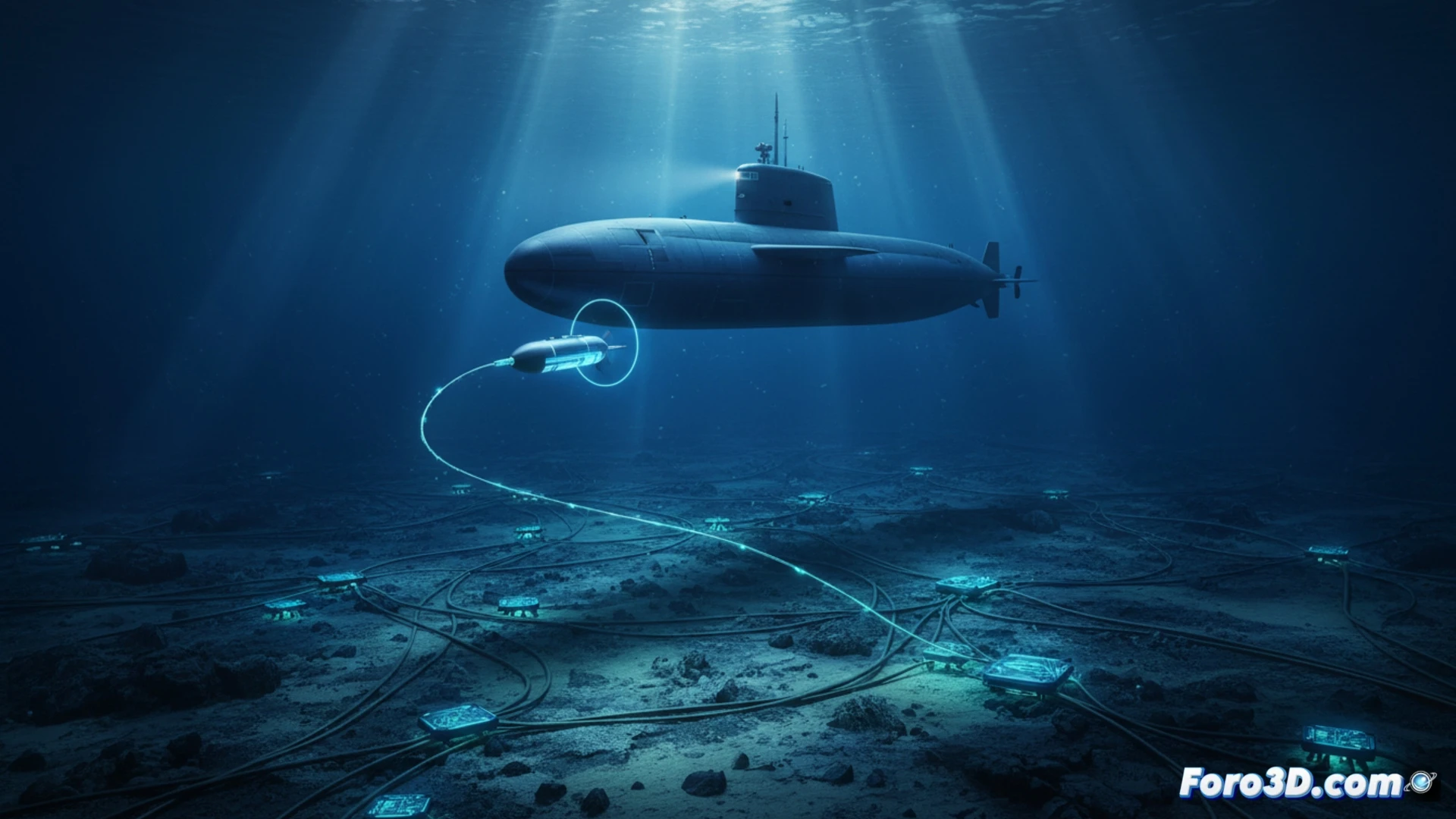
The project aims to establish an ultrasecure underwater communications network. Its backbone would be fiber optic cables laid on the seabed, linking naval bases, ships, and, the greatest challenge, submerged submarines. The architecture is decentralized: if a cable section is damaged, information is automatically rerouted through other available paths. It's the same principle as using your mobile phone to stay connected when the main WiFi signal fails.
Key components of the system:- Fiber optic backbone network: Main infrastructure on the ocean floor to transmit data at high speed and with high security.
- Dynamic routing protocols: Software that manages data routes in real time, always seeking the most efficient and available path.
- Connectivity for submerged platforms: Specific technological solution to integrate submarines, which by nature avoid emitting signals that could reveal them.
The logic to avoid disconnecting from an online game could one day protect critical missions at sea.
Buoys: The Digital Periscope of the 21st Century
Connecting a submerged submarine without revealing its location is the great challenge. The proposed solution uses special deployable buoys. The submarine can release one of these buoys, attached to the hull by a thin, resistant cable. This buoy floats to the surface acting as a retractable antenna, capturing and sending data to the seabed cable network. Thus, the submarine can "chat" securely without needing to surface or approach the surface dangerously.
Advantages of this method:- Preserves stealth: The submarine's real position remains hidden, as only the floating buoy establishes contact.
- On-demand connection: The submarine controls when and where to deploy the buoy to communicate, minimizing its exposure window.
- Robustness: The system complements and supports other more traditional and vulnerable communication methods.
From Virtual to Strategic: A Technological Fusion
This development is a clear example of how concepts proven in digital and consumer environments, such as fault tolerance in online networks, are adapted to solve complex problems in the physical world 🌊. It demonstrates that innovation for creating fluid user experiences can, when transferred, serve to design critical and interruption-proof communication systems in national defense scenarios.