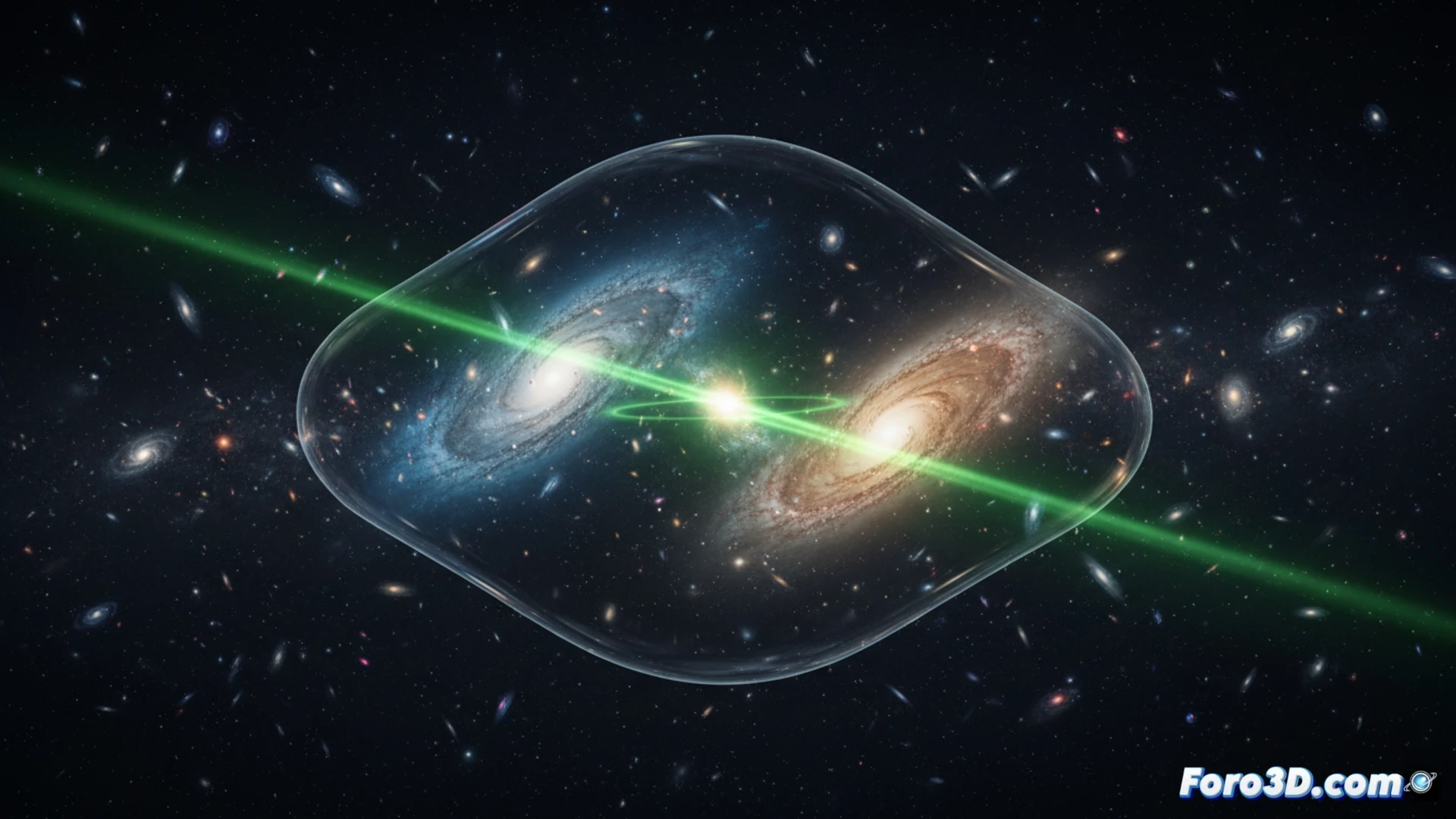
A team of astronomers has located the most distant and luminous maser emission recorded. It comes from the galaxy H1429-0028, nearly 8 billion light-years away, and its signal was amplified by a gravitational lens. This phenomenon occurs in galactic collisions, where compressed gas generates a very intense and focused beam of microwave radiation.
The Technology Behind the Discovery: MeerKAT and Gravitational Lenses 📡
The discovery was made possible by the MeerKAT radio telescope in South Africa, whose sensitivity captured the signal. A key effect was the gravitational lens: a galaxy between the source and Earth curved and amplified the light, acting as a cosmic magnifying glass. This allowed the study of details of an emission that, due to its power and spectral narrowness, is proposed to be classified as a gigamaser.
When a Galaxy Collision "Sounds," It Emits Microwaves 💥
It seems the universe has its own way of making noise. While here two cars collide and the horns sound, out there two galaxies merge and "sound" by emitting a beam of microwaves that we can detect billions of light-years away. Perhaps it's their way of protesting cosmic traffic, though with a spectral precision that any of our ovens would envy.