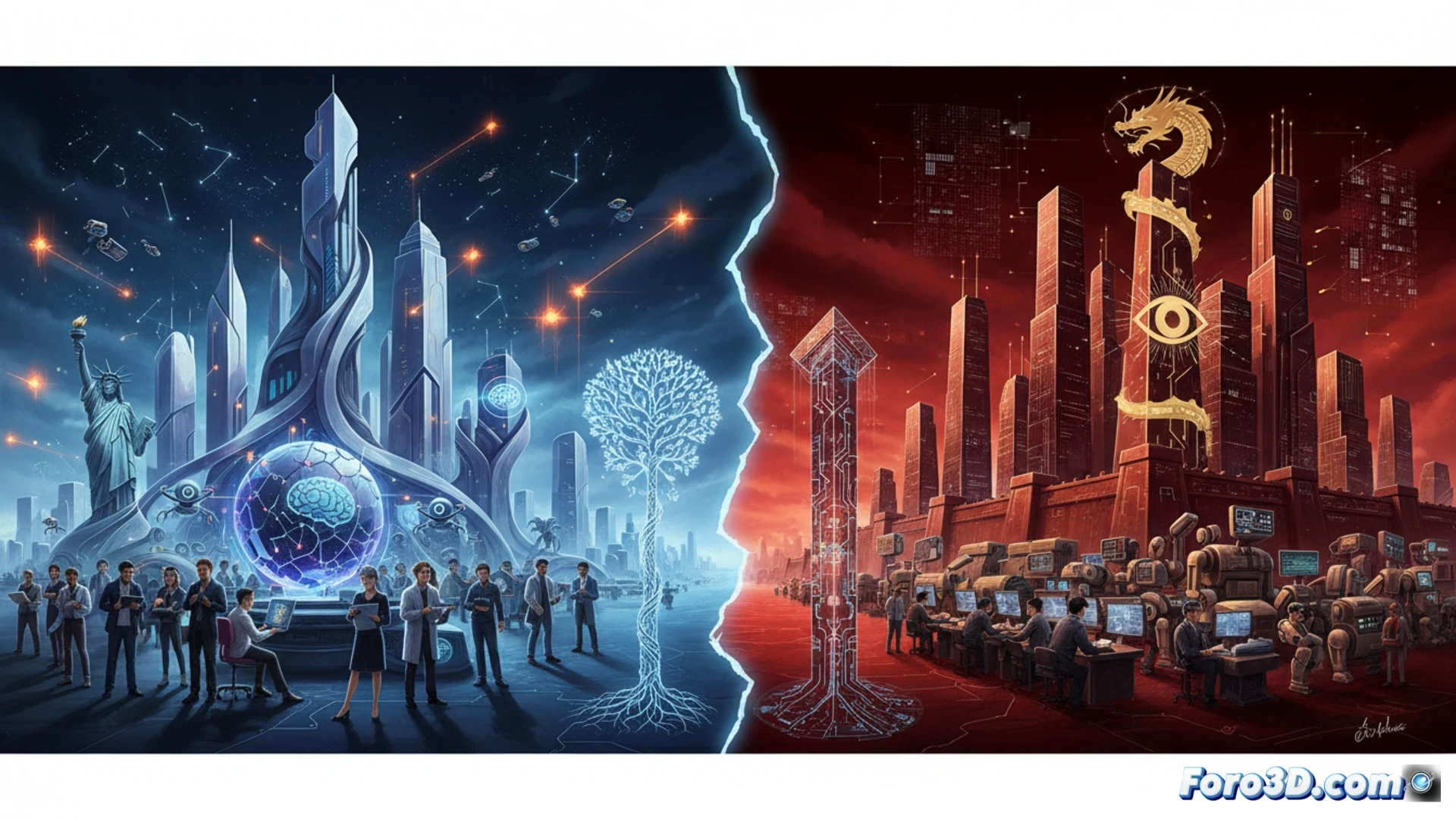
The advancement of artificial intelligence is not a simple race with a single goal. The United States and China are building their AI ecosystems on distinct philosophical and structural bases. While China integrates the technology into a framework of state control and practical application in services, the U.S. prioritizes fundamental innovation from the private sector. These differences reflect their political systems and will define their global influence.
Technical Foundations and Implementation Approaches ??�/h2>
The divergence is observed in infrastructure and incentives. China channels resources toward national projects, with AI development strongly linked to state cloud computing and integration into smart city systems and biometric recognition. The U.S. approach, more fragmented, emerges from corporate and academic labs, driving advances in base model architectures and specialized hardware (GPUs/TPUs), with applications that then scale commercially.
Social Credit Surveillance vs. Hyper-Personalized Advertising: Who Controls Whom? ?Ž¯
In the end, the average user will experience these models in a curious way. On one hand, a system that assigns you a social score for your behavior and suggests civic improvements. On the other, an algorithm that knows your desires before you do and sells them to the highest bidder, disguised as a helpful recommendation. Two visions of control: one watches you for the State, the other for the board of directors. Freedom, in both cases, is a technically complex concept to define.