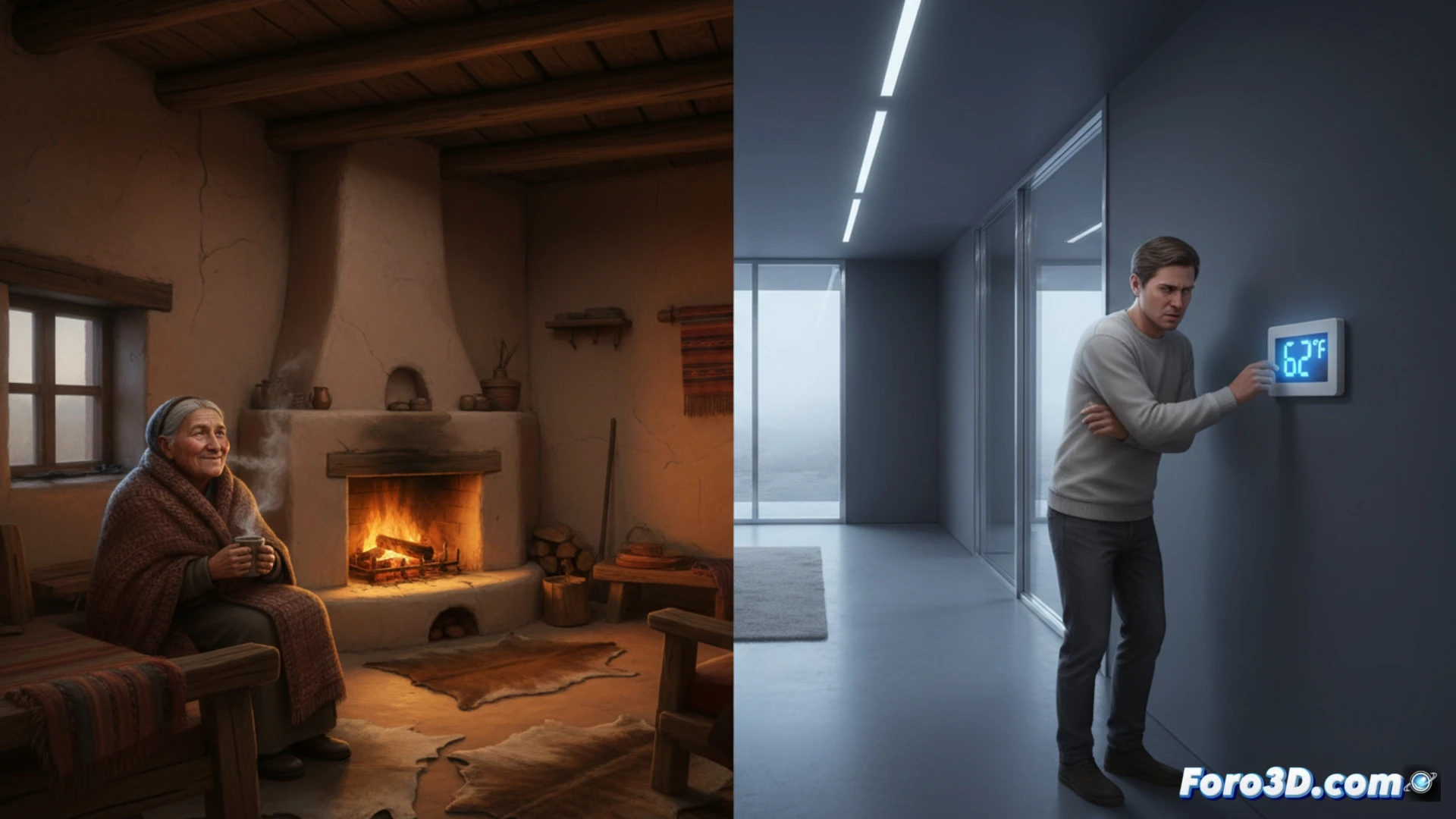
The thermal paradox: why we feel colder with better insulation
Past generations lived in spaces without central heating and endured harsh winters. Today, with double glazing and efficient boilers, a small adjustment on the thermostat can make us shiver. How is it possible that with superior technology we are more sensitive to the cold? 🤔
The human body as a thermoregulatory system
Our body is designed to adapt to a wide range of temperatures. By providing it with a constantly 21°C environment, its internal mechanism for generating heat atrophies from lack of use. A minimal drop is then interpreted as a threat, activating discomfort signals. Thermal variability is the necessary training to keep this system alert and efficient.
Key differences between ancient and modern environments:- Physical adaptation: Regular exposure to cold developed greater tolerance.
- Comfort expectation: Now we expect a perfect and constant temperature, which reduces our resilience.
- Body response: A "pampered" body reacts exaggeratedly to small changes.
Perhaps the true insulation was not only in the walls, but in the strength forged by living with a certain dose of discomfort.
The hidden wisdom in traditional materials
Adobe and other materials with high thermal mass acted as natural regulators. They absorbed heat energy during sunlight hours and released it progressively at night, smoothing the transition and avoiding abrupt peaks. In contrast, contemporary insulations create such airtight capsules that any deviation from the ideal setpoint is perceived intensely.
Characteristics of thermal mass:- Thermal inertia: Delays and dampens temperature changes between the outside and inside.
- Slow release: Distributes accumulated heat over a prolonged period.
- Natural stabilizer: Acts as a buffer against external climatic fluctuations.
Relearning to coexist with the environment
The current challenge is not just to insulate better, but to recover some adaptive flexibility. Allowing our body to experience a wider range of temperatures can be key to regaining its innate thermoregulation capacity. In short, the greatest enemy is not the cold itself, but the unrealistic expectation of eliminating it completely from our daily experience. 🏠❄️