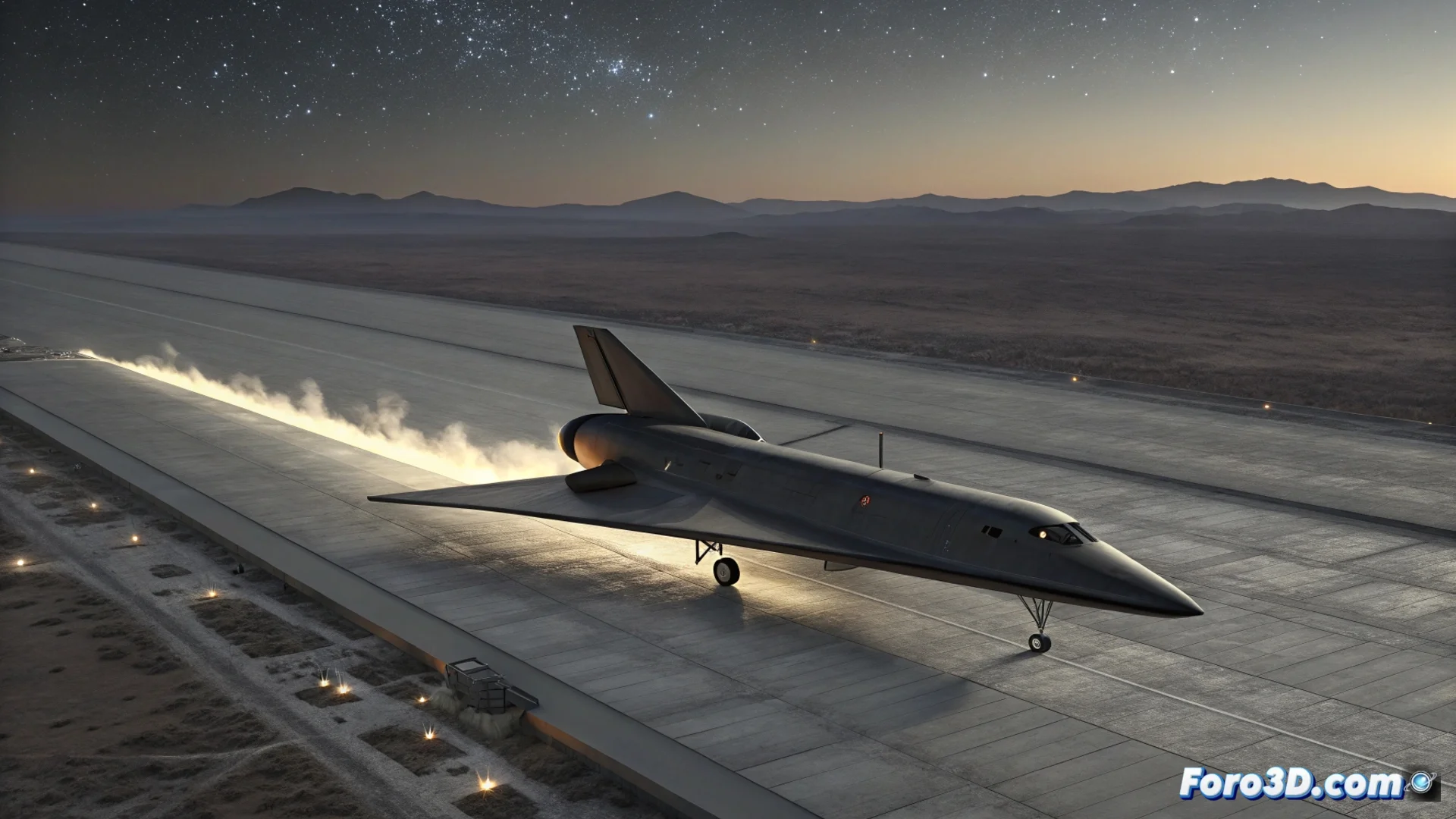
The Shenlong: how a secret spaceplane lands
Can you imagine how a vehicle that has orbited the planet returns to Earth? 🛰️ Think of an airplane, but one that has just completed numerous high-speed orbits. This is precisely what China achieved with the fourth mission of its spaceplane Shenlong, a vehicle that takes off attached to a launcher and returns gliding until it lands on a runway, ready to be reused.
An orbital taxi shrouded in mystery
This vehicle, with a delta-wing design and a weight close to twelve tons, serves as China's response to the secretive US X-37B. Its launch in February 2026 took place without revealing public data. How long did it remain in space? What type of tests did it conduct? The official silence fuels speculation, but also confirms that the program is advancing to perfect its capabilities.
Key features of the Shenlong:- It is a reusable system, similar to a commercial airplane, that optimizes costs.
- It is launched with a rocket and performs an autonomous landing by gliding.
- Its previous missions demonstrated great orbital duration, of several months.
Today's space race is no longer just about who arrives first, but about who develops the smartest and most cost-effective technology to operate in orbit.
The advantage of reusing spacecraft
The main innovation of these vehicles lies in their ability to operate again. Instead of consuming a complete rocket on each trip, the Shenlong uses a disposable launcher only to reach space. Afterward, it returns intact to base. During its stay in orbit, it can test new materials, conduct scientific experiments, or deploy minor payloads.
Possible activities in orbit:- Evaluate the behavior of advanced materials in the space environment.
- Conduct microgravity experiments for scientific research.
- Test navigation technologies and critical systems for future missions.
A step toward routine space access
Each successful landing of this spaceplane on a conventional runway represents a significant advance. Although details are scarce, each mission brings humanity closer to a future where accessing space could become a more routine and less costly operation. The Shenlong is not just a symbol of technical capabilities, but a demonstrator of a practical approach to orbital exploration. 🚀