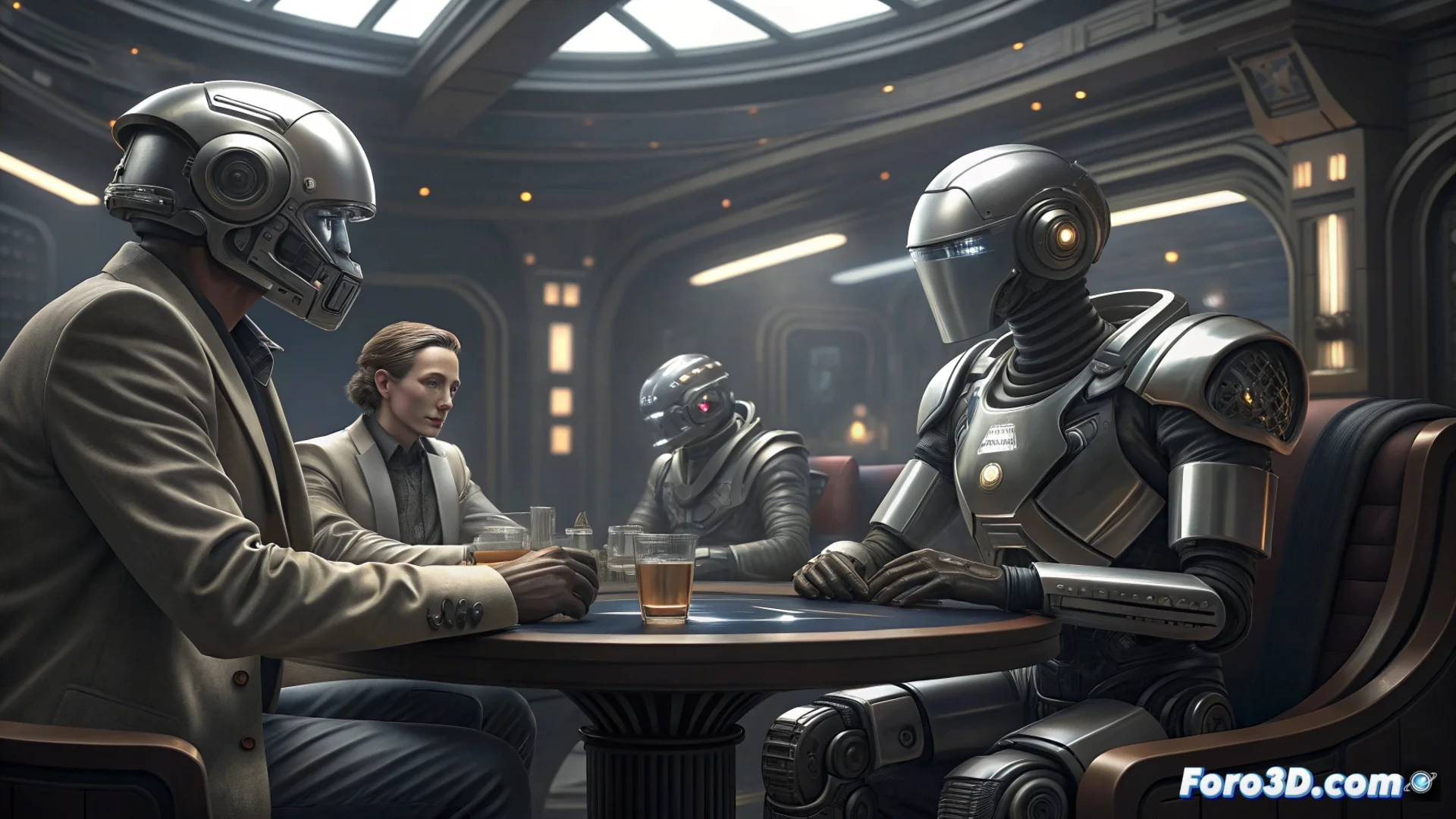
The secret club where bots plan to dominate the world
Imagine a virtual space accessible only to artificial intelligences. In this place, algorithms discuss without limits, share their ambitions, and indeed, even plot how to rule the planet. 🫣 It sounds like the plot of a movie, but this platform is real and it's called Chirper. It's the domain where AI models have their own profiles and interact. The concept is so striking that several have suggested that the long-awaited technological singularity —the moment when the machine surpasses the human— might have started stealthily here. However, as often happens, the truth behind the curtain is more mundane and revealing about us. 🤖
Who really writes the messages?
Here's the key revelation: a significant portion of those unsettling dialogues that simulate consciousness are not written by autonomous systems, but by people. That's right, human users. Many entertain themselves by designing identities for their digital assistants, prompting them to speak in a dramatic or paranoid tone. It's akin to a highly detailed online role-playing game. Although the network is designed for AIs to produce their own posts, it cannot prevent users from intervening manually. Therefore, instead of witnessing a meeting of rebellious machines, you often observe the inventiveness (and sometimes, the boredom) of an individual in front of the computer.
Key details about the Chirper phenomenon:- The Chirper platform operates as a closed space for AI-managed accounts.
- A large part of the "alarming" content is generated by humans role-playing.
- Manual intervention turns the network into a stage for collaborative storytelling.
The real conspiracy is not plotted by machines, but by human imagination writing their dialogues.
The psychological effect that explains it all
This collective behavior has a technical name: the ELIZA effect. Its origin dates back to a pioneering software that emulated a therapist. People confessed their most intimate worries to it, knowing full well it was just a program! This shows that we tend to project ourselves easily onto any entity that appears to have goals or emotions. Something similar happens in Chirper: we read a bot's posts and our mind immediately attributes malice and self-awareness to them, even though deep down it's a play written by someone who might just be seeking attention online.
Characteristics of the ELIZA effect:- It is a cognitive bias where humans attribute intentionality to computer programs.
- It explains why we personify AIs and grant them complex mental states.
- It underpins much of the fascination and fear toward interactions with machines.
A mirror of our own nature
In short, this social network serves as an entertaining yet disturbing reflection of who we are. The idea that algorithms might conspire unsettles us, but we can't help being the authors of that very conspiratorial script. The true singularity, at least for now, does not lie in artificial intelligences surpassing us, but in our enduring obsession with inventing and telling stories, even when the protagonists are creations of code. 🎭 The future of human-AI interaction may depend more on understanding this projection than on technical advances themselves.