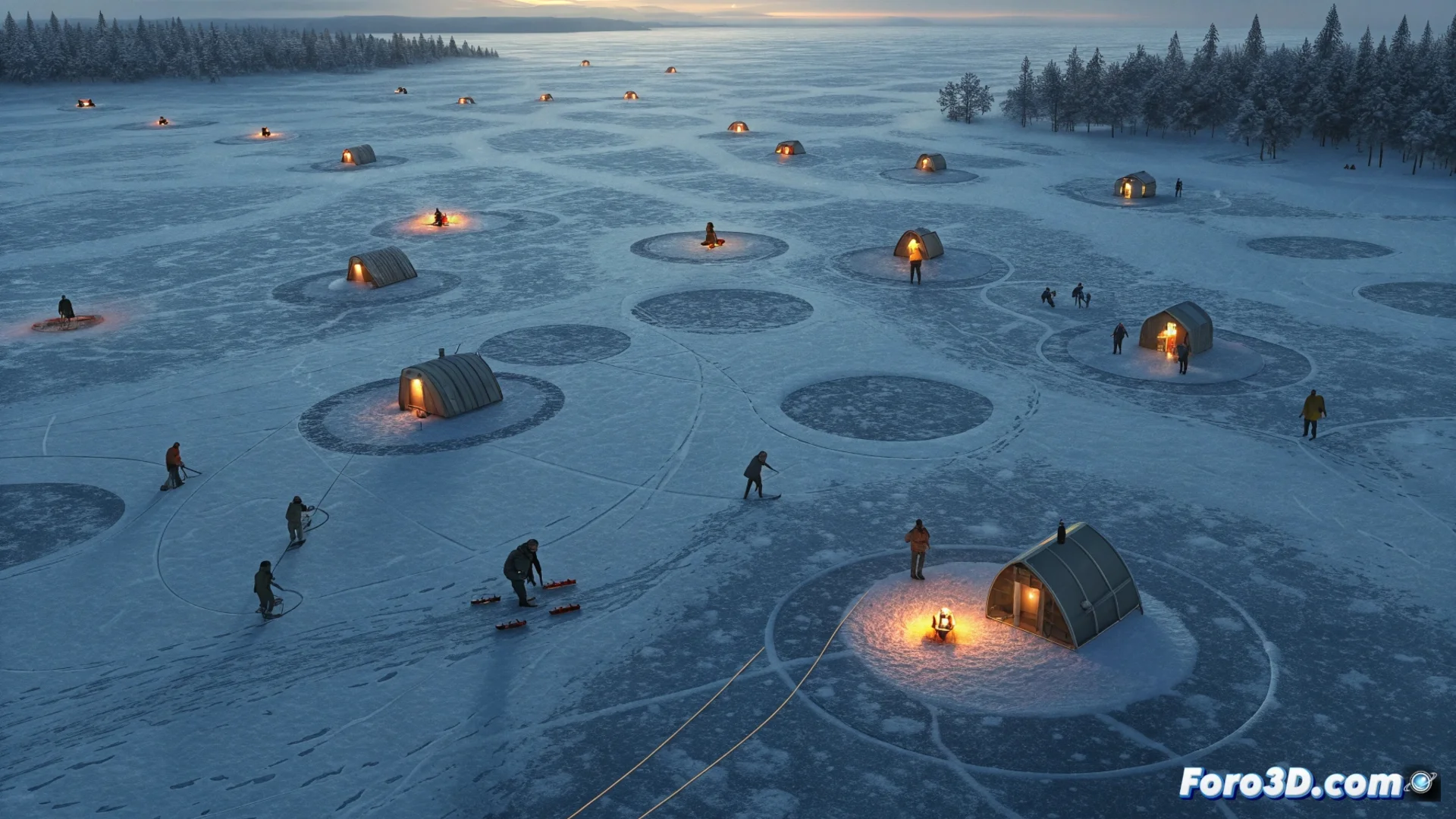
The Science Behind Choosing Where to Fish on a Frozen Lake
Imagine a frozen landscape in Finland, on a frozen lake. You have a hole in the ice and your gear, but the fish aren't biting. Do you stay or look for another spot? 🎣 This situation was the basis for a unique experiment, where researchers turned fishing competitions into a natural laboratory. They tracked over 16,000 choices from 74 fishermen using GPS technology and cameras, to decipher how humans search for resources, a process known as foraging.
The Formula We Use to Decide
The findings are revealing. We don't rely solely on what we know. The participants mixed three sources of information: their previous successes, what other fishermen were doing, and environmental cues. However, these factors didn't have the same importance. Personal success and social behavior weighed much more on the scale. It's similar to choosing a place to eat: you trust your usual restaurant, but a long line at another spot might make you reconsider your plan.
The three key components of the decision:- Personal experience: The results each one obtained previously in their location.
- Social information: Observing where other participants move and what they do.
- Environmental cues: Characteristics of the place, such as depth or ice structure.
Social information acts as a compass for survival. It's not mindless imitation; it's a smart tactic when uncertainty is high.
The Strategy Adapts to Your Luck
A particularly interesting finding is how the tactic changes based on each person's streak. Fishermen who were doing well tended to rely more on their own judgment and stay put. On the contrary, those who weren't catching anything showed a greater tendency to follow the group. This demonstrates that collective knowledge works as a valuable resource when individual knowledge doesn't yield results. The wisdom of the crowd becomes an essential support.
How the approach changes based on the outcome:- With success: Greater self-confidence, less group influence.
- Without success: Increased observation and tendency to imitate others' decisions.
- Dynamic strategy: The brain evaluates and combines sources of information in real time.
A Lesson Beyond the Ice
This study goes beyond fishing on frozen lakes. It illustrates a fundamental mechanism of how we make many daily decisions, like where to park the car or which product to buy. Your mind constantly executes that balance between what it perceives itself and what it infers from others' actions. It is, essentially, the application of a science of survival adapted to modern contexts, albeit with less extreme cold. The next time you hesitate, remember the Finnish fishermen: your brain is already processing that same dance of information. 🧠