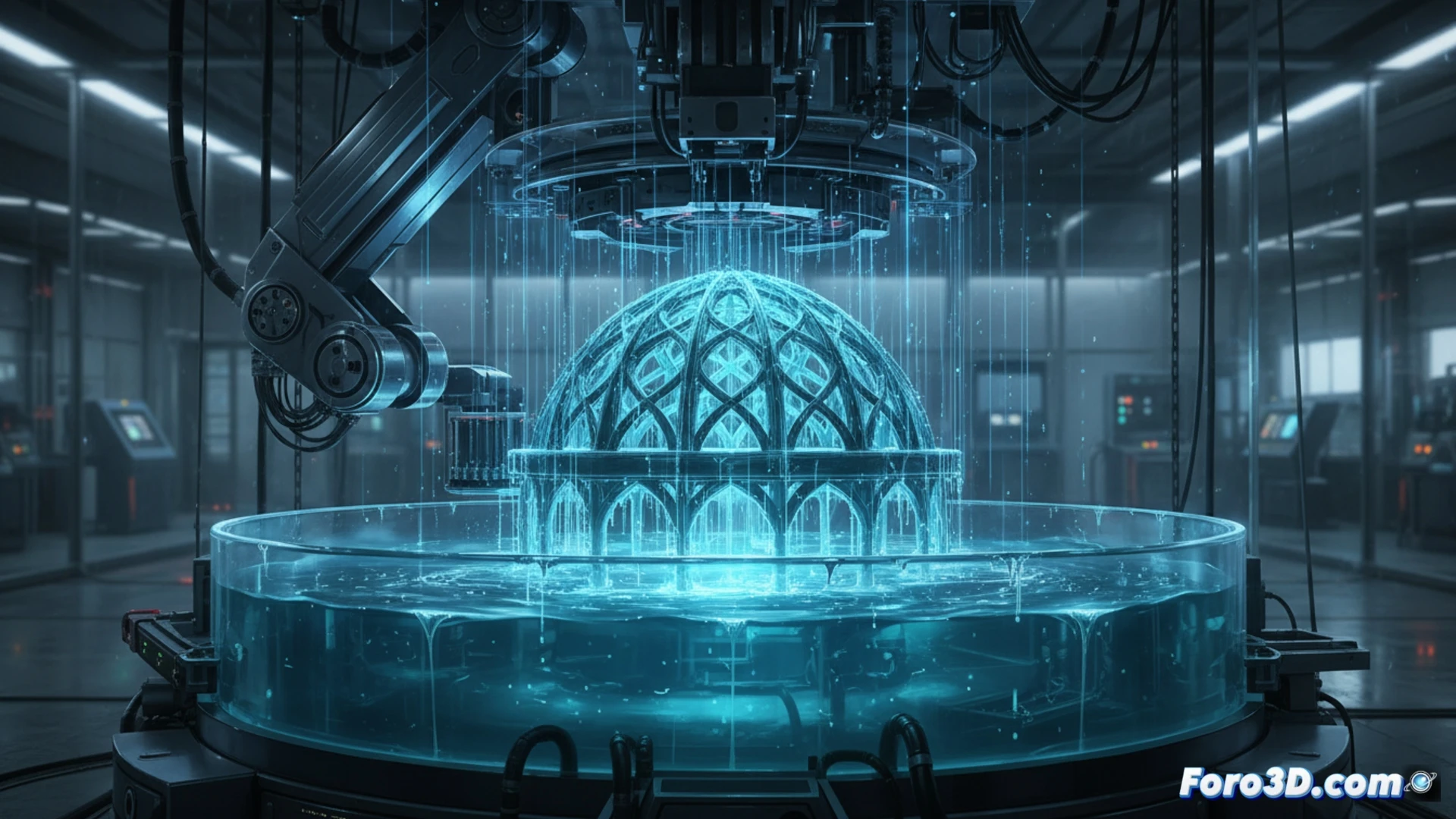
The new generation of 3D printing that redefines industrial manufacturing
Can you imagine creating large-scale components with the precision of a watchmaker? 🛠️ Today we explore an evolution in additive manufacturing that fuses speed and fidelity in details, transforming how objects are produced on a large scale.
The principle of sculpting with laser light
The base technology, known as stereolithography (SLA), operates similarly to a painter using light as a brush. An ultraviolet laser beam traces with precision over a tank filled with photosensitive resin. The liquid material solidifies upon contact with the light, building the object layer by layer. What distinguishes systems like SmartBuild is their ability to execute this process at a volume and pace typical of heavy industry, scaling from prototypes to functional parts for the aeronautical or automotive sector. 🚗✈️
Key advantages of this technological leap:- Allows manufacturing of large parts with extremely tight tolerances.
- Increases the speed of production, reducing processes from weeks to just a few days.
- Enables customization of short runs with the same efficiency as long ones.
This evolution brings digital manufacturing closer to a future where customizing a unique product will be as fast as producing a thousand identical ones.
Simultaneous production and paradigm shift
A revolutionary aspect is its potential to print multiple large parts in a single work cycle, analogous to an inkjet printer but in three dimensions. Visualize manufacturing a complete chess set at once, with each rook, bishop, and pawn perfectly defined. This approach not only optimizes time but also represents a turning point for sectors that require agile prototyping or manufacturing limited batches. ⚡
Impact on industry:- Drastically reduces the time to take a design from the drawing board to physical reality.
- Empowers companies to test and adjust designs iteratively and quickly.
- Facilitates the creation of custom components, such as vehicle parts or furniture, with the robustness of traditional methods.
The future of manufacturing in sight
The boundary separating a prototype from a final product is becoming increasingly blurred. This technology brings closer a landscape where ordering a unique, solid, custom-made component will be an agile and accessible process. Manufacturing is heading toward an era of massive customization, where flexibility and speed will be standard. 🔮