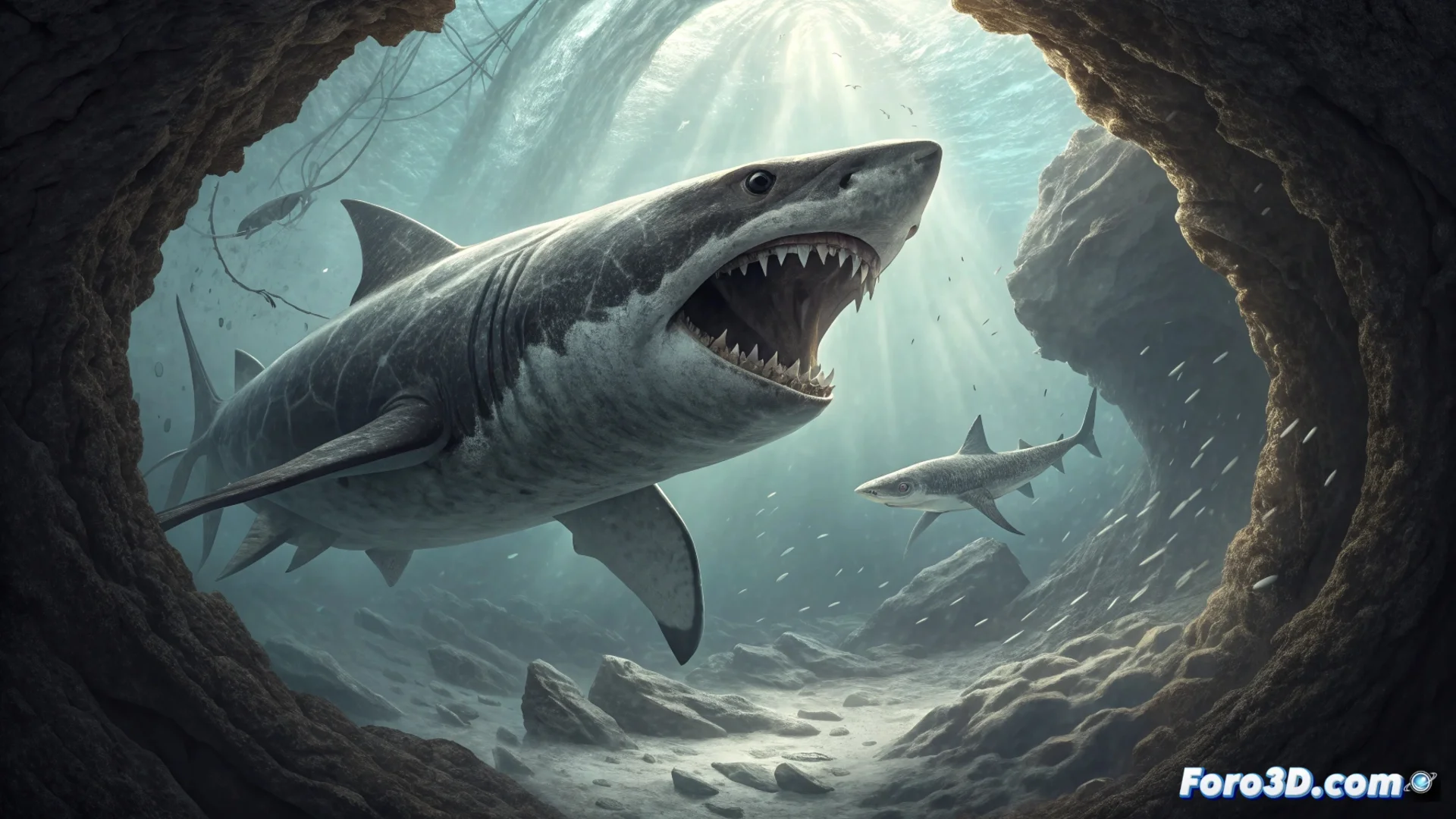
Intrauterine Cannibalism of the Megalodon: How the Strongest Embryos Devoured Their Siblings
Imagine your first home not as a shelter, but as a competition arena where your survival depends on devouring your siblings. That was existence for the offspring of Otodus megalodon, the colossus of ancient seas. A recent study confirms that these embryos practiced intrauterine cannibalism, a brutal strategy that ensured only the fittest survived. 🦈
The Uterus as an Evolutionary Battlefield
Far from being a nursery, the inside of the mother megalodon was a space of accelerated natural selection. This phenomenon, called oophagy, is still employed today by species like the bull shark. The female produces multiple eggs, but only a few embryos reach term. The first to develop consume the unfertilized eggs first and then turn to their siblings. For the megalodon, this practice resulted in neonates approximately two meters long, a size comparable to an adult human. They emerged into the ocean not as vulnerable young, but as experienced hunters, after winning their first battle in the most intimate place.
Keys to the Oophagy Strategy:- Nutritional Advantage: Feeding on their siblings provided a massive and constant source of energy, crucial for such rapid growth.
- Selection of the Fittest: Only the strongest and most developed embryos survived, optimizing the litter's chances in a hostile environment.
- Immediate Preparation for Life: Being born with great size and strength turned them into active predators from the first day, without a prolonged period of vulnerability.
The fact that they were born so enormous only makes sense if they had a supernutritious and constant food source inside the uterus. That source was, sadly, their siblings.
Deciphering the Past Through Bones
Scientists didn't discover a fossilized uterus, obviously. They reached this conclusion after examining fossilized vertebrae of megalodon of various sizes. By analyzing their "growth rings", similar to those of a tree, they could precisely estimate their size at birth. The evidence points to such a colossal birth size only being possible with exceptional nutritional input inside the uterus, which in this case was cannibalism. This mechanism ensured that only the most robust and largest individuals emerged into the sea, a decisive advantage in a world full of threats.
How This Behavior Was Investigated:- Vertebrae Analysis: Fossils from different life stages were studied, focusing on growth patterns.
- Comparison with Current Species: Knowledge of oophagy in modern sharks was used to interpret fossil data.
- Growth Modeling: Calculations of neonatal size confirmed the need for a hypercaloric intrauterine diet.
A Legacy That Begins with a Fraternal Banquet
It is fascinating that the most formidable marine predator of all time began its path as a sibling with a voracious appetite. This unexpected twist adds a complex layer to its legend. Nature designs its methods without loose ends, even if sometimes its tactics may seem extreme or ruthless to us. The case of the megalodon reminds us that the struggle to exist can begin much before seeing the light of day. 🌊